Calla palustris
L.
Bog arum, Wild calla, Water arum, Water dragon
(c) Matthias Buck, some rights reserved (CC BY-NC), uploaded by Matthias Buck

(c) Douglas Goldman, some rights reserved (CC BY-SA), uploaded by Douglas Goldman
(c) Nikolay V Dorofeev, some rights reserved (CC BY-NC), uploaded by Nikolay V Dorofeev
What to Eat
Edible parts: Fruit, Roots, Rhizome, Seeds, Leaves
Edible Parts: Fruit Root Seed Edible Uses: Rhizome - cooked. It is usually prepared by drying the root, grinding it into a powder and then thoroughly cooking it to ensure that any acrimonious principle is completely destroyed. The resulting powder is rich in starch and can be used as a flour for making bread etc, especially in conjunction with cereal flours. It is said to be very tasty. Fruit (does this include the seed?) - it should be dried and then thoroughly cooked. The dried fruit and rootstalk can be ground into an unpalatable but nutritious powder. The seed is dried, cooked and ground into a powder.
Known Hazards
Where to Find It
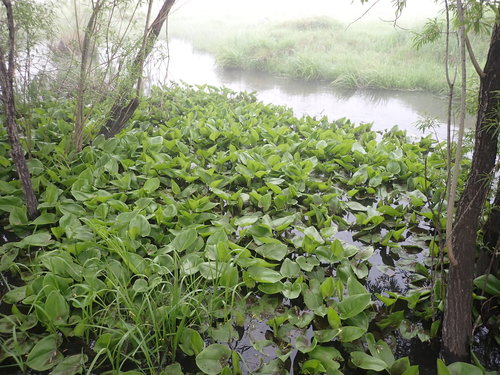
It grows in temperate places. It grows in meadows, swamps, in shallow water below 1100 m in northern China. It grows near the edge of water. It cannot tolerate more than 5 cm of water over its crown.
Alaska, Asia, Australia, Bangladesh, Britain, Canada, China, Czech Republic, Estonia, Europe, France, Germany, Korea, Luxembourg, North America, Russia, Scandinavia, Slovenia, Turkey, Türkiye, USA,
How to Identify
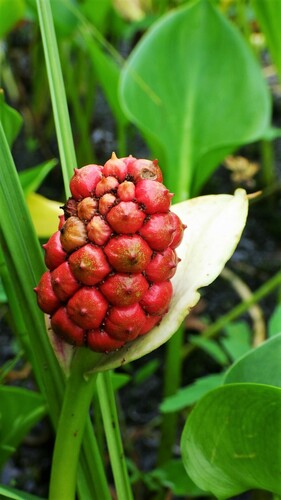
A creeping plant. It has a creeping rhizome. This can be 15-50 cm long. It has round, shiny, heart shaped leaves. They are pointed and firm and leathery. The flowers are lily like and white. The flowers are pollinated by water snails. The fruit spikes are made up of red berries.
How to Grow
It is grown by division of the rootstock. Plants can also be grown by seeds.
Propagation: Seed - best sown as soon as it is ripe in late summer in a cold frame in pots standing in about 3cm of water. Sow stored seed as early as possible in the year in a greenhouse. The germination rate of stored seed is often poor. When large enough to handle, prick the seedlings out into individual pots and grow them on in trays of water in the greenhouse for at least their first winter, planting them out into their permanent positions in late spring or early summer, after the last expected frosts. Division in spring. Very easy, it is possible to divide this plant at almost any time in the growing season. Any part of the stem, if placed in water or a pot of very wet soil, will quickly root away to form a new plant. Stem cuttings in summer, rooted in wet mud.
Medicinal Uses
Antirheumatic Poultice Antirheumatic. Used in the treatment of colds and flu. A tea made from the dried root has been used in the treatment of flu, shortness of breath, bleeding and as a poultice on swellings and snakebites. The aerial stems have been used in the treatment of sore legs.
Other Uses
None known Special Uses
Wikipedia
Source ↗A perennial herb reaching 0.3 m (1 ft) tall and wide, hardy to UK zone 4. Flowers bloom June to July with seeds ripening August to September. Hermaphroditic flowers pollinated by flies. Grows in light sandy, medium loamy, and heavy clay soils. Tolerates mildly acidic, neutral, and very acidic pH. Requires full sun and wet or aquatic conditions; cannot grow in shade.
Other Information
It is a famine food.
Notes
There is only one Calla species.
Names & Synonyms
D'ablik bahenni, Kachu, Khlebnik, Khlebnitsa, Marsh calla, Močvirska kačunka, Soovonk, Vehka, Zhitnitsa
References (23)
- Beckstrom-Sternberg, Stephen M., and James A. Duke. "The Foodplant Database." http://probe.nalusda.gov:8300/cgi-bin/browse/foodplantdb.(ACEDB version 4.0 - data version July 1994)
- Bircher, A. G. & Bircher, W. H., 2000, Encyclopedia of Fruit Trees and Edible Flowering Plants in Egypt and the Subtropics. AUC Press. p 73
- Bodkin, F., 1991, Encyclopedia Botanica. Cornstalk publishing, p 193
- Brown, D., 2000, Aroids. Plants of the Arum family. Timber Press. (Second edition) p 270
- Bowser, M., 2017, Handout on Edible Plants of the Kenai Peninsula. USFWS Kenai National Wildlife Refuge p 10
- Brickell, C. (Ed.), 1999, The Royal Horticultural Society A-Z Encyclopedia of Garden Plants. Convent Garden Books. p 205
- DARLINGTON & AMMAL
- DILLINGHAM, 1900,
- Esperanca, M. J., 1988. Surviving in the wild. A glance at the wild plants and their uses. Vol. 2. p 319
- Facciola, S., 1998, Cornucopia 2: a Source Book of Edible Plants. Kampong Publications, p 23
- Hedrick, U.P., 1919, (Ed.), Sturtevant's edible plants of the world. p 142
- Heywood, V.H., Brummitt, R.K., Culham, A., and Seberg, O., 2007, Flowering Plant Families of the World. Royal Botanical Gardens, Kew. p 347
- Hibbert, M., 2002, The Aussie Plant Finder 2002, Florilegium. p 49
- Kolosova, V., et al, 2020, Foraging in Boreal Forest: Wild Food Plants of the Republic of Karelia, NW Russia. Foods 2020, 9, 1015; p 31
- Lim, T. K., 2015, Edible Medicinal and Non Medicinal Plants. Volume 9, Modified Stems, Roots, Bulbs. Springer p 20
- PARMENTIER
- Plants for a Future database, The Field, Penpol, Lostwithiel, Cornwall, PL22 0NG, UK. http://www.scs.leeds.ac.uk/pfaf/
- RAHAMAN
- Romanowski, N., 2007, Edible Water Gardens. Hyland House. p 105
- Simkova, K. et al, 2014, Ethnobotanical review of wild edible plants used in the Czech Republic. Journal of Applied Botany and Food Quality 88, 49-67
- Slocum, P.D. & Robinson, P., 1999, Water Gardening. Water Lilies and Lotuses. Timber Press. p 91
- Sp. pl. 2:968. 1753
- Toupal, R. S. & Hollenback, K., 2009, An Ethnobotany of Indiana Dunes National Lakeshore: Plant Uses of the Ojibwa People. Bureau of Applied Research in Anthropology. University of Arizona


