Aphloia theiformis
(Vahl) Benn.
Mountain peach, Albino peach

(c) hsteyn, some rights reserved (CC BY-NC), uploaded by hsteyn

(c) hsteyn, some rights reserved (CC BY-NC), uploaded by hsteyn
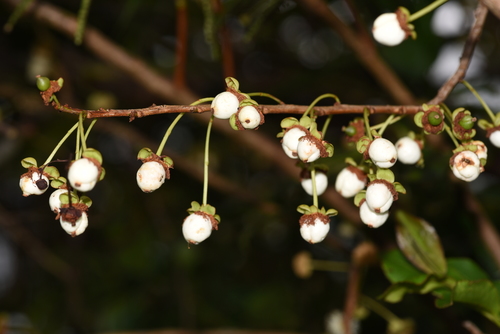
(c) CORDENOS Thierry, some rights reserved (CC BY-NC), uploaded by CORDENOS Thierry
What to Eat
Edible parts: Fruit, Leaves - tea
The small white fruit can be eaten fresh, and the leaves are used to make tea.
Where to Find It
A tropical plant. It grows in rainforest and also near the edges of the forest. It suits humid locations. It grows in mid altitude and mountain forest. In Malawi it grows between 1,250-2,450 m altitude. It can grow in arid places.
Africa, Comoros, East Africa, Eswatini, Kenya, Madagascar, Malawi, Mascarene Islands, Mozambique, Seychelles, South Africa, Southern Africa, Swaziland, Tanzania, Zambia, Zimbabwe,
How to Identify
A shrub or tree. It grows 10-18 m tall. The bark is brown and smooth. The leaves are alternate and simple. They are 3-8 cm long by 1-3 cm wide. They are glossy dark green above and tend to droop. The leaves have teeth. The flowers are in the axils of the leaves. They are in groups of 1-3 and are white. They have yellow stamens in the centre. The flowers have a scent. The fruit is a fleshy berry. It is white. It is 5 mm across.
Medicinal Uses
The roots are used as a treatment for stomach worms.
Other Uses
The wood is hard. It is used for building poles, withies, tool handles, spoons and combs.
Other Information
The fruit are small.
Notes
There is probably only one Aphloia species. Also put in the Flacourtiaceae family.
Names & Synonyms
Albino berry, Fandramanana, Ipatatiho, Kirandrambehivavy, Mussicate, Rambafotsy, Sicate, Voafotsy
References (10)
- Bircher, A. G. & Bircher, W. H., 2000, Encyclopedia of Fruit Trees and Edible Flowering Plants in Egypt and the Subtropics. AUC Press. p 35
- Fowler, D. G., 2007, Zambian Plants: Their Vernacular Names and Uses. Kew. p 9
- Fox, F. W. & Young, M. E. N., 1982, Food from the Veld. Delta Books. p 232
- Long, C., 2005, Swaziland's Flora - siSwati names and Uses http://www.sntc.org.sz/flora/
- Porcher, V., et al, 2022, Growing up in the Betsileo landscape: Children’s wild edible plants knowledge in Madagascar. PLoS ONE 17(2): e0264147.
- Royal Botanic Gardens, Kew (1999). Survey of Economic Plants for Arid and Semi-Arid Lands (SEPASAL) database. Published on the Internet; http://www.rbgkew.org.uk/ceb/sepasal/internet [Accessed 16th April 2011]
- Schmidt, E., Lotter, M., & McCleland, W., 2007, Trees and shrubs of Mpumalanga and Kruger National Park. Jacana Media p 428
- Styger, E., et al, 1999, Indigenous fruit trees of Madagascar: potential components of agroforestry systems to improve human nutrition and restore biological diversity. Agroforestry Systems 46: 289-310
- White, F., Dowsett-Lemaire, F. and Chapman, J. D., 2001, Evergreen Forest Flora of Malawi. Kew. p 266
- World Checklist of Useful Plant Species 2020. Royal Botanic Gardens, Kew