Apodytes dimidiata
E. Mey. ex Arn.
White pear

(c) Errol Douwes, some rights reserved (CC BY-NC), uploaded by Errol Douwes

(c) Pieter, some rights reserved (CC BY-NC), uploaded by Pieter
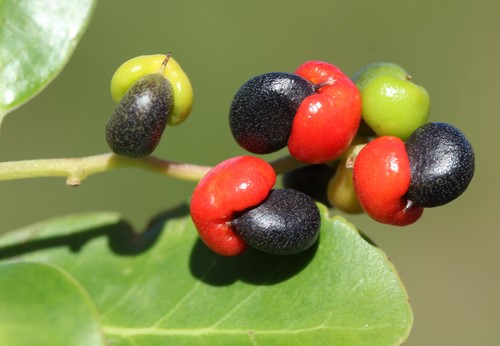
(c) Sharon Louw, some rights reserved (CC BY-NC), uploaded by Sharon Louw
What to Eat
Edible parts: Leaves, Bark, Fruit
The leaves can be cooked and eaten, and the ripe fruit are eaten.
Where to Find It
A tropical plant. It grows in evergreen forest and grassy mountain slopes. It needs frost protection when young. In southern China it grows between 500-1,900 m above sea level. In Yunnan.
Africa, Angola, Asia, Botswana, Cameroon, Central Africa, China, East Africa, Eswatini, Ethiopia, India, Indochina, Indonesia, Kenya, Laos, Madagascar, Malawi, Malaysia, Myanmar, Mozambique, Nigeria, Philippines, Rwanda, SE Asia, South Africa, Southern Africa, Sri Lanka, Sudan, Swaziland, Thailand, West Africa, Zambia, Zimbabwe,
How to Identify
A shrub or tree. It grows 7-10 m tall. It can grow 25 m high. Large trees have fluted trunks. The bark is smooth and grey. The leaves vary. They can be oval or oblong. They are 2-15 cm long by 2-8 cm wide. The flowers are in large groups at the ends of branches. The fruit is flattened and oblong. It is 8 mm long. They are black when ripe with a red attachment.
Nutrition Score: 23/100
| Part | Moisture | kJ | kcal | Protein | Vit A | Vit C | Iron | Zinc |
|---|---|---|---|---|---|---|---|---|
| Fruit | 59 | — | — | 8 | — | — | — | — |
How to Grow
It is easily grown from seeds. Seeds can take 6 months to germinate. Seeds are sown 3-5 mm deep in a seedling tray.
Other Uses
The whitish wood is solid, close-grained, strong, hard and elastic. It is used by wagon makers and for high class cabinet work.
Wikipedia
Source ↗Apodytes dimidiata (white pear or umDakane) is a bushy tree with white flowers bearing a fragrance reminiscent of fresh coconut, and small black and red fruits. It is usually about 5 m tall (but reaches a height of 20 m when growing in deep forest), and it is indigenous to Southern Africa. The taxonomical family placement for this and other Apodytes was uncertain; it is now placed in the Metteniusaceae. Its English common name is in reference to the timber which is similar in appearance to that of the European pear tree of the northern hemisphere.
Production
Plants grow slowly for the first year.
Notes
There are 2 Apodytes species.
Names & Synonyms
Doongiicho, Fotatrala, Manqeroo, Mukalasu-nguni, Munwa-mazi, Musvipa, Rotra, Tchomaate, Umdagane, Umdakana, Umdakane, Umdzagane, Umnqabaza, Umusiibyarugeendo
References (16)
- Beche D, Gebeyehu G, Feyisa K., 2016, Indigenous Utilization and Management of Useful Plants in and around Awash National Park, Ethiopia. J Plant Biol Soil Health. 3(1):12.
- Chapman, J. D. & Chapman, H. M., 2001, The Forest Flora of Taraba and Andamawa States, Nigeria. WWF & University of Canterbury. p 179
- Flora Zambesiaca. http://apps.kew.org/efloras
- Fowler, D. G., 2007, Zambian Plants: Their Vernacular Names and Uses. Kew. p 41
- Fox, F. W. & Young, M. E. N., 1982, Food from the Veld. Delta Books. p 238
- Gardner, S., et al, 2000, A Field Guide to Forest Trees of Northern Thailand, Kobfai Publishing Project. p 125
- Joffe, P., 2007, Creative Gardening with Indigenous Plants. A South African Guide. Briza. p 73
- Long, C., 2005, Swaziland's Flora - siSwati names and Uses http://www.sntc.org.sz/flora/
- Plowes, N. J. & Taylor, F. W., 1997, The Processing of Indigenous Fruits and other Wildfoods of Southern Africa. in Smartt, L. & Haq. (Eds) Domestication, Production and Utilization of New Crops. ICUC p 185
- Ruiters-Welcome, A. K., 2019, Food plants of southern Africa. Ph.D. thesis. Univ. of Johannesburg p 66
- Shava, S., 2000, The Use of Indigenous Plants as Food by a Rural Community in the Eastern Cape: an Educational Exploration. Masters Thesis Rhodes University. p 63
- Sina, B. & Degu, H. D., 2015, Knowledge and use of Wild Edible Plants in the Hula District of the Sidama Zone. International Journal of Bio-resource and Stress Management 6(3):352-365
- Venter, F & J., 2009, Making the most of Indigenous Trees. Briza. p 52
- White, F., Dowsett-Lemaire, F. and Chapman, J. D., 2001, Evergreen Forest Flora of Malawi. Kew. p 291
- Welcome, A. K. & Van Wyk, B.-E., 2019, An inventory and analysis of the food plants of southern Africa. South African Journal of Botany 122 (2019) 136–179
- www.zimbabweflora.co.zw 2011


