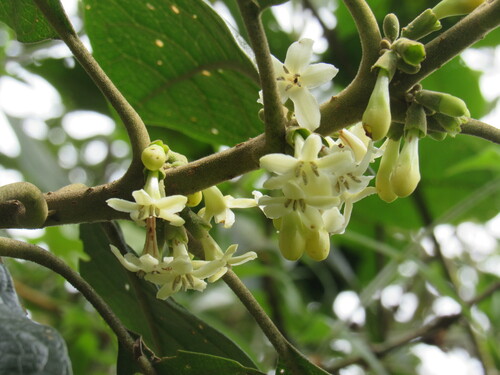
Clerodendrum ternatum
Schinz
Dwarf Cat's whiskers

(c) Amelia Ryan, some rights reserved (CC BY-NC), uploaded by Amelia Ryan

(c) 116916927065934112165, some rights reserved (CC BY), uploaded by 116916927065934112165

(c) Riana Fourie, some rights reserved (CC BY-NC), uploaded by Riana Fourie
What to Eat
Edible parts: Fruit
The fruit are eaten.
Where to Find It
It is a tropical and subtropical plant. In Zimbabwe it grows between 550-1,480 m above sea level. It grows in dry deciduous woodland and on Kalahari sand.
Africa, Botswana, East Africa, Eswatini, Malawi, Mozambique, South Africa, Southern Africa, Swaziland, Zambia, Zimbabwe,
How to Identify
A shrub with underground stems or rhizomes and a woody rootstock. It forms colonies with many stems. The stems are woody at the base. They grow 60 cm high. The leaves are in 3 rings or opposite and without leaf stalks. The leaves have an unpleasant smell when crushed. The leaf blade is 2-10 cm long by 1-2 cm wide. It is narrowly sword shaped. The flowers are in groups of 3. They are in the axils of the upper leaves. The fruit are black and about 8 mm across. They have 4 deep lobes.
How to Grow
A plant of drier places in the tropics and subtropics, where it can be found at elevations from 90 - 1,500 metres. Succeeds in full sun or partial shade. Grows best in a moist but well-drained, humus-rich soil. The leaves have an unpleasant aroma. Flowers are produced on the current seasons growth and so, to encourage flowering, any pruning is best carried out when the plant is dormant.
Propagation: Seed - best sown as soon as it is ripe. Germination can be erratic but usually takes place within 20 - 60 days at 20°c. When large enough to handle, prick the seedlings out into individual pots and grow them on until large enough to plant out. Root cuttings, 6 - 8cm long usually grow away well. Division of suckers in the dormant season. Very easy, they can be planted out direct into their permanent positions if required.
Medicinal Uses
The roots are diuretic. A decoction is used to treat problems related to urinating. The freshly grated root is rubbed into incisions in the skin around affected areas as a treatment for leg ailments.
Names & Synonyms
Civumbe, Pitirira, Umalanjana, Umphehlacwatsi, Umqotshanja
References (5)
- Flora Zambesiaca. http://apps.kew.org/efloras
- Fowler, D. G., 2007, Zambian Plants: Their Vernacular Names and Uses. Kew. p 42
- Long, C., 2005, Swaziland's Flora - siSwati names and Uses http://www.sntc.org.sz/flora/
- Roodt, V., 1998, Trees & Shrubs of the Okavango Delta. Medicinal Uses and Nutritional value. The Shell Field Guide Series: Part 1. Shell Botswana. p 197
- www.zimbabweflora.co.zw 2011