Dissotis princeps
(Kunth) Triana
Royal dissotis

(c) Barbara Parris, some rights reserved (CC BY-NC)
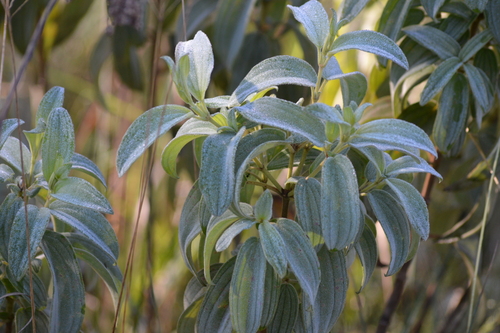
(c) siennatooz, some rights reserved (CC BY-NC)

(c) laurenRSA, some rights reserved (CC BY-NC)
What to Eat
Edible parts: Leaves
The leaves are cooked and eaten, traditionally used as a famine food.
Where to Find It
It is a tropical plant. It is best in rich, fertile, moist, well-drained soils. It needs a open shaded position. It is damaged by drought or frost. In Zimbabwe it grows between 1,200-2,000 m above sea level.
Africa*, Australia, Botswana, East Africa, Eswatini, Malawi, Mozambique, South Africa, Southern Africa, Swaziland, Zambia, Zimbabwe,
How to Identify
An evergreen shrub. It grows 2.5 m high and spreads 2 m wide. The stem is erect and slender. It is hairy. The leaves are green and opposite. They are sword shaped and have parallel veins. The flowers are a blue to purple colour. They have 5 petals. They are in clusters at the ends of the branches. There are two varieties.
How to Grow
Plants can be grown from seeds or cuttings.
Other Information
They are a famine food.
Names & Synonyms
Musukandarira, Rusukandarira, Sichobochono, Umpongamponga
References (8)
- Bodkin, F., 1991, Encyclopedia Botanica. Cornstalk publishing, p 350
- Fowler, D. G., 2007, Zambian Plants: Their Vernacular Names and Uses. Kew. p 47
- Fox, F. W. & Young, M. E. N., 1982, Food from the Veld. Delta Books. p 263
- Joffe, P., 2007, Creative Gardening with Indigenous Plants. A South African Guide. Briza. p 324
- Long, C., 2005, Swaziland's Flora - siSwati names and Uses http://www.sntc.org.sz/flora/
- Ruiters-Welcome, A. K., 2019, Food plants of southern Africa. Ph.D. thesis. Univ. of Johannesburg p 78
- Welcome, A. K. & Van Wyk, B.-E., 2019, An inventory and analysis of the food plants of southern Africa. South African Journal of Botany 122 (2019) 136–179
- www.zimbabweflora.co.zw 2011


