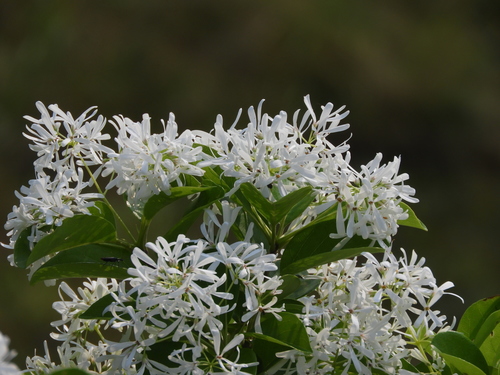
Jasminum multipartitum
Hochst.
Starry wild jasmine

(c) Igmar Grewar, some rights reserved (CC BY-NC), uploaded by Igmar Grewar

no rights reserved
What to Eat
Edible parts: Leaves - tea, Fruit
The leaves can be made into tea, and the fruit is edible, traditionally used as a famine food.
Where to Find It
It is a subtropical plant. It is best in fertile, well-drained soil. It grows in woodland and rocky slopes. In Brisbane Botanical Gardens.
Africa, Australia, East Africa, Eswatini, Mozambique, South Africa, Southern Africa, Swaziland, Zambia, Zimbabwe,
How to Identify
A climber or shrub. It can be 3 m tall. The leaves are opposite and simple. They are narrowly oval and can be 4.5 cm long by 3 cm wide. They are pointed at the tip. The leaves are dark green. The flowers are white and pink underneath. They occur in large groups. They have a scent. The fruit are small and shiny black. The fruit usually have 2 lobes.
How to Grow
Plants can be grown from seeds or cuttings.
Wikipedia
Source ↗Jasminum multipartitum, the starry wild jasmine, African jasmine, or imfohlafohlane, is a species of jasmine, in the family Oleaceae, that is native to Southern Africa.
Other Information
The fruit is a famine food.
Names & Synonyms
Muvwipyo
References (8)
- Fox, F. W. & Young, M. E. N., 1982, Food from the Veld. Delta Books. p 283
- https://growwild.co.za Edible Indigenous plants
- Joffe, P., 2007, Creative Gardening with Indigenous Plants. A South African Guide. Briza. p 355
- Long, C., 2005, Swaziland's Flora - siSwati names and Uses http://www.sntc.org.sz/flora/
- Ruiters-Welcome, A. K., 2019, Food plants of southern Africa. Ph.D. thesis. Univ. of Johannesburg p 82
- Schmidt, E., Lotter, M., & McCleland, W., 2007, Trees and shrubs of Mpumalanga and Kruger National Park. Jacana Media p 532
- Welcome, A. K. & Van Wyk, B.-E., 2019, An inventory and analysis of the food plants of southern Africa. South African Journal of Botany 122 (2019) 136–179
- World Checklist of Useful Plant Species 2020. Royal Botanic Gardens, Kew