Pavetta edentula
Sond.
Large-leaved bride's bush

(c) Linda Loffler, some rights reserved (CC BY-NC), uploaded by Linda Loffler
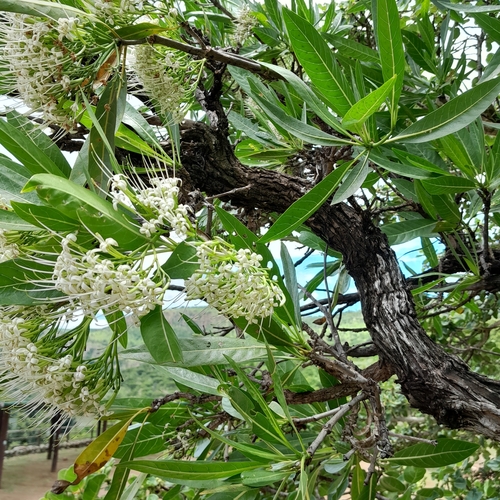
(c) berthapi2, some rights reserved (CC BY-NC), uploaded by berthapi2
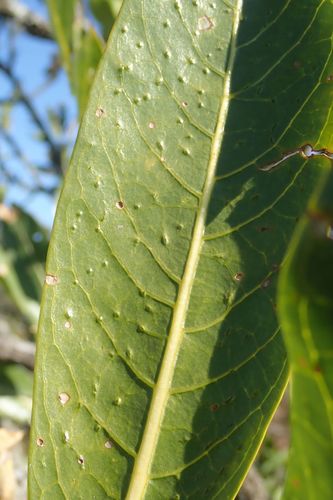
no rights reserved, uploaded by Andrew Deacon
What to Eat
Edible parts: Fruit, Leaves
The leaves are eaten as a snack and vegetable, and the fruit are also edible.
Where to Find It
It is a tropical plant. It grows on rocky hillsides and wooded grassland.
Africa, Eswatini, Mozambique, South Africa, Southern Africa, Swaziland,
How to Identify
A shrub or small tree. It grows 5 m tall. The main stem usually branches low down. The bark is dark grey and rough and cracked. The leaves are opposite and often in clusters near the ends of branches. They are narrowly oval and 25 cm long by 8 cm wide. They are leathery and shiny green. There are nodules scattered over the leaf. The flowers are white and in large clusters in the axils of leaves. The fruit are in branched clusters and 5-7 mm across. The are round and black.
How to Grow
A plant of the moist subtropical zone in eastern Africa, just moving into the tropical areas of Mozambique. Many Pavetta species, including this one, produce leaves with bacterial nodes - these bacteria live in symbiosis with the plant and pass into any seeds that are produced, thus seedlings are already inocculated with the bacteria. It is not certain what function the bacteria play, theories include nitrogen-fixation, growth-regulation and making the leaves poisonous to livestock.
Names & Synonyms
Sawoti, Samunyane, Simunyane
References (4)
- Fox, F. W. & Young, M. E. N., 1982, Food from the Veld. Delta Books. p 324
- Long, C., 2005, Swaziland's Flora - siSwati names and Uses http://www.sntc.org.sz/flora/
- Ruiters-Welcome, A. K., 2019, Food plants of southern Africa. Ph.D. thesis. Univ. of Johannesburg p 97
- Welcome, A. K. & Van Wyk, B.-E., 2019, An inventory and analysis of the food plants of southern Africa. South African Journal of Botany 122 (2019) 136–179


