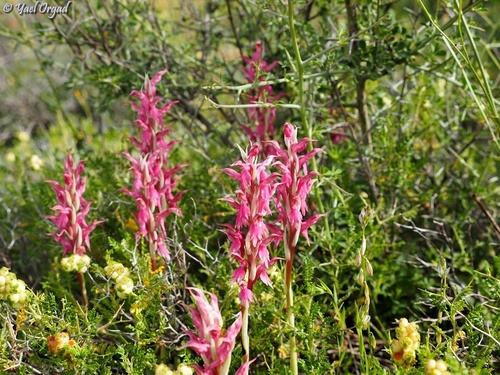
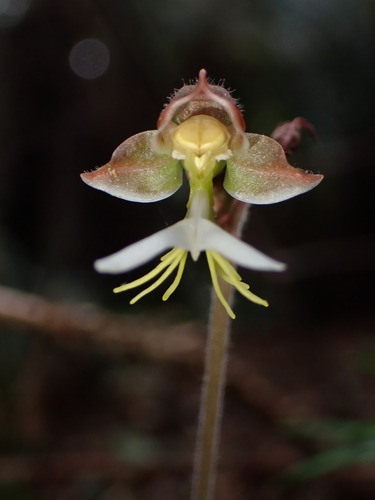
Satyrium macrophyllum
Lindl.
Pink-head orchid

no rights reserved, uploaded by Peter Warren
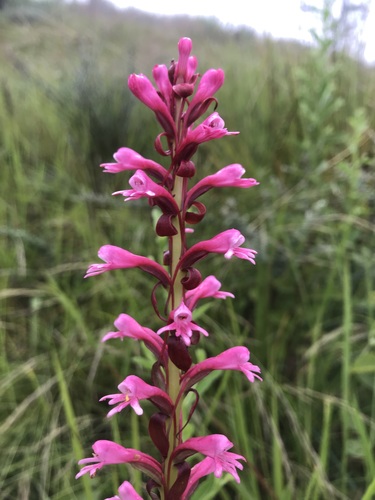
(c) Ren Hoekstra, some rights reserved (CC BY), uploaded by Ren Hoekstra
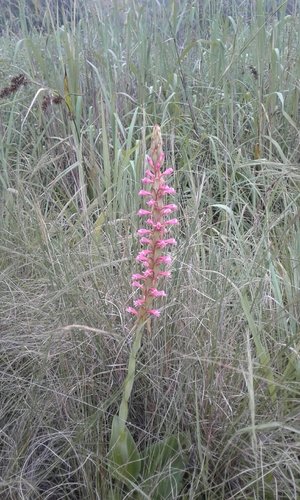
(c) Charmaine C King, some rights reserved (CC BY-NC), uploaded by Charmaine C King
What to Eat
Edible parts: Roots
The tubers are peeled, washed, and cooked like potatoes, or peeled, pounded into flour, fermented, and baked into cakes. The tubers and cakes are sold in local markets.
Known Hazards
Where to Find It
It is a tropical plant. In South Africa, it grows in grassland and woodland between 1,000-1,940 m above sea level. In Tanzania it grows between 1,200-2,900 m above sea level.
Africa, Central Africa, Congo, East Africa, Eswatini, Kenya, Malawi, Mozambique, South Africa, Southern Africa, Swaziland, Tanzania, Zimbabwe,
How to Identify
A herb. It is an orchid that grows in the soil. It grows 15-80 cm high. There are 6-10 leaves. The lowest ones form a sheath. The higher leaves are 24 cm long by 8 cm wide. The flowering stalks are 22 cm long. There are many flowers. The flowers are pink. The tubers are 2.5 cm long by 1 cm wide. They are oval.
How to Grow
Plants can be grown from tubers.
Propagation: Seed - Division of tubers.
Wikipedia
Source ↗Satyrium macrophyllum is a species of orchid occurring from Kenya to South Africa.
Production
Tubers are dug up during and soon after the rainy season. Tubers can be stored for several months if kept cool and dry.
Other Information
Tubers and cakes are sold in local markets.
Notes
Over collecting has meant that the plant is at risk.
Names & Synonyms
Chikande, Kikande, Nyamachebele, Nyamasebele, Uklamkleshe, Unoklamu
References (4)
- Long, C., 2005, Swaziland's Flora - siSwati names and Uses http://www.sntc.org.sz/flora/
- Ruffo, C. K., Birnie, A. & Tengnas, B., 2002, Edible Wild Plants of Tanzania. RELMA p 588
- Ruiters-Welcome, A. K., 2019, Food plants of southern Africa. Ph.D. thesis. Univ. of Johannesburg p 84
- Welcome, A. K. & Van Wyk, B.-E., 2019, An inventory and analysis of the food plants of southern Africa. South African Journal of Botany 122 (2019) 136–179