Anthephora pubescens
Nees
Wool grass, Bottle brush grass
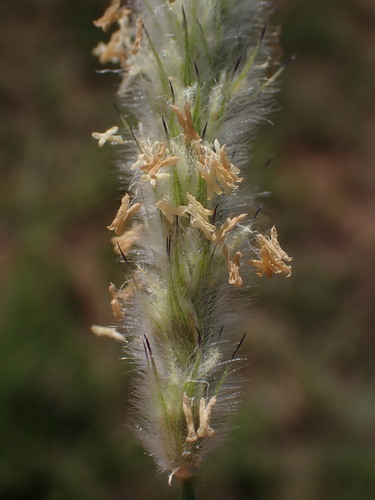
(c) David Hoare, some rights reserved (CC BY-NC-SA), uploaded by David Hoare
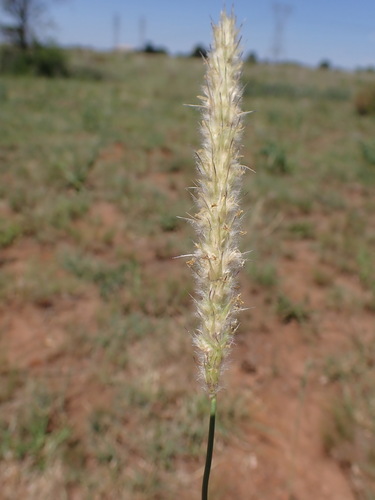
(c) David Hoare, some rights reserved (CC BY-NC-SA), uploaded by David Hoare
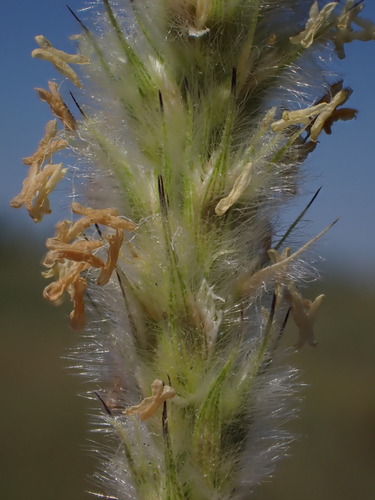
(c) David Hoare, some rights reserved (CC BY-NC-SA), uploaded by David Hoare
What to Eat
Edible parts: Seeds, Cereal
The seeds are eaten as a cereal and it is used as a famine food.
Where to Find It
It is a tropical plant. It grows in rocky sites in deciduous bushland in West Africa. It grows in savanna woodland between 600-1,300 m above sea level.
Africa, Angola, Botswana, Central Africa, East Africa, Eritrea, Ethiopia, Iran, Mali, Middle East, Mozambique, Namibia, Somalia, South Africa, Southern Africa, Sudan, Uganda, West Africa, Zimbabwe,
How to Identify
A grass that grows in tufts. It keeps growing from year to year. It grows 1-2 m high. It has sturdy rhizomes or underground stems. The leaves form a tuft at the base. These are long and narrow and 30-50 cm long. The leaves on the stalk are 10-15 cm long and 3-5 mm wide. They taper to a soft point. The edges are thickened. The flowers are straw coloured or dull purple. They are 5-15 cm long and 1 m wide. The flower spikelets are in clusters. They are 6-11 mm long. They are densely hairy.
Wikipedia
Source ↗Anthephora pubescens, with the common names bottle brush grass and wool grass, is a drought tolerant bunchgrass native to tropical and southern Africa. Common names in other languages include: Afrikaans: Borseltjiegras, Khoekhoe: uruǀgâab, Otjiherero: otjimbele, German: Ästiges Kruggras.
Other Information
It is a famine food.
Notes
It is grown as a pasture grass.
Names & Synonyms
References (2)
- Burkill, H. M., 1985, The useful plants of west tropical Africa, Vol. 2. Kew.
- World Checklist of Useful Plant Species 2020. Royal Botanic Gardens, Kew


