Bertiera racemosa
(G. Don) K. Schum.
Kakadua
RubiaceaeLeaves
iNaturalist · cc-by-nc
(c) Carel Jongkind, some rights reserved (CC BY-NC), uploaded by Carel Jongkind
(c) Carel Jongkind, some rights reserved (CC BY-NC), uploaded by Carel Jongkind
iNaturalist · cc-by-nc
(c) Carel Jongkind, some rights reserved (CC BY-NC), uploaded by Carel Jongkind
(c) Carel Jongkind, some rights reserved (CC BY-NC), uploaded by Carel Jongkind

iNaturalist · cc-by-nc
(c) Zac Peterson, some rights reserved (CC BY-NC), uploaded by Zac Peterson
(c) Zac Peterson, some rights reserved (CC BY-NC), uploaded by Zac Peterson
What to Eat
Edible parts: Leaves
The leaves are eaten.
Where to Find It
It is a tropical plant. It grows in forests in West Africa. It can be in swamps. It grows in open places in forests.
Africa, Cameroon, Central Africa, Central African Republic, CAR, Congo DR, Côte d'Ivoire, Gabon, Ghana, Guinea, Guinée, Ivory Coast, Liberia, Sao Tome and Principe, Sierra Leone, Tanzania, Uganda, West Africa,
Countries: Angola, Burkina Faso, Burundi, Benin, Botswana, Congo (DRC), Central African Republic, Congo (Republic), Cote d'Ivoire, Cameroon, Cape Verde, Djibouti, Algeria, Egypt, Eritrea, Ethiopia, Gabon, Ghana, Gambia, Guinea, Equatorial Guinea, Guinea-Bissau, Kenya, Comoros, Liberia, Lesotho, Libya, Morocco, Madagascar, Mali, Mauritania, Mauritius, Malawi, Mozambique, Namibia, Niger, Nigeria, Rwanda, Seychelles, Sudan, Sierra Leone, Senegal, Somalia, South Sudan, Sao Tome & Principe, Eswatini, Chad, Togo, Tunisia, Tanzania, Uganda, South Africa, Zambia, Zimbabwe
How to Identify
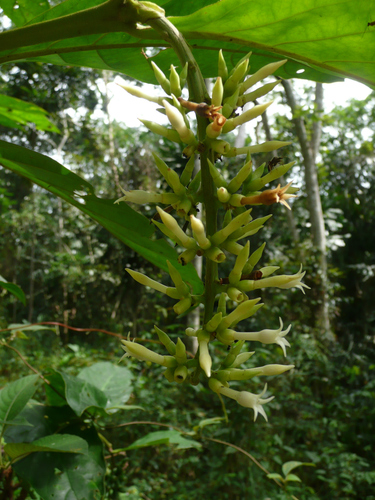
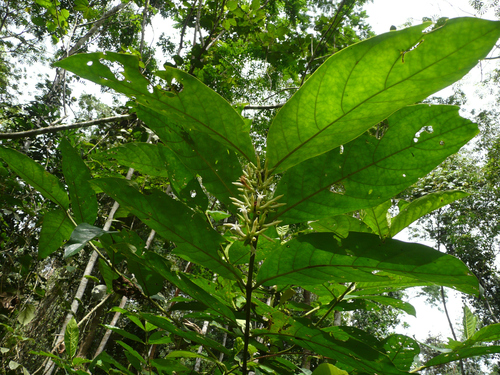
An erect or scrambling shrub. It can grow 2-8 m high. The leaves are 12-25 cm long by 5-11 cm wide.
Notes
It is considered to have medicinal properties.
Names & Synonyms
Anankoe, Boa wa wele, Gbah-chu, Kafa, Kolo di munsala
Wendlandia racemosa G. Don
References (3)
- Burkill, H. M., 1985, The useful plants of west tropical Africa, Vol. 4. Kew.
- Latham, P. & Mbuta, A. K., 2014, Useful Plants of Bas-Congo Province, Democratic Republic of Congo. Volume 1. Salvation Army. p 75
- World Checklist of Useful Plant Species 2020. Royal Botanic Gardens, Kew


