Chukrasia tabularis
A. Juss.
Chittagong wood, Burma almond tree
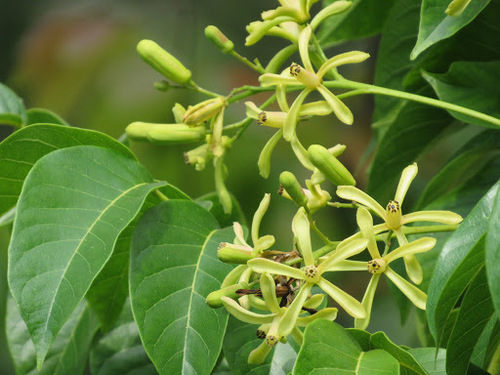
(c) Jonathan Hiew, some rights reserved (CC BY-NC-SA)
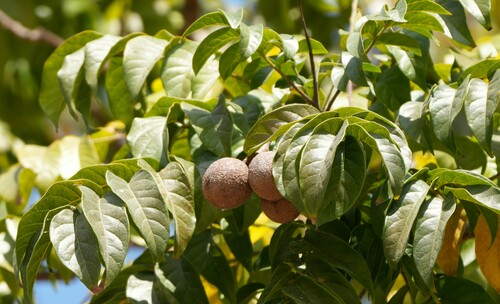
(c) Ryan Yue Wah Chan, some rights reserved (CC BY-NC), uploaded by Ryan Yue Wah Chan

(c) A. J. T. Johnsingh, WWF-India and NCF, some rights reserved (CC BY-SA)
What to Eat
Edible parts: Fruit ?
The young fruit are possibly edible. The seeds contain approximately 50% oil, though how this is used is unrecorded. The tree also produces a gum.
Where to Find It
It is a tropical plant. In the south of China it grows in mixed evergreen broad-leaved and deciduous forests between 300-1,600 m above sea level. It is usually on limestone mountains. In XTBG Yunnan.
Africa, Asia*, Australia, Bhutan, Cambodia, China, Himalayas, India, Indochina, Indonesia, Japan, Laos, Malaysia, Myanmar, Nepal, Nigeria, SE Asia, Sikkim, Sri Lanka, Thailand, Tibet, Vietnam, West Africa,
How to Identify
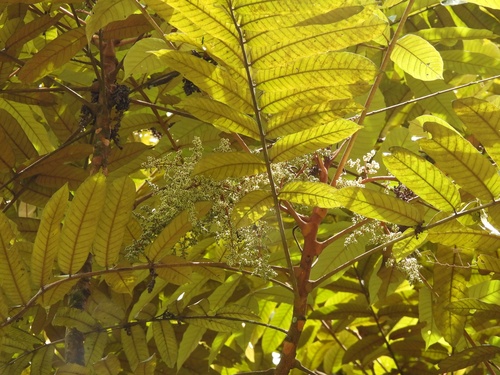
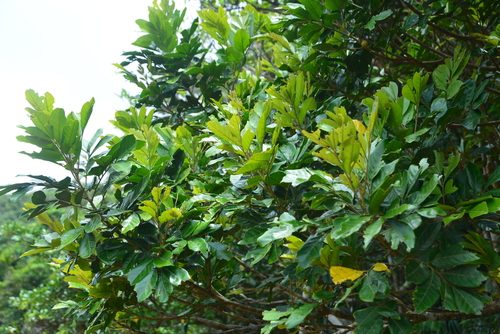
A tree. It grows 25-35 m tall. The trunk is long and straight. It can be 20 m long and 1 m across. It has a large spreading crown. The bark is dark brown and coarsely cracked. The inner bark is red. The leaves are 30-85 cm long. There are 8-13 pairs of leaflets. These are 7-13 cm long by 3-5 cm wide. They are narrowly oval and taper to the tip. Young leaves have fine hairs. There are 7-10 pairs of side veins. The flowers are 3 cm across. They are pale red but often with a red tinge on the outside. They are in branched clusters. The fruit is yellowish grey and 4 cm long. It is slightly hairy when young. It becomes wrinkled when ripe. It splits into 3 sections. It is full of winged seeds.
How to Grow
Chickrassy is a plant of the lowland tropics, usually found in an altitude range of 300 - 800 metres. It succeeds in areas where the mean annual temperature is in the range 20 - 25°c with an absolute minimum of 5 - 10°c. It grows best in areas where the mean annual rainfall is 1,400 - 4,000mm - it can tolerate as little as 850mm rainfall, but growth is then rather slow, in fact it does not achieve its full potential below 2,000mm rainfall. Prefers a sunny position, tolerating light shade. Avoids heavy and wet soils. It is usually found on well-drained soil in the plains and on hills. Plants are often found on limestone in the wild. Prefers a pH in the range 5.5 - 6.5, tolerating 5 - 7. Plants are generally wind-tolerant. The growth of seedlings is moderately fast over the first few years with plants reaching a height of 1.2 - 2.1 metres after two years; 2.8 - 3.4 metres after 3 years; 5.5 metres tall after 6 years. The tree coppices particularly well.
Propagation: Seed requires no pre-treatment and is sown under overhead shade in light, porous soil. Germination rates vary by region: approximately 35% in Malaysia, germinating in 1–2.5 weeks, and 80–90% in India, germinating in 1–4 weeks. Where seed is plentiful, broadcast sowing in strips 0.6m wide and 1.8m apart gives good results. Best results overall are obtained by raising seedlings in well-drained boxes and pots before transplanting. Seedlings are pricked out and moved to nursery beds when about one month old and 6–8cm high. Fresh seed retains viability for only about three months. Air-layering is also used.
Medicinal Uses
An extract of the bark has powerful astringent properties and has been used to treat diarrhoea and as a febrifuge. A leaf extract has been reported to exhibit considerable antimalarial activity as well as antibacterial and antifungal activities; the essential oil in the leaf is responsible for these effects. This oil consists of oxygenated monoterpenes (42.8%, mainly carvacrol, thymol, and borneol), phenyl propanoids (25.2%, mainly (E)-methyl isoeugenol and myristicin), and smaller amounts of sesquiterpene hydrocarbons, monoterpene hydrocarbons, and oxygenated sesquiterpenes. The plant is widely used in Ayurveda as an important medicinal plant.
Other Uses
The tree is regarded as a pioneer species and is common in areas of former shifting cultivation. Its straight bole and self-pruning ability make it suitable for growing in combination with crops such as banana, Citrus spp., and guava, and it is used to provide shade in coffee plantations in India. Its coppicing and pollarding ability make it well suited to home gardens. A yellow, transparent gum exudes from the trunk and is marketed mixed with other gums. The flowers yield both red and yellow dyes. Young leaves and bark contain 22% and 15% tannin respectively. A twig extract has proved an effective antifeedant against Pieris rapae in southern China, and root extracts showed antifeedant activity against Spodoptera insects, with phragmalin limonoids — tabulalin and tabulalides A through E — as the active compounds. The heartwood is pale reddish-brown to red, darkening to dark yellowish-brown or reddish-brown on exposure, sharply differentiated from the yellowish-white to greyish-brown sapwood, with density of 625–800 kg/cubic metre at 15% moisture content. The grain is interlocked and sometimes wavy, producing a rose figure, with a moderately fine but uneven texture. Freshly cut wood has a fragrant odour; dried wood has no characteristic odour or taste. The wood is moderately hard and considered non-durable to moderately durable under exposed conditions, with termite resistance varying from good to poor. Planed surfaces have a high lustrous satiny sheen. The timber is highly prized for high-grade cabinetwork, decorative panelling, interior joinery including doors, windows, and light flooring, and for carving, toys, and turnery. It is also used for railway sleepers, ship and boat building, furniture, musical instruments including pianos, packing cases, sporting goods, lorry bodies, mallet heads, anvil blocks, brush wares, drawing equipment, rifle butts, veneer, and pulp. In India it is used for light to medium-heavy construction including posts, beams, scantlings, and planks. The wood peels well and gives very fine veneer, and is suitable for commercial and moisture-proof plywood. It can also be used as fuel.
Wikipedia
Source ↗A deciduous tree growing to 30 m tall with a straight, self-pruning bole. Hardy to UK zone 10, it grows at a medium rate on well-drained sandy to loamy soils across a wide pH range. Prefers moist soil and full sun, tolerating strong winds but not maritime exposure.
Notes
There is only one Chukrasia species. It is used as medicine.
Names & Synonyms
Chickrassia, Chukrasay, Indian redwood, Kin-thabut-gyi, Lat, Lat hoa, Nhom, Nhom hin, Nhom khao, Pohon suntang, Taw-yinma, Yinma, Vor yong
References (6)
- Burkill, H. M., 1985, The useful plants of west tropical Africa, Vol. 4. Kew.
- Gardner, S., et al, 2000, A Field Guide to Forest Trees of Northern Thailand, Kobfai Publishing Project. p 121
- Sukarya, D. G., (Ed.) 2013, 3,500 Plant Species of the Botanic Gardens of Indonesia. LIPI p 196
- Van Sam, H. et al, 2004, Trees of Laos and Vietnam: A Field Guide to 100 Economically or Ecologically Important Species. Blumea 29 (2004) 201-349
- Wongprasert, T. et al, 2011, A Synoptic Account of the Meliaceae of Thailand. Thai For. Bull. 39:210-266
- World Checklist of Useful Plant Species 2020. Royal Botanic Gardens, Kew