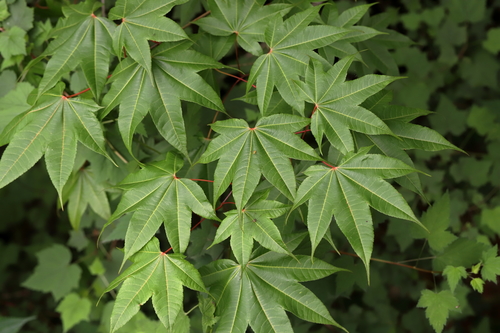
Acer tataricum
L.
Tatarium maple, Amur maple

(c) Alexander Baransky, some rights reserved (CC BY-NC), uploaded by Alexander Baransky

(c) Alexey P. Seregin, some rights reserved (CC BY-NC), uploaded by Alexey P. Seregin

(c) Sergey Mayorov, some rights reserved (CC BY-NC), uploaded by Sergey Mayorov
What to Eat
Edible parts: Seeds, Sap
The sap contains sugar and can be drunk fresh or boiled down into a syrup used as a sweetener on many foods, though its sugar concentration is considerably lower than in sugar maples (A. saccharum). Tap the trunk in early spring, as sap flows best on warm sunny days following a frost; trees in cold-winter continental climates produce the best yields. The seeds can also be eaten cooked — remove the wings first, then boil them.
Where to Find It
It is a temperate plant. It needs a light, fertile, well-drained soil. It needs a protected sunny position. It is resistant to frost but sensitive to drought. It suits hardiness zones 4-8.
Afghanistan, Albania, Asia, Australia, Austria, Balkans, Britain, Bulgaria, China, Europe, Greece, Hungary, Japan, Korea, Mediterranean, Middle East, Mongolia, Romania, Russia, Serbia, Siberia, Slovenia, Turkey, Türkiye, Ukraine,
How to Identify
A shrub or small tree. It grows 5 m tall. There are prickles along the stem. The leaves are twice divided and there are 8-18 pairs of pinnae. There are up to 50 pairs of pinnules on each pinnae. The flowers are yellow. They are in large clusters at the ends of branches. The pods are flattened.
How to Grow
Seed should be pre-soaked for 24 hours then kept cold at 0-8°C for 2-4 months to assist them to grown. Seed can be sown fresh if green seeds are used. Layering or cuttings can be used.
Propagation: Seed is best sown as soon as ripe in a cold frame, typically germinating the following spring. Stored seed should be pre-soaked for 24 hours then stratified for 2–4 months at 1–8°C; germination can be slow. Seed can also be harvested green — fully developed but before drying and producing germination inhibitors — and sown immediately for late-winter germination. Seed harvested too early will yield very weak or no plants. Prick seedlings out into individual pots once large enough to handle, growing them on to at least 20cm before planting out permanently. Layering takes about 12 months and works well for most species in this genus. Cuttings of young shoots taken in June or July should have 2–3 pairs of leaves plus one pair of buds at the base; remove a thin slice of bark at the base and use a rooting hormone to improve success. Rooted cuttings must produce new growth during summer before being potted up, otherwise they are unlikely to survive winter.
Medicinal Uses
None known
Other Uses
The leaves can be packed around apples, root crops, and similar produce to help preserve them.
Wikipedia
Source ↗Acer tataricum, the Tatar maple or Tatarian maple, is a species of maple widespread across central and southeastern Europe and temperate Asia, from Austria and Turkey, and in some circumscriptions, with a disjunct population in eastern Asia in northern and central China, Japan and the Russian Far East. The species is named after the Tatar peoples of southern Russia; the tree's name is similarly commonly also misspelled "Tartar" or "Tartarian" in English.
Notes
There are about 120-150 Acer species
Names & Synonyms
Asian maple, Tatarski javor
References (13)
- Bircher, A. G. & Bircher, W. H., 2000, Encyclopedia of Fruit Trees and Edible Flowering Plants in Egypt and the Subtropics. AUC Press. p 6
- Bodkin, F., 1991, Encyclopedia Botanica. Cornstalk publishing, p 43
- Cundall, P., (ed.), 2004, Gardening Australia: flora: the gardener's bible. ABC Books. p 90
- Etherington, K., & Imwold, D., (Eds), 2001, Botanica's Trees & Shrubs. The illustrated A-Z of over 8500 trees and shrubs. Random House, Australia. p 72
- Hedrick, U.P., 1919, (Ed.), Sturtevant's edible plants of the world. p 23
- Kremer, B.P., 1995, Shrubs in the Wild and in Gardens. Barrons. p 131
- Lord, E.E., & Willis, J.H., 1999, Shrubs and Trees for Australian gardens. Lothian. p 46
- Marinelli, J. (Ed), 2004, Plant. DK. p 443
- Plants for a Future database, The Field, Penpol, Lostwithiel, Cornwall, PL22 0NG, UK. http://www.scs.leeds.ac.uk/pfaf/
- Sfikas, G., 1984, Trees and shrubs of Greece. Efstathiadis Group. Athens. p 116
- Sp. pl. 2:1054. 1753
- Svanberg, I. et al, 2012, Uses of tree saps in northern and eastern parts of Europe. Acta Societatis Botanicorum Poloniae 81 (4): 343-357
- Young, J., (Ed.), 2001, Botanica's Pocket Trees and Shrubs. Random House. p 65