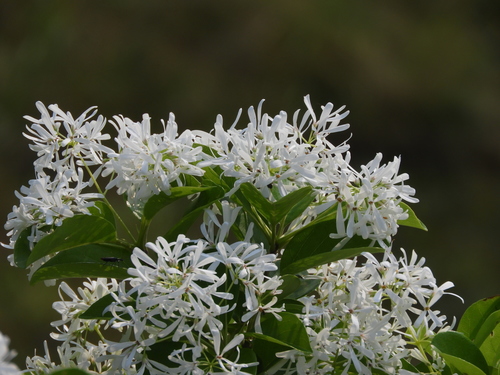
Jasminum fluminense
Vell.
(c) Helio Lourencini, some rights reserved (CC BY), uploaded by Helio Lourencini

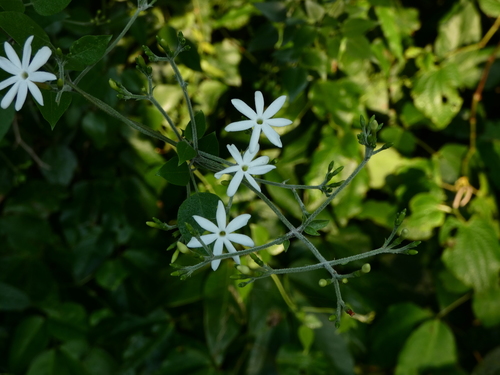
(c) Julie Hall, some rights reserved (CC BY-NC)
What to Eat
Edible parts: Leaves, Vegetable
The leaves are eaten as a vegetable.
Where to Find It
It is a tropical plant. It grows in dry thickets in the lowlands and uplands in West Africa.
Africa, Arabia, Botswana, Brazil, Cameroon, Central Africa, Dominican Republic, East Africa, Kenya, Malawi, Mauritius, Middle East, Mozambique, Nigeria, Puerto Rico, Sao Tome and Principe, Seychelles, Sierra Leone, Southern Africa, Tanzania, Uganda, West Africa, West Indies, Zambia, Zimbabwe,
How to Identify
A bushy shrub or a woody creeper. It has twining stems. It grows 6 m long. The leaves have 3 leaflets. They can have white hairs on both surfaces. The leaflets are oval and 1-6 cm long by 1-4 cm for the side leaflets and the end leaflet is 3-9 cm long by 2-4 cm wide. The flowers are in groups at the ends of the plant. The plant varies a lot.
Wikipedia
Source ↗Jasminum fluminense is a species of vine plant. It mainly grows in the seasonally dry tropical biomes. It is a native species to various countries in Africa and Arabia; and an invasive species in parts of the Americas.
Names & Synonyms
Ambahu, Kamemena
References (9)
- Burkill, H. M., 1985, The useful plants of west tropical Africa, Vol. 4. Kew.
- Fowler, D. G., 2007, Zambian Plants: Their Vernacular Names and Uses. Kew. p 52
- Grubben, G. J. H. and Denton, O. A. (eds), 2004, Plant Resources of Tropical Africa 2. Vegetables. PROTA, Wageningen, Netherlands. p 562
- Hanelt, P. et al, (Eds.), 2001, Mansfield's encyclopedia of agricultural and horticultural crops. p 1710
- Pickering, H., & Roe, E., 2009, Wild Flowers of the Victoria Falls Area. Helen Pickering, London. p 87
- Reis, S. V. and Lipp, F. L., 1982, New Plant Sources for Drugs and Foods from the New York Botanical Garden herbarium. Harvard. p 237
- Roodt, V., 1998, Common Wild Flowers of the Okavango Delta. Medicinal Uses and Nutritional value. The Shell Field Guide Series: Part 2. Shell Botswana. p 125
- von Katja Rembold, 2011, Conservation status of the vascular plants in East African rain forests. Dissertation Universitat Koblenz-Landau p 170
- World Checklist of Useful Plant Species 2020. Royal Botanic Gardens, Kew