Pandanus candelabrum
P. Beauv.
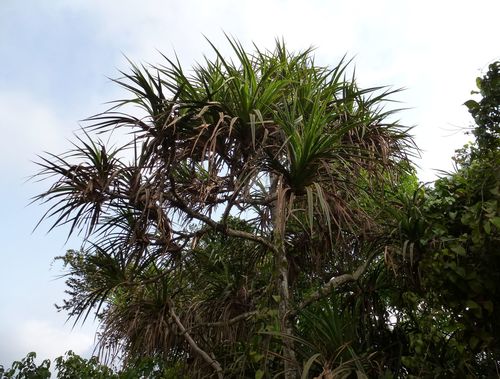
(c) Carel Jongkind, some rights reserved (CC BY-NC), uploaded by Carel Jongkind
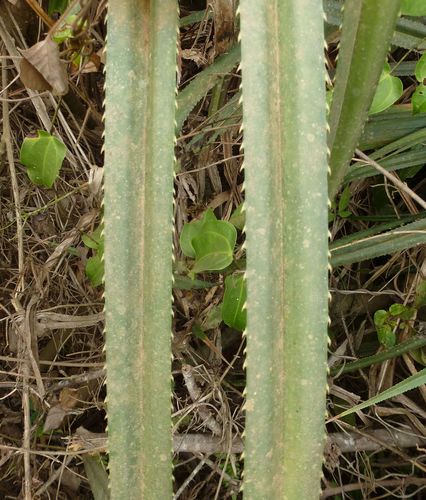
(c) Carel Jongkind, some rights reserved (CC BY-NC), uploaded by Carel Jongkind
What to Eat
Edible parts: Fruit
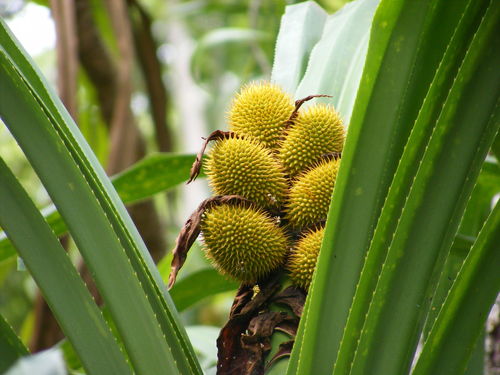
Although no specific records have yet been seen for this species, most members of this genus have more or less edible fruits, seeds and inner leaf bases. The cylindrical fruit is a syncarp made up of a number of individual drupes. Individual drupes are hard, woody wedges - each containing a few, slender seeds. Each wedge has a fleshy base imbued with a sweet-smelling, orange pulp that in many species has a delicious flavour. This pulp needs to be cooked in order to destroy a deleterious substance. The seed often has a delicious nutty flavour when eaten raw or cooked, though it is fiddly to extract. Seeds contain 44 - 50% fat and 20 - 34% protein. Inner base of young leaves - raw.
Where to Find It
It is a tropical plant. It is near the edges of forests in savannah. In Nigeria it is recorded as growing at 230 m and 1,360 m above sea level.
Africa, Central Africa, Congo DR, Gabon, Nigeria, Sao Tome and Principe, Senegal, West Africa,
How to Identify
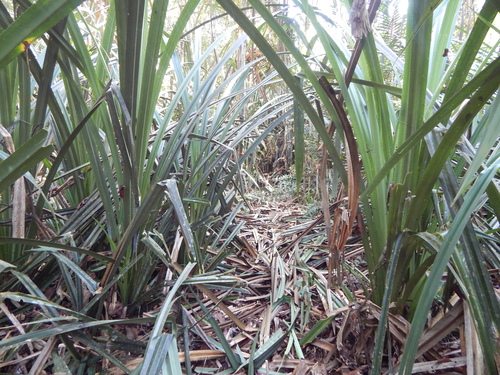
A tree. It is a screw-pine. It grows 3-10 m high. It has stilt roots. The trunk is thorny. Male and female flowers are on separate plants. The female flowers are white.
How to Grow
It can be grown from seeds or aerial shoots.
Propagation: Seed - best pre-soaked for 24 hours prior to sowing.
Other Uses
The leaves are made into mats. Mats, baskets and sacks are produced from the one metre long leaves. When dried, the leaves are used for making mats for wrapping goods as well as for sleeping-mats. In the Benin and Jekri country, thin receptacles around 60cm long are made which are used for holding salt, which is sold in these bags in the market. The bag keeps the salt dry. The leaves are used for thatching. A fibre is obtained from the brace roots. The fibre (the report does not specify which part of the plant the fibre comes from) is very tough, apparently very durable, and of moderate length, averaging around 90cm. The stem is very porous when dry, and cannot be said to yield timber, although the cork-like material might serve for a light substitute for it.
Wikipedia
Source ↗Pandanus candelabrum, also known as the chandelier tree or candelabrum tree, is a species of screw palm found in tropical Africa, notably Liberia. It only grows on kimberlite outcroppings, making it a potentially useful indicator for diamond prospecting in a process called Geobotanical prospecting.
Names & Synonyms
References (5)
- Burkill, H. M., 1985, The useful plants of west tropical Africa, Vol. 4. Kew. (As Pandanus spp.)
- Chapman, J. D. & Chapman, H. M., 2001, The Forest Flora of Taraba and Andamawa States, Nigeria. WWF & University of Canterbury. p 212
- Flora of West Tropical Africa, Vol 3 Part 1.
- Latham, P., 2004, Useful Plants of Bas-Congo province. Salvation Army & DFID p 212
- World Checklist of Useful Plant Species 2020. Royal Botanic Gardens, Kew