Acer truncatum
Bunge
Flat-base maple

(c) Jason, some rights reserved (CC BY-NC), uploaded by Jason
(c) 茶棚, some rights reserved (CC BY-NC), uploaded by 茶棚

(c) Yushi Wang, some rights reserved (CC BY-NC), uploaded by Yushi Wang
What to Eat
Edible parts: Seeds, Branches - drink
The seeds can be eaten roasted, though they are rather small and fiddly to make use of in any quantity.
Where to Find It
It is a temperate plant. It grows in good moist soil. It grows in forests between 400-1,000 m altitude in northern China. It suits hardiness zones 5-8.
Asia, Australia, Britain, China, Europe, Korea, Manchuria,
How to Identify
A shrub or small tree. It grows 5 m tall. There are prickles along the stem. The leaves are twice divided and there are 8-18 pairs of pinnae. There are up to 50 pairs of pinnules on each pinnae. The flowers are yellow. They are in large clusters at the ends of branches. The pods are flattened.
How to Grow
Seed should be pre-soaked for 24 hours then kept cold at 0-8°C for 2-4 months to assist them to grown. Seed can be sown fresh if green seeds are used. Layering or cuttings can be used.
Propagation: Seed is best sown as soon as ripe in a cold frame, typically germinating the following spring. This species has hypogeal germination, meaning the true seed leaves remain below the soil and the first leaves visible above ground are true leaves. Stored seed should be pre-soaked for 24 hours then stratified for 2–4 months at 1–8°C; germination can be slow. Seed can also be harvested green — fully developed but before drying and producing germination inhibitors — and sown immediately for late-winter germination. Seed harvested too early will yield very weak or no plants. Prick seedlings out into individual pots once large enough to handle, growing them on to at least 20cm before planting out permanently. Layering takes about 12 months and works well for most species in this genus. Cuttings of young shoots taken in June or July should have 2–3 pairs of leaves plus one pair of buds at the base; remove a thin slice of bark at the base and use a rooting hormone to improve success. Rooted cuttings must produce new growth during summer before being potted up, otherwise they are unlikely to survive winter.
Medicinal Uses
None known
Other Uses
The leaves can be packed around apples, root crops, and similar produce to help preserve them.
Wikipedia
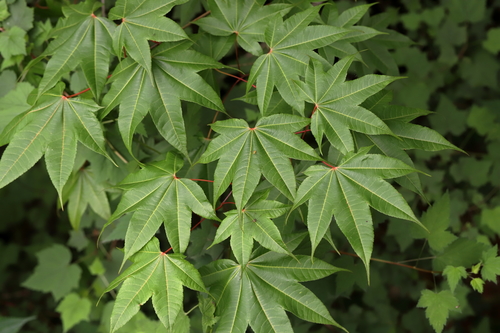
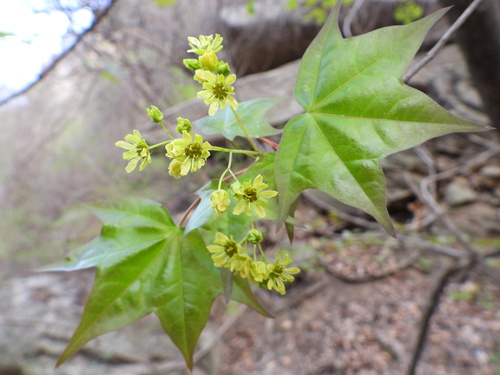
Source ↗Acer truncatum, the Shantung maple, Shandong maple, or purpleblow maple, is a maple native to northern China, in the provinces of Gansu, Hebei, Henan, Jiangsu, Jilin, Liaoning, Inner Mongolia, Shaanxi, Shandong, Shanxi, and to Korea. It is a medium-sized deciduous tree growing to 15 metres (49 ft) tall with a broad, rounded crown. The bark is smooth on young trees, becoming shallowly ridged with age. The leaves are opposite, palmately lobed with five lobes, 5 centimetres (2.0 in) to 12 centimetres (4.7 in) long and 7 centimetres (2.8 in) to 11 centimetres (4.3 in) broad, with a 3 centimetres (1.2 in) to 10 centimetres (3.9 in) petiole; the lobes are usually entire, but occasionally with a pair of teeth on the largest central lobe, and the margin is often wavy. The petiole bleeds a milky latex when broken. The flowers are in corymbs, yellow-green with five petals 5 millimetres (0.20 in) to 7 millimetres (0.28 in) long; flowering occurs in early spring. The fruit is a double samara with two winged seeds, the seeds are disc-shaped, slightly flattened, 13 millimetres (0.51 in) to 18 millimetres (0.71 in) across. The wings are 2 centimetres (0.79 in) long, widely spread, approaching a 180° angle. The bark is greenish-grey, smooth in young trees, becoming shallowly grooved in mature. It is drought and heat resistant. It is closely related to, and often difficult to distinguish from, Acer amplum, Acer cappadocicum, and Acer pictum subsp. mono, which replace it further south and west in China, and in Japan. From Acer cappadocicum it is best distinguished by the shoots which turn brown by their first winter, not remaining green for several years. From Acer mono (syn. A. pictum auct. non Thunb.) it is best distinguished by the larger, thicker (less flattened) seeds. Acer truncatum is very unusual among maples in showing hypogeal germination.
Notes
There are about 120-150 Acer species.
Names & Synonyms
Monkey maple, Pingji Qi, Shantung maple, Yuan bao qi
References (7)
- Cundall, P., (ed.), 2004, Gardening Australia: flora: the gardener's bible. ABC Books. p 90
- Enum. pl. China bor. 10. 1833 (Mem. Acad. Imp. Sci. St.-Petersbourg Divers Savans 2:84. 1835)
- Etherington, K., & Imwold, D., (Eds), 2001, Botanica's Trees & Shrubs. The illustrated A-Z of over 8500 trees and shrubs. Random House, Australia. p 73
- Hu, Shiu-ying, 2005, Food Plants of China. The Chinese University Press. p 522
- Plants for a Future database, The Field, Penpol, Lostwithiel, Cornwall, PL22 0NG, UK. http://www.scs.leeds.ac.uk/pfaf/
- Valder, P., 1999, The Garden Plants of China. Florilegium. p 261
- Xu Ting-zhi; Aceraceae, Flora of China.