Urera hypselodendron
(Hochst.) Wedd.
Norroi
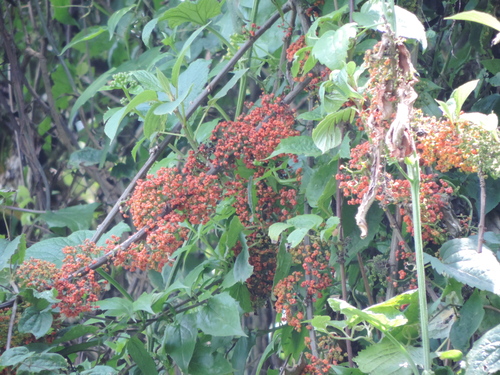
(c) Marco Schmidt, some rights reserved (CC BY-NC-SA)
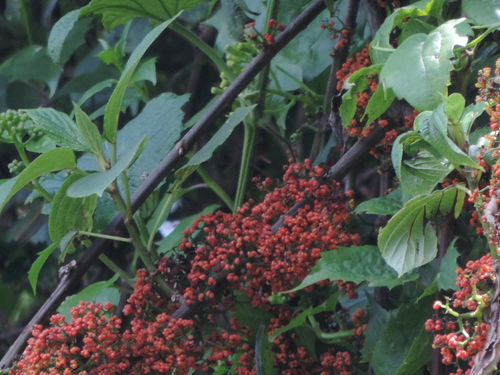
(c) Marco Schmidt, some rights reserved (CC BY-NC-SA)
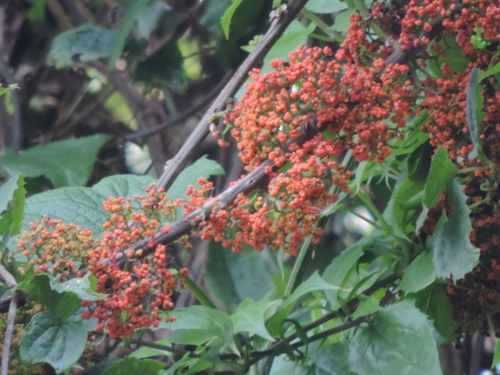
(c) Marco Schmidt, some rights reserved (CC BY-NC-SA)
What to Eat
Edible parts: Stem, Leaves
The stems and leaves are eaten.
Known Hazards
Where to Find It
It is a tropical plant. It climbs over rocks and grows in rough places in West and East Africa. It grows in mountain rainforest. It suits humid locations. In southern Africa it grows between 1,450-2,150 m altitude.
Africa, Burundi, Central Africa, Congo DR, East Africa, Ethiopia, Guinea-Bissau, Kenya, Malawi, Mozambique, Rwanda, Southern Africa, Sudan, Tanzania, Uganda, West Africa, Zambia, Zimbabwe,
How to Identify
A woody creeper. It climbs over trees. It can climb 30 m high. The stems can be 30 cm across. The bark is rough and soft. There are roots along the stem. It has stinging hairs. It has lots of clear sap. The leaves are 10-18 cm long by 7-13 cm wide. They are oval. The base is round and there is a short tip. There are fine teeth along the edge. The flowering stalks are 4-18 cm long. They have stinging hairs. The fruit is small, dry and one seeded. It is 1 mm long.
How to Grow
A dioecious species, both male and female forms need to be grown if fruit and seed are required.
Propagation: Seed - the optimum temperature for germination is 25°c.
Medicinal Uses
The stem bark is used in traditional medicine for the treatment of impetigo. Liquid from the stem is used as a tonic for pregnant women. A decoction of the stem is mixed with milk and drunk by pregnant women with abdominal pain. A decoction of the leaf is taken as a purgative. The leaves are chewed as an antivenin against snake bites, or the bite is rubbed with a maceration of the whole plant.
Other Uses
A strong, black fibre is obtained from the stem bark. It is used for making string and as sewing thread to stitch up gourds for holding milk. It is also used for making fishing nets and lines. To obtain the fibre, the bark is dried and crumpled well, and the fibre is taken out. The stem is used for basketry.
Names & Synonyms
Bwete, Mushambia, Mutimkula
References (9)
- Burkill, H. M., 1985, The useful plants of west tropical Africa, Vol. 5. Kew.
- Fowler, D. G., 2007, Zambian Plants: Their Vernacular Names and Uses. Kew. p 85
- Harkonen, M. & Vainio-Mattila, K., 1998, Some examples of Natural Products in the Eastern Arc Mountains. Journal of East African Natural History 87:265-278
- http://aflora.africa.kyoto-u.ac.jp
- Vainio-Mattila, K., 2000, Wild vegetables used by the Sambaa in the Usumbara Mountains, NE Tanzania. Ann. Bot. Fennici 37:57-67
- von Katja Rembold, 2011, Conservation status of the vascular plants in East African rain forests. Dissertation Universitat Koblenz-Landau p 185
- White, F., Dowsett-Lemaire, F. and Chapman, J. D., 2001, Evergreen Forest Flora of Malawi. Kew. p 582
- World Checklist of Useful Plant Species 2020. Royal Botanic Gardens, Kew
- Yamada, T., 1999, A report of the Ethnobotany of the Nyindu in the Eastern part of the former Zaire. African Study Monographs 20(1):1-72


