Caltha palustris
L.
Yellow marsh marigold, Water buttercup
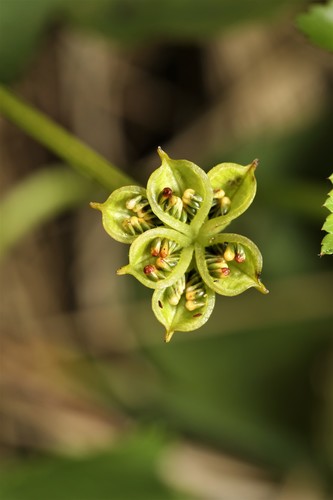
(c) Paul Marcum, some rights reserved (CC BY-NC)
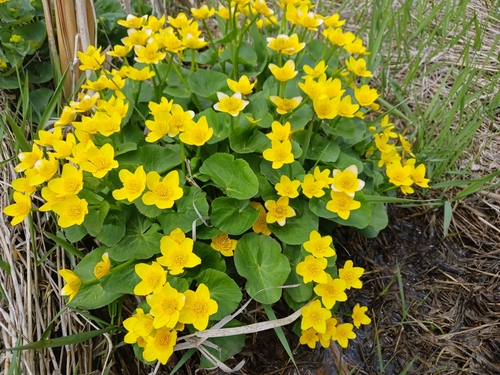
(c) eeyipes, some rights reserved (CC BY)
What to Eat
Edible parts: Flowers, Leaves, Root, Caution
Edible Parts: Flowers Leaves Root Edible Uses: Root - must be well cooked. The raw root should not be eaten. Some caution is advised, see the notes above on toxicity. Flower buds - raw, cooked or pickled and used as a caper substitute. Eating the raw flower buds can lead to intoxication. Some caution is advised, see the notes above on toxicity. Young leaves - raw or cooked. The leaves are harvested in the spring as the plant is coming into flower and is used like spinach after cooking in two or more changes of water. Eating the raw leaves can lead to intoxication. Some caution is advised, see the notes above on toxicity. Older leaves, before the plant flowers, can be eaten if they are well cooked. Some caution is advised, see the notes above on toxicity.
Known Hazards
Where to Find It
A temperate plant. It is frost hardy. It grows along the edges of streams and ditches. It grows in wetlands and swamps. In Nepal it grows at 2,250-4,200 m above sea level. It suits hardiness zones 3-9. In Sichuan and Yunnan.
Alaska, Albania, Arctic, Armenia, Asia, Australia, Austria, Balkans, Belarus, Belgium, Bhutan, Bosnia, Britain, Bulgaria, Canada, Caucasus, Central Asia, China, Czech, Denmark, Estonia, Europe*, Finland, France, Germany, Greece, Himalayas, Hungary, Iceland, India, Ireland, Italy, Japan, Kazakhstan, Korea, Latvia, Lithuania, Luxembourg, Mediterranean, Moldova, Mongolia, Myanmar, Nepal, Netherlands, North America, Norway, Poland, Portugal, Romania, Russia, Scandinavia, SE Asia, Siberia, Slovakia, Spain, Sweden, Switzerland, Turkey, Türkiye, Ukraine, USA, Yugoslavia,
How to Identify
A perennial plant. It grows 15-38 cm high and 45-60 cm wide. The roots are long and white. The stems are stout and hollow. The leaves are kidney shaped and deep green. They are 5-18 cm wide. The lower leaves have long stalks while higher leaves do not have stalks. The flowers are cup shaped. They are rich yellow. They can occur singly or in clusters.
How to Grow
A plant of the waterside, it prefers growing in a sunny position in wet soils or shallow water up to 15cm deep, though it will tolerate drier conditions if there is shade from the summer sun. Another report says that it grows best in partial shade. Requires a deep rich slightly alkaline soil. Grows well in heavy clay soils. Prefers a chalky soil. Tolerates a pH in the range 4.8 to 7.5. A very ornamental and polymorphic plant, there are some named varieties. Plants often self-sow when well sited. A good bee plant. A greedy plant, inhibiting the growth of nearby plants, especially legumes. This species is probably the most primitive flower in the British flora.
Propagation: Seed - best sown as soon as it is ripe in a cold frame in late summer. Stand the pots in 2 - 3cm of water to keep the soil wet. The seed usually germinates in 1 - 3 months at 15°c. When they are large enough to handle, prick the seedlings out into individual pots and grow them on in a tray of water in a cold frame until they are at least 15cm tall. Plant them out into their permanent positions in the summer. Division in early spring or autumn. Very easy, larger clumps can be replanted direct into their permanent positions, though it is best to pot up smaller clumps and grow them on in a cold frame until they are rooting well. Plant them out in the summer or following spring.
Medicinal Uses
Anodyne Antirheumatic Antispasmodic Diaphoretic Diuretic Expectorant Irritant Rubefacient Warts Every part of this plant is strongly irritant and so it should be used with caution. The whole plant is anodyne, antispasmodic, diaphoretic, diuretic, expectorant and rubefacient. It has been used to remove warts and is also used in the treatment of fits and anaemia. The root is antirheumatic, diaphoretic, emetic and expectorant. A decoction is used in the treatment of colds. A poultice of the boiled and mashed roots has been applied to sores. A tea made from the leaves is diuretic and laxative. All parts of the plant can irritate or blister the skin or mucous membranes.
Other Uses
Dye A yellow dye is obtained from the flowers[, a saffron substitute. It is used as a dye when mixed with alum, though it is not very permanent. Plants can be grown for ground cover when planted about 45cm apart each way. Special Uses Attracts Wildlife Ground cover
Wikipedia
Source ↗Caltha palustris, known as marsh-marigold and kingcup, is a small to medium sized perennial herbaceous plant of the buttercup family, native to marshes, fens, ditches and wet woodland in temperate regions of the Northern Hemisphere. It flowers between April and August, dependent on altitude and latitude, but occasional flowers may occur at other times.
Production
Young plants are collected before flowering.
Other Information
The well cooked leaves are often used.
Notes
There are about 10 Caltha species. They grow in temperate bogs.
Names & Synonyms
Abububa, Ahklingquahk, Allmaguaq, Allmaruat, Allngiguaq, Cowflock, Cowslip, Huang hua cai, Kengerosh, Kingcup, Lilpar, Lulpar, Mamris, Meadow-bright, Mumiri, Tayahksungwak, Wivlut
References (49)
- Ager, T. A. & Ager, L. P., 1980, Ethnobotany of the eskimos of Nelson Island, Alaska. Arctic Anthropology Vol 17. No. 1 pp 26-48 (As Caltha palustris subsp. arctica)
- Ambasta S.P. (Ed.), 2000, The Useful Plants of India. CSIR India. p 98
- Beckstrom-Sternberg, Stephen M., and James A. Duke. "The Foodplant Database." http://probe.nalusda.gov:8300/cgi-bin/browse/foodplantdb.(ACEDB version 4.0 - data version July 1994)
- Bircher, A. G. & Bircher, W. H., 2000, Encyclopedia of Fruit Trees and Edible Flowering Plants in Egypt and the Subtropics. AUC Press. p 75
- Bodkin, F., 1991, Encyclopedia Botanica. Cornstalk publishing, p 204
- Brickell, C. (Ed.), 1999, The Royal Horticultural Society A-Z Encyclopedia of Garden Plants. Convent Garden Books. p 212
- Brouk, B., 1975, Plants Consumed by Man. Academic Press, London. p 322, 286
- Bowser, M., 2017, Handout on Edible Plants of the Kenai Peninsula. USFWS Kenai National Wildlife Refuge p 17
- Cakir, E. A., 2017, Traditional knowledge of wild edible plants of Iğdır Province (East Anatolia, Turkey). Acta Soc Bot Pol. 2017;86(4):3568.
- Cormack, R. G. H., 1967, Wild Flowers of Alberta. Commercial Printers Edmonton, Canada. p 103
- Cundall, P., (ed.), 2004, Gardening Australia: flora: the gardener's bible. ABC Books. p 291
- Dangol, D. R. et al, 2017, Wild Edible Plants in Nepal. Proceedings of 2nd National Workshop on CUAOGR, 2017.
- Dogan, Y., et al, 2015, Of the importance of a leaf: the ethnobotany of sarma in Turkey and the Balkans. Journal of Ethnobiology and Ethnomedicine, 11:56
- Elias, T.S. & Dykeman P.A., 1990, Edible Wild Plants. A North American Field guide. Sterling, New York p 100
- Ertug, F, Yenen Bitkiler. Resimli Türkiye Florası -I- Flora of Turkey - Ethnobotany supplement
- Esperanca, M. J., 1988. Surviving in the wild. A glance at the wild plants and their uses. Vol. 2. p 71
- Facciola, S., 1998, Cornucopia 2: a Source Book of Edible Plants. Kampong Publications, p 121
- Hedrick, U.P., 1919, (Ed.), Sturtevant's edible plants of the world. p 144
- Heller, C. A., 1962, Wild Edible and Poisonous Plants of Alaska. Univ. of Alaska Extension Service. p 9
- Hibbert, M., 2002, The Aussie Plant Finder 2002, Florilegium. p 50
- https://en.wikipedia.org/wiki/List of wild edible plants in Mongolian cuisine
- Irving, M., 2009, The Forager Handbook, A Guide to the Edible Plants of Britain. Ebury Press p 70
- Jernigan, K. (Ed.), 2012, A Guide to the Ethnobotany of the Yukon-Kuskokwim Region. Draft.
- Joshi, N., et al, 2007, Traditional neglected vegetables of Nepal: Their sustainable utilization for meeting human needs. Tropentag 2007. Conference on International Agricultural Research for Development.
- Joyce, D., 1998, The Garden Plant Selector. Ryland, Peters and Small. p 212
- Kalle, R. & Soukand, R., 2012, Historical ethnobotanical review of wild edible plants of Estonia (1770s-1960s) Acta Societatis Botanicorum Poloniae 81(4):271-281
- Kang, Y., et al, 2014, Wild food plants used by the Tibetans of Gongba Valley (Zouqu country, Gansu, China) Journal of Ethnobiology and Ethnomedicine 10:20
- Kiple, K.F. & Ornelas, K.C., (eds), 2000, The Cambridge World History of Food. CUP p 1764
- Lim, T. K., 2015, Edible Medicinal and Non Medicinal Plants. Volume 9, Modified Stems, Roots, Bulbs. Springer p 21
- MacKinnon, A., et al, 2009, Edible & Medicinal Plants of Canada. Lone Pine. p 253
- Pieroni, A., et al, 2020, Wild food plants traditionally gathered in central Armenia: archaic ingredients or future sustainable foods? Environment, Development and Sustainability. Springer p 7
- Plants for a Future database, The Field, Penpol, Lostwithiel, Cornwall, PL22 0NG, UK. http://www.scs.leeds.ac.uk/pfaf/
- Porsild, A.E., 1953, Edible Plants of the Arctic, Arctic 6:15-34, page 27
- Redzic, S. J., 2006, Wild Edible Plants and their Traditional Use in the Human Nutrition in Bosnia-Herzegovina. Ecology of Food and Nutrition, 45:189-232
- Romanowski, N., 2007, Edible Water Gardens. Hyland House. p 104
- Ryan, S., 2008, Dicksonia. Rare Plants Manual. Hyland House. p 97
- Seidemann J., 2005, World Spice Plants. Economic Usage, Botany, Taxonomy. Springer. p 75
- Slocum, P.D. & Robinson, P., 1999, Water Gardening. Water Lilies and Lotuses. Timber Press. p 91
- Sp. pl. 1:558. 1753
- Toupal, R. S. & Hollenback, K., 2009, An Ethnobotany of Indiana Dunes National Lakeshore: Plant Uses of the Ojibwa People. Bureau of Applied Research in Anthropology. University of Arizona
- Tozer, F., 2007, The Uses of Wild Plants. Green Man Publishing. p 51
- Urgamal, M., Oyuntsetseg, B., Nyambayar, D. & Dulamsuren, Ch. 2014. Conspectus of the vascular plants of Mongolia. (Editors: Sanchir, Ch. & Jamsran, Ts.). Ulaanbaatar, Mongolia. “Admon“ Press. 334pp. (p. 79-90).
- USDA, ARS, National Genetic Resources Program. Germplasm Resources Information Network - (GRIN). [Online Database] National Germplasm Resources Laboratory, Beltsville, Maryland. Available: www.ars-grin.gov/cgi-bin/npgs/html/econ.pl (10 April 2000)
- Wiersema, J. H. & Leon, B., 2013, World Economic Plants. A Standard Reference CRC Press. 2nd Ed. p 134
- Wild edible plants of Himachal Pradesh
- Wilson, S., 1997, Some Plants are Poisonous. Reed. p 40
- World Checklist of Useful Plant Species 2020. Royal Botanic Gardens, Kew
- www.wildediblefood.com
- Zhang, Y., et al, 2014, Diversity of wetland plants used traditionally in China: a literature review. Journal of Ethnobiology and Ethnomedicine. 10:72


