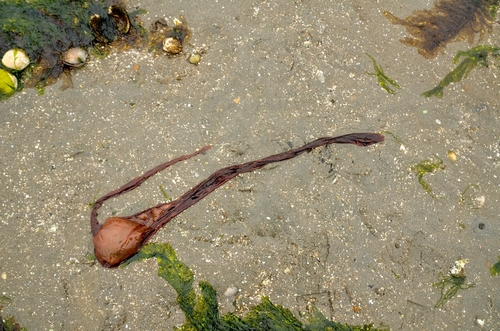
Pyropia abbottiae
(V. Krishnamurthy) S. C. Lindstrom
Red laver
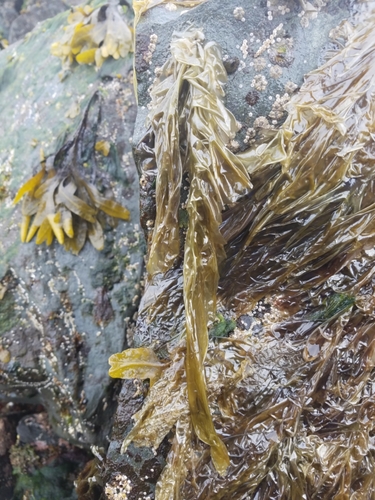
iNaturalist · cc-by-nc-sa
(c) M. Goff, some rights reserved (CC BY-NC-SA), uploaded by M. Goff
(c) M. Goff, some rights reserved (CC BY-NC-SA), uploaded by M. Goff
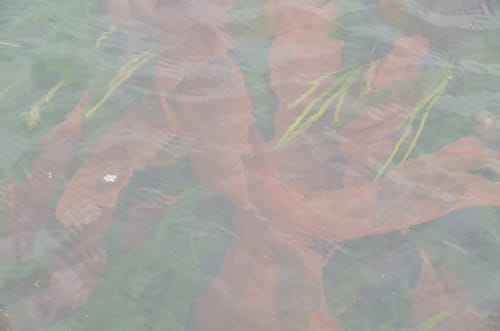
iNaturalist · cc-by-nc
(c) Dailun Shi, some rights reserved (CC BY-NC)
(c) Dailun Shi, some rights reserved (CC BY-NC)
What to Eat
Edible parts: Algae, Seaweed
Within the genus Pyropia multiple species are used for nori (edible seaweed), Pyropia yezoensis and P. haitanensis being most popular. It is a two-billion-dollar industry with most major growers located in China, Korea, and Japan. Nori contains substantial amounts of Vitamin B12 according to a 2014 paper. However, the Academy of Nutrition and Dietetics considers this source unreliable for vegans.
Where to Find It
It grows in temperate waters.
Alaska, Asia, Canada, North America, Russia, USA,
Countries: United Arab Emirates, Afghanistan, Antigua & Barbuda, Armenia, Azerbaijan, Barbados, Bangladesh, Bahrain, Brunei, Bahamas, Bhutan, Belize, Canada, China, Costa Rica, Cuba, Dominica, Dominican Republic, Grenada, Georgia, Guatemala, Honduras, Haiti, Indonesia, Israel, India, Iraq, Iran, Jamaica, Jordan, Japan, Kyrgyzstan, Cambodia, St Kitts & Nevis, North Korea, South Korea, Kuwait, Kazakhstan, Laos, Lebanon, St Lucia, Sri Lanka, Myanmar, Mongolia, Maldives, Mexico, Malaysia, Nicaragua, Nepal, Oman, Panama, Philippines, Pakistan, Puerto Rico, Qatar, Russia, Saudi Arabia, Singapore, El Salvador, Syria, Thailand, Tajikistan, Timor-Leste, Turkmenistan, Turkey, Trinidad & Tobago, Taiwan, United States, Uzbekistan, St Vincent, Vietnam, Yemen
How to Identify
A seaweed. It has a thin blade. It is broad and irregular shaped. The blades are only 1 or 2 cells thick.
Nutrition Score: 64/100
| Part | Moisture | kJ | kcal | Protein | Vit A | Vit C | Iron | Zinc |
|---|---|---|---|---|---|---|---|---|
| Fronds | 10 | 1 | 303 | 24.4 | — | — | 2.9 | 1.7 |
Other Information
An important edible seaweed.
Notes
There are 116 Porphyra species.
Names & Synonyms
Porphyra abbottiae V. KrishnamurthyPorphyra perforata
References (7)
- http://www.seavegetables.com (As Porphyra abbottiae)
- Kuhnlein, H. V. and Turner, N. J., 1991, Traditional Plant Foods of Canadian Indigenous Peoples. Food and Nutrition in History and Anthropology Volume 8. Gordon and Breach. p 18 (As Porphyra abbottiae)
- Kuhnlein, H. V., et al, 2009, Indigenous Peoples' food systems. FAO Rome p 33 (As Porphyra abbottiae)
- Moerman, D. F., 2010, Native American Ethnobotany. Timber Press. p 433 (As Porphyra abbottiae)
- Turner, N., 1995, Food Plants of Coastal First Peoples. Royal BC Museum Handbook p 121 (As Porphyra abbottiae)
- Turner, N., 2003, The ethnobotany of edible seaweed Porphyra abbottae and related species; Rhodophyta Canadian Journal of Botany; 81, 4; (As Porphyra abbottiae)
- Zemke-White, W. L. & Ohno, M., 1999, World seaweed utilisation: An end-of-century summary. Journal of Applied Phycology 11: 369-376 (As Porphyra abbottiae)