Campanula edulis
Forssk.
Bellflower
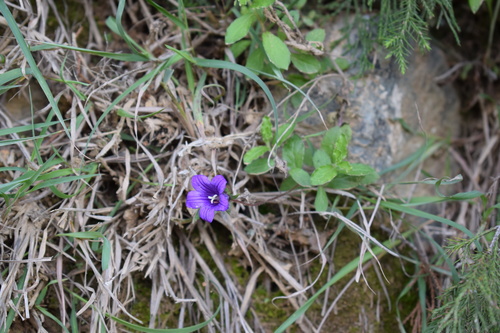
(c) Pádraic Flood, some rights reserved (CC BY-NC-SA), uploaded by Pádraic Flood

(c) mikee84, some rights reserved (CC BY-NC)
What to Eat
Edible parts: Root
The root is thick and flavourful, and is eaten by children.
Where to Find It
It is a Mediterranean climate plant. In Somalia it grows between 1,450-2,025 m above sea level.
Africa, Arabia, Djibouti, East Africa, Egypt, Eritrea, Ethiopia, Kenya, Middle East, North Africa, Rwanda, Somalia, Sudan, Tanzania, Uganda,
How to Identify
A herb. It keeps growing from year to year. The stems can be 70 cm long. The leaves do not have leaf stalks. They are oval to sword shaped and 1-5 cm long by 1 cm wide. The flowering clumps are loose and leafy. The fruit is a nodding capsule.
How to Grow
We have very little information on this species and do not know if it will be hardy in Britain. There is some doubt as to the validity of this name, the plant is closely related to C. dulcis and to the annual C. strigosa. The following notes are based on the general needs of the genus. Succeeds in most well-drained fertile soils, but prefers a moist but well-drained rich sandy loam and a neutral or alkaline soil in sun or partial shade. The species in this genus do not often hybridize and so seed can generally be relied upon to come true. The plants are self-fertile. Members of this genus are rarely if ever troubled by browsing deer.
Propagation: Seed: Surface sow in spring in a cold frame. Germination typically occurs in 2–4 weeks at 18°C. Once seedlings are large enough to handle, prick them out into individual pots and grow on in a cold frame for at least their first winter. Plant out into permanent positions in late spring or early summer, after the last expected frosts. Basal cuttings: Take in spring, harvesting shoots when they are about 10–15cm long with plenty of underground stem. Pot into individual pots and keep in light shade in a cold frame or greenhouse until rooting well, then plant out in summer. Division: Divide in spring or autumn. Larger clumps can be replanted directly into permanent positions, though smaller clumps are best potted up and grown on in a cold frame until rooting well, then planted out in summer or the following spring.
Medicinal Uses
None known.
Other Uses
None known.
Wikipedia
A compact perennial reaching 20cm in height, with a self-fertile, hermaphrodite form pollinated by bees, flies, beetles, and butterflies. Grows in light sandy or medium loamy, well-drained soils at neutral to basic pH levels. Tolerates semi-shade or full sun and prefers moist soil conditions.
Other Information
It is eaten especially by children.
Notes
There are about 300 Campanula species.
Names & Synonyms
Yebeg-lat
References (4)
- Asfaw, Z., Conservation and use of traditional vegetables in Ethiopia. FAO
- Asfaw, Z. and Tadesse, M., 2001, Prospects for Sustainable Use and Development of Wild Food Plants in Ethiopia. Economic Botany, Vol. 55, No. 1, pp. 47-62
- Fl. Aegypt.-Arab. 44. 1775
- Plants for a Future database, The Field, Penpol, Lostwithiel, Cornwall, PL22 0NG, UK. http://www.scs.leeds.ac.uk/pfaf/


