Campanula fenestrellata
Feer.
Adriatic bellflower, Window bellflower
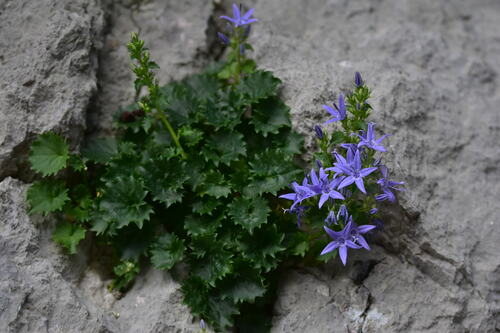
(c) Sebastian Ćato, some rights reserved (CC BY-NC), uploaded by Sebastian Ćato

(c) Sebastian Ćato, some rights reserved (CC BY-NC)
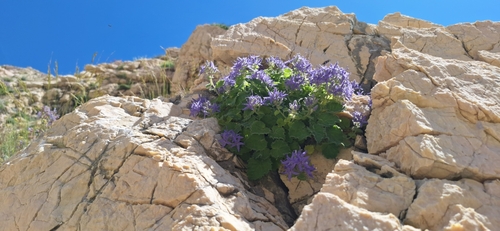
(c) Dubravko Dender, some rights reserved (CC BY-NC)
What to Eat
Edible parts: Flowers, Leaves
The leaves can be eaten raw or cooked and have a pleasant sweet flavour, making a very acceptable addition to mixed salads in winter. The flowers are eaten raw and are produced in abundance; they share the same pleasant sweetness and make a decorative addition to the salad bowl.
Where to Find It
It suits hardiness zones 4-9.
Australia, Balkans, Croatia, Europe- Adriatic, Slovenia,
How to Identify
A low growing plant. It keeps growing from year to year. It forms tight clumps. It grows 5-10 cm high and spreads 20 cm wide. The flowers are blue and like stars. They have a paler centre.
How to Grow
Prefers a moist but well-drained rich sandy loam and a neutral or alkaline soil in full sun though it also tolerates partial shade. Plants are very drought-tolerant and can be grown on a dry stone wall, they also succeed in poor soils. Plants are hardy to at least -15°c. Closely related to C. garganica, differing in its larger leaves, longer stems and fewer flowers. The pollen is blue, whilst that of C. garganica is yellow. The species in this genus do not often hybridize and so seed can generally be relied upon to come true. The plants are self-fertile. Members of this genus are rarely if ever troubled by browsing deer.
Propagation: Seed: Surface sow in spring in a cold frame. Germination typically occurs in 2–4 weeks at 18°C. Once seedlings are large enough to handle, prick them out into individual pots and grow on in a cold frame for at least their first winter. Plant out into permanent positions in late spring or early summer, after the last expected frosts. Basal cuttings: Take in spring, harvesting shoots when they are about 10–15cm long with plenty of underground stem. Pot into individual pots and keep in light shade in a cold frame or greenhouse until rooting well, then plant out in summer. Division: Divide in spring or autumn. This plant can be divided at almost any time of year.
Medicinal Uses
None known.
Other Uses
None known.
Wikipedia
An evergreen perennial growing 20cm tall and 50cm wide at a medium rate, hardy to UK zone 6. Maintains foliage year-round and flowers from July to September. Self-fertile hermaphrodite pollinated by bees, flies, beetles, and butterflies. Prefers light sandy or medium loamy, well-drained soils at neutral to basic pH, tolerates semi-shade or full sun, and prefers moist conditions.
Notes
There are about 300 Campanula species.
Names & Synonyms
Oknasta zvončnica
References (3)
- Cundall, P., (ed.), 2004, Gardening Australia: flora: the gardener's bible. ABC Books. p 320
- J. Bot. 28:272. 1890
- Plants for a Future database, The Field, Penpol, Lostwithiel, Cornwall, PL22 0NG, UK. http://www.scs.leeds.ac.uk/pfaf/


