Campanula persicifolia
L.
Harebell, Peach-leaf Bellflower
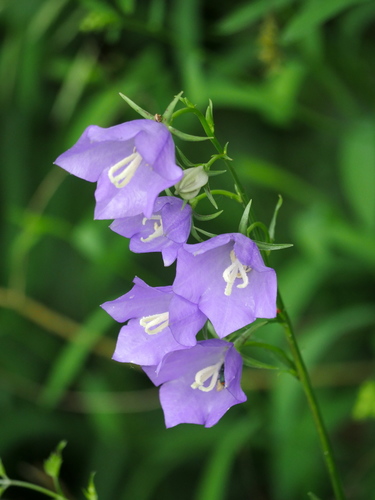
(c) reddad, some rights reserved (CC BY-NC), uploaded by reddad

(c) lejapiko, some rights reserved (CC BY-NC)
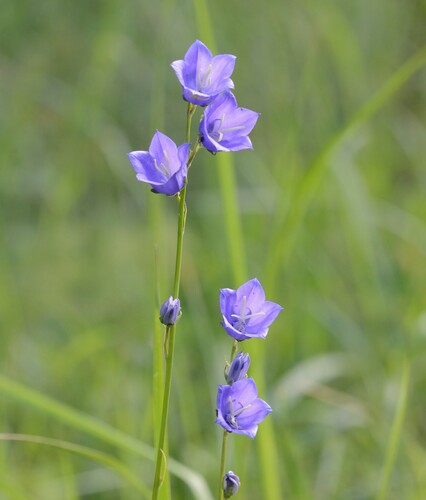
(c) Хаматов Гадылхан, some rights reserved (CC BY-NC), uploaded by Хаматов Гадылхан
What to Eat
Edible parts: Flowers, Leaves, Root
The leaves can be eaten raw or cooked, are rich in vitamin C, and have a mild flavour that is well liked in salads. The plant produces over-wintering basal rosettes, providing fresh leaves throughout winter, though the leaves are very narrow and it takes quite a lot of picking to gather a reasonable quantity. The root can be eaten raw. The flowers are edible raw, have a pleasant sweetness, and make a highly ornamental addition to mixed salads.
Where to Find It
It is a temperate plant. It does best in light to medium humus-rich soil. It needs to be well drained and in a sunny position. It is frost hardy. It grows in open woodland. It is sensitive to drought. It suits hardiness zones 4-9.
Africa, Asia, Australia, Balkans, Britain, Bulgaria, Europe*, France, Greece, Hungary, Italy, Luxembourg, Mediterranean, North Africa, Poland, Russia, Slovenia, Tasmania, Turkey, Türkiye,
How to Identify
A perennial herb. It grows 30-90 cm high and 30-38 cm wide. The stems are wiry. They arise from a rosette of narrow leaves. They are erect and do not branch. The leaves near the base are narrowly oval with blunt teeth and stalks. The upper leaves are narrow and have teeth. The flowers are open bells. They face outward and are nodding. They are blue or white and 30-40 mm long.
How to Grow
Easily grown in ordinary garden soil. Prefers a moist but well-drained rich sandy loam and a neutral or alkaline soil in sun or partial shade. Succeeds in light woodland. Plants are hardy to at least -15°c. The species in this genus do not often hybridize and so seed can generally be relied upon to come true. The plants are self-fertile. A very ornamental plant, there are many named varieties. It was at one time grown as a culinary vegetable, but is now only grown as an ornamental plant. The sub-species C. persicifolia crystalocalyx has larger leaves than the species and so is more suitable as a food crop. A very long-lived and easily grown plant, it is best divided every other year. Slugs are very fond of this plant and can cause severe damage even to large plants. Members of this genus are rarely if ever troubled by browsing deer. This plant is a potential winter salad plant, it retains a basal rosette of leaves all winter.
Propagation: Surface sow seed in spring in a cold frame. Germination typically takes 2–4 weeks at 18°C. Prick seedlings out into individual pots when large enough to handle and grow on in a cold frame for at least their first winter, then plant out into permanent positions in late spring or early summer after the last expected frosts. For basal cuttings in spring, harvest shoots when they are about 10–15cm long with plenty of underground stem, pot individually, and keep in light shade in a cold frame or greenhouse until rooting well, then plant out in summer. Division in spring or autumn is very easy; larger clumps can be replanted directly into permanent positions, while smaller clumps are better potted up in a cold frame until well rooted, then planted out in summer or the following spring.
Medicinal Uses
The plant is noted as a source of vitamin C.
Other Uses
None known
Wikipedia
Source ↗Campanula persicifolia, the peach-leaved bellflower, is a flowering plant species in the family Campanulaceae. It is an herbaceous perennial growing to 1 m (3 ft 3 in). Its flowers are cup-shaped and can be either lilac-blue or white. Its foliage is narrow and glossy with a bright green appearance. It is widely considered an English cottage garden classic.
Other Information
The flowers are eaten especially by children.
Notes
There are about 300 Campanula species.
Names & Synonyms
Breskovolistna zvončnica, Kambanka, Kupa, Narrow-leafed bellflower, Peach bells, Tocservirag, Vadcsengo
References (14)
- Bircher, A. G. & Bircher, W. H., 2000, Encyclopedia of Fruit Trees and Edible Flowering Plants in Egypt and the Subtropics. AUC Press. p 76
- Blamey, M and Grey-Wilson, C., 2005, Wild flowers of the Mediterranean. A & C Black London. p 429
- Bodkin, F., 1991, Encyclopedia Botanica. Cornstalk publishing, p 208
- Cerne, M., 1992, Wild Plants from Slovenia used as Vegetables. Acta Horticulturae 318
- Crawford, M., 2012, How to grow Perennial Vegetables. Green Books. p 79
- Cundall, P., (ed.), 2004, Gardening Australia: flora: the gardener's bible. ABC Books. p 321
- Denes, A., et al, 2012, Wild plants used for food by Hungarian ethnic groups living in the Carpathian Basin. Acta Societatis Botanicorum Poloniae 81 (4): 381-396
- Hedrick, U.P., 1919, (Ed.), Sturtevant's edible plants of the world. p 145
- Hibbert, M., 2002, The Aussie Plant Finder 2002, Florilegium. p 58
- Joyce, D., 1998, The Garden Plant Selector. Ryland, Peters and Small. p 214
- Łukasz Łuczaj and Wojciech M Szymański, 2007, Wild vascular plants gathered for consumption in the Polish countryside: a review. J Ethnobiol Ethnomedicine. 3: 17
- Nedelcheva A., 2013, An ethnobotanical study of wild edible plants in Bulgaria. EurAsian Journal of BioSciences 7, 77-94
- Plants for a Future database, The Field, Penpol, Lostwithiel, Cornwall, PL22 0NG, UK. http://www.pfaf.org
- Sp. pl. 1:164. 1753


