Canarium strictum
Roxburgh
Black damar
(c) AKHIL MURALI, some rights reserved (CC BY-NC), uploaded by AKHIL MURALI
(c) Rama Narayanan, some rights reserved (CC BY), uploaded by Rama Narayanan
(c) Ansil B.R., some rights reserved (CC BY), uploaded by Ansil B.R.
What to Eat
Edible parts: Fruit, Kernel, Nut
The fruit cover (skin) is eaten raw or used for pickles and can be dried. The seeds/nuts are also eaten.
Where to Find It
A tropical plant. It is native to the eastern Himalayas between 400-1,300 m altitude. In XTBG Yunnan.
Asia, Bhutan, China, Himalayas, India, Indochina, Myanmar, Northeastern India, SE Asia, Thailand,
How to Identify
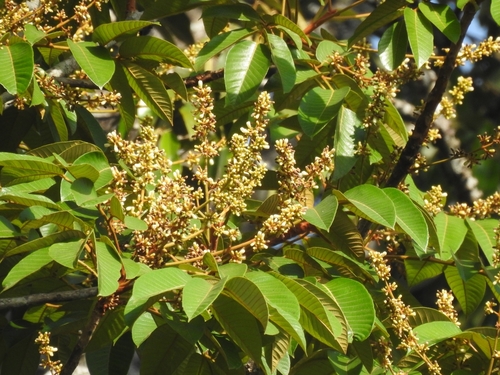
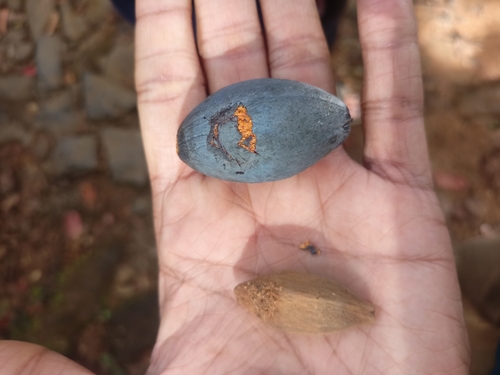
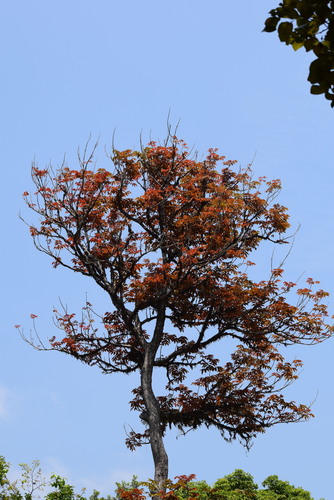
A large tree. It grows 40 m tall. It has buttresses. The bark is hard and has a metallic sound when hit. The bark peels off in rectangle shaped flakes. The tree crown is dense and umbrella shaped. The young leaves are bright red with rusty hairs. The mature leaves are 30-60 cm long and 5-9 cm wide. They have 3-7 pairs of leaflets and one leaflet at the end. The flowers are in clusters 20-30 cm long. The flowers are brownish yellow. The fruit are hard and egg shaped. They are 3-4 cm long. They taper at both ends.
How to Grow
Plants are grown from seeds.
Propagation: Seed - we have no specific information for this species but seeds of this genus generally have a hard seed coat and germinate erratically. Filing away some of the seed coat to allow moisture to enter more readily, without damaging the seed, will encourage a faster and more even germination.
Medicinal Uses
The resin obtained from the trunk is used medicinally.
Other Uses
A clear, amber-coloured, brittle resin is obtained from the trunk. It is used for making incense, waxes and varnishes[, 730n ]. The resin is traditionally obtained by cutting gashes in the lower part of the stem and then setting it on fire. On destructive distillation it yields an oil (75%) known as Dammar oil. The wood is moderately hard with a pink heartwood and greyish-white sapwood. It is little utilized.
Wikipedia
Source ↗Canarium strictum, known by common names including black dhup, Raal, Raal dhup and black dammar, is a species of tree in the family Burseraceae (the incense tree family). It is known for the medicinal and commercial use of the resin it exudates, called black dammar.
Production
It is fast growing. In Nagaland fruit are available October to December.
Notes
There are 80-95 Canarium species. This one has a black resin which burns.
Names & Synonyms
Beraw, Chakronthi, Dhuna, Dhup, Doopamara, Gokul dhup, Halemmadu, Hilum, Kala dammar, Karapu kongiliam, Karinkunthirik-kam, Karuttukungiliyam, Kong, Kundrikam, Kungilium, Liangmesen, Nalla, Pantappayan, Poirek gulo, Raldhup, Rojanamu, Schellum, Singlu, Tendalake, Thelli, Thellippayin
References (27)
- Ambasta S.P. (Ed.), 2000, The Useful Plants of India. CSIR India. p 100
- Angami, A., et al, 2006, Status and potential of wild edible plants of Arunachal Pradesh. Indian Journal of Traditional Knowledge 5(4) October 2006, pp 541-550
- Arinathan, V., et al, 2007, Wild edibles used by Palliyars of the western Ghats, Tamil Nadu. Indian Journal of Traditional Knowledge. 6(1) pp 163-168
- Bircher, A. G. & Bircher, W. H., 2000, Encyclopedia of Fruit Trees and Edible Flowering Plants in Egypt and the Subtropics. AUC Press. p 79
- Chandrashekara, U. M., 2009, Tree species yielding edible fruit in the coffee-based homegardens of Kerala, India: their diversity, uses and management. Food Sec. 1:361-370
- Crevost & Lemarie, 1917,
- Fl. ind. ed. 1832, 3:138. 1832
- Gardner, S., et al, 2000, A Field Guide to Forest Trees of Northern Thailand, Kobfai Publishing Project. p 111
- Hu, Shiu-ying, 2005, Food Plants of China. The Chinese University Press. p 506
- Kar, A., et al, 2013, Wild Edible Plant Resources used by the Mizos of Mizoram, India. Kathmandu University Journal of Science, Engineering and Technology. Vol. 9, No. 1, July, 2013, 106-126
- Kunkel, G., Plants for Human Consumption
- Leenhouts, 1959, Blumea 9(2):414-416
- Luo, B., et al, 2019, Wild edible plants collected by Hani from terraced rice paddy agroecosystem in Honghe Prefecture, Yunnan, China. Journal of Ethnobiology and Ethnomedicine 15:56
- Matthew, K.M., 1983, The flora of Tamilnadu Carnatic
- Medhi, P., Sarma, A and Borthakur, S. K., 2014, Wild edible plants from the Dima Hasao district of Assam, India. Pleione 8(1): 133-148
- Mozhui, R., et al, 2011, Wild edible fruits used by the tribals of Dimapur district of Nagaland, India. Pleione 5(1): 56 - 64.
- Mukhia, P.K., et al, 2013, Wild plants as Non Wood Forest Products used by the rural community of Dagana, a southern foothill district of Bhutan, SAARC Journal, 27 pages
- Murtem, G. & Chaudhrey, P., 2016, An ethnobotanical note on wild edible plants of Upper Eastern Himalaya, India. Brazilian Journal of Biological Sciences, 2016, v. 3, no. 5, p. 63-81.
- Pradheep, K., et al, 2016, Wild edible plants used by Konyak tribe in Mon district of Nagaland: Survey and inventorisation. Indian Journal of Natural Products and Resources. Vol 7(1) pp 74-81
- Sahni, K.C., 2000, The Book of Indian Trees. Bombay Natural History Society. Oxford. p 53
- Saldanha, C. J.,& Nicholson, 1976, Flora of Hassan district.
- Singh, V. B., et al, (Ed.) Horticulture for Sustainable Income and Environmental Protection. Vol. 1 p 214
- Taram, M., et al, 2018, Wild Food Plant Resources of Komkar Adi Tribe of Upper Siang District in Arunachal Pradesh, India. Bulletin of Arunachal Forest Research, Vol. 33(2), 27-35
- Tanaka, p 126
- Terrell, et al, 1986, Agric. Handb. No 505.
- Wealth of India, 1950,
- Wiersma, J.H., USDA GRIN database


