Cyclophyllum coprosmoides
(F. Muell.) S.T. Reynolds & R.J.F. Hend.
Large-leaf canthium
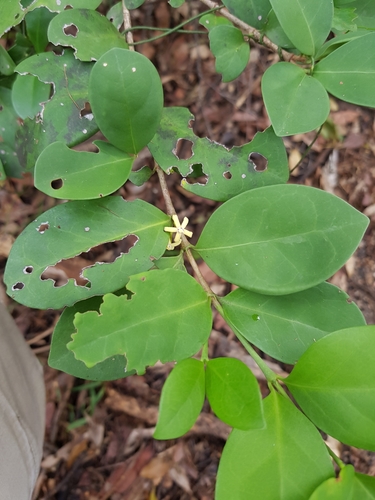
(c) Jenny Gursanscky, some rights reserved (CC BY-NC), uploaded by Jenny Gursanscky

(c) pdwaar, some rights reserved (CC BY-NC), uploaded by pdwaar
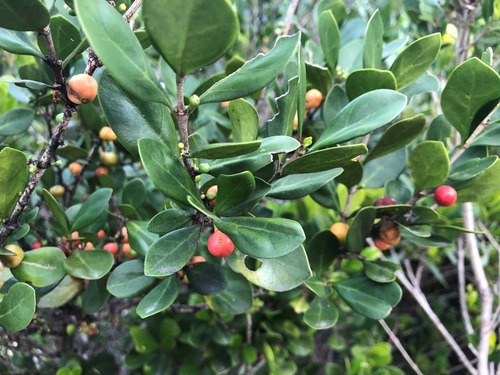
(c) Martin Bennett, some rights reserved (CC BY-NC), uploaded by Martin Bennett
What to Eat
Edible parts: Fruit
The fruit is eaten; the seeds are traditionally consumed after the hairs are removed.
Where to Find It
A tropical plant. They grow best in deep well-drained soil. It grows near creeks and in forest near beaches.
Australia*,
How to Identify
A tree up to 2-6 m tall. It can spread 3.5 m wide. The leaves are simple and 3-11 cm long by 1.5-3 cm wide. They are smooth and dull green. It is paler underneath. The flowers are white and about 0.8 cm across. They occur in clusters in the axils of leaves. The fruit are 12-14 mm long. They are round and red. There are 2 seeds inside.
How to Grow
Plants can be grown from seed or stem cuttings.
Wikipedia
Source ↗Cyclophyllum coprosmoides , also known as coast canthium, supple jack, and sweet susie, is a shrub or tree occurring in eastern Australia. It is commonly seen growing in a variety of different rainforest situations, from Jervis Bay in New South Wales to the islands of the Torres Strait.
Production
Plants are fairly slow growing.
Notes
There are about 200 Canthium species.
Names & Synonyms
Coast Canthium, Jilaban tree, Kooni or marko, Native currant
References (18)
- Anon., 2003, Native Plants for the Fitzroy basin. Society for Growing Australian Plants Inc. (Rockhampton Branch)
- Bodkin, F., 1991, Encyclopedia Botanica. Cornstalk publishing, p 211 (As Canthium coprosmoides)
- Cherikoff V. & Isaacs, J., The Bush Food Handbook. How to gather, grow, process and cook Australian Wild Foods. Ti Tree Press, Australia p 194 (As Canthium coprosmoides)
- Cooper W & Cooper W T, 1994, Fruits of the Rain Forest. RD Press p 87 (As Canthium coprosmoides)
- Cooper, W. and Cooper, W., 2004, Fruits of the Australian Tropical Rainforest. Nokomis Editions, Victoria, Australia. p 438
- Cundall, P., (ed.), 2004, Gardening Australia: flora: the gardener's bible. ABC Books. p 325 (As Canthium coprosmoides)
- Elliot, W.R., & Jones, D.L., 1982, Encyclopedia of Australian Plants suitable for cultivation. Vol 2. Lothian. p 457 (As Canthium coprosmoides)
- Haslam, S., 2004, Noosa's Native Plants. Noosa Integrated Catchment Assn. Inc. p 19 (As Canthium coprosmoides)
- Hibbert, M., 2002, The Aussie Plant Finder 2002, Florilegium. p 59 (As Canthium coprosmoides)
- Jackes, B.R., 2001, Plants of the Tropics. Rainforest to Heath. An Identification Guide. James Cook University. p 77 (As Canthium coprosmoides)
- Jones D, L, 1986, Ornamental Rainforest Plants in Australia, Reed Books, p 87 (As Canthium coprosmoides)
- Melzer, R. & Plumb, J., 2011, Plants of Capricornia. Belgamba, Rockhampton. p 294
- Scarth-Johnson, V., 2000, National Treasures. Flowering Plants of Cooktown and Northern Australia. Vera Scarth-Johnson Gallery Association. Cooktown, Australia. p 76 (As Canthium coprosmoides)
- Townsend, K., 1994, Across the Top. Gardening with Australian Plants in the tropics. Society for Growing Australian Plants, Townsville Branch Inc. p 119 (As Canthium coprosmoides)
- Williams, J.B., Harden, G.J., and McDonald, W.J.F., 1984, Trees and shrubs in rainforests of New South Wales and Southern Queensland. Univ. of New England, Armidale. p 116 (As Canthium coprosmoides)
- Williams, K.A.W., 1999, Native Plants of Queensland Volume 4. Keith A.W. Williams North Ipswich, Australia. p 94 (As Canthium coprosmoides)
- www.theplantlist.org
- Yallakool Reserve Plant List July 1, 2009 Off internet (As Canthium coprosmoides)


