Carapa procera
DC
Bitter kola, Crab nut

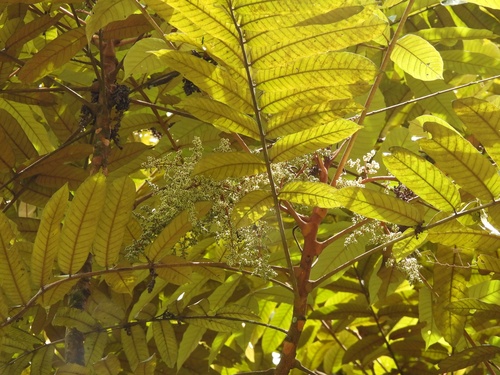
(c) Marco Schmidt, some rights reserved (CC BY-NC-SA), uploaded by Marco Schmidt

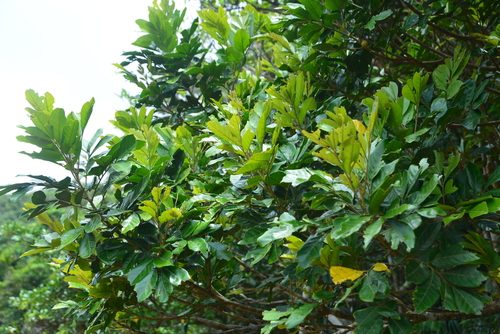
(c) Scamperdale, some rights reserved (CC BY-NC)

(c) Scamperdale, some rights reserved (CC BY-NC)
What to Eat
Edible parts: Seeds, Fruit
The ripe fruits are eaten raw, and the seeds are processed to make a type of butter.
Where to Find It
A tropical plant. It grows in the rainforest. It suits humid locations. It can also be in savannah woodland, palm groves and along river banks.
Africa, Angola, Brazil, Burkina Faso, Cameroon, Central Africa, Central African Republic, CAR, Central America, Colombia, Congo DR, Costa Rica, Côte d'Ivoire, East Africa, Gabon, Guiana, Guianas, Guinea, Guinée, Guinea-Bissau, Ivory Coast, Nigeria, Peru, Sao Tome and Principe, SE Asia, Senegal, Sierra Leone, Singapore, Suriname, Tanzania, Uganda, West Africa,
How to Identify
An evergreen tree. It grows up to 25 m tall. The branches are crooked, spread out wide and curve over. It has a dense crown of leaves. The trunk is often fluted and the branches grow low down on the trunk. The bark is thin and smooth and dark grey. It has a gummy resin when cut. The leaves are very large and at the ends of the thick small branches. The young leaves are red then orange and change to green as they mature. They are divided into 6-9 pairs of leaflets. Each leaflet is oblong and about 25 cm long by 9 cm wide. The leaves have a rounded tip with a blunt point. The flowers are in a much branched head shaped like a pyramid. It is 70 cm long. Each flower has 5 yellow, pink and white petals about 1 cm long. The fruit is a large woody capsule 12-15 cm across. The fruit cracks open in 5 parts. There are 12-20 angular seeds inside. The seeds are 3 cm long and shiny dark brown. They have a rough pitted surface.
How to Grow
Plants can be grown from seed. The seed germinate easily. Seeds should be planted within 2 months. The young plants should have light shade.
Propagation: Seed - does not require any specific pre-treatment and should be germinated within the range of 26 to 31°C, and typically germinates within 4 weeks. The seed does not tolerate drying nor low temperatures. The lowest safe moisture content is c. 34%. For short term storage the seed should be stored with moist sawdust/vermiculite to maintain them at their harvest moisture content. During moist storage the seeds should be frequently ventilated to prevent anoxia.
Medicinal Uses
The bark is tonic and febrifuge. A bitter oil is obtained from the seed. It is used for treating a range of skin conditions including scabies, yaws, burns and mosquito bites. An infusion of the wood is used to relieve diarrhoea.
Other Uses
The seeds contain about 55% oil. It is used for making soap. Foresters recognize two types of wood from this tree:- Andiroba Vermelha, also known as 'Red' or 'Hill Crabwood' is derived from trees growing on higher, well-drained land. It produces a heavier wood of superior quality which does not float on water. Andiroba Branca, also known as 'White Crabwood', is derived from trees growing in swampy locations. The wood is lighter, of lower quality and does float on water. The heartwood is reddish-brown; it is not clearly demarcated from the 3 - 5cm wide band of sapwood. The texture is medium; the grain straight or interlocked. The wood is moderately soft to moderately hard; strong; moderately tough; of medium weight, moderately durable with some resistance to fungi and termites, but susceptible to dry wood borers. It is somewhat slow to season, with a high risk of checking but only a slight risk of distortion; once dry it is moderately stable in service. It works quite well with ordinary tools, though there are some difficulties in planing when the grain is interlocked; it has a slight tendency to split on nailing or screwing, so pre-boring is recommended; it glues well and polishes satisfactorily. The wood's main application is for high-quality furniture and cabinetwork, stairs and flooring, and as veneer for furniture, interior work and plywood. It is also used for masts, building material, boxes and crates, and as a substitute for okoumé (Aucoumea klineana) and walnut (Juglans regia). In Colombia, shoemakers prefer it for making shoe pieces[, , 325,848].
Wikipedia
Source ↗Carapa procera, called African crabwood, is a species of tree in the genus Carapa, native to the West African tropics and to the Amazon rainforest, and introduced to Vietnam. Some authorities have split off the South American population into its own species, Carapa surinamensis. The nuts are intensively collected in the wild for their oil, a non-timber forest product. In tropical Africa, the species is increasingly threatened.
Production
The plant is slow growing. In Congo fruit are available November to December.
Other Information
It is commonly used in West Africa.
Notes
There are 25 Carapa species. There are 3 Carapa species in tropical America.
Names & Synonyms
Bepale, Boco, Boculamape, Boncom-hadje, Boncom-o, Boru, Buaque, Bugwere, Bunhogone, Buweci, Carahane, Cola-amargoso, Cola-malegossa, Coque, Dona, Ebegogo, Engang, Gobi, Godjo, Irere, Karaba, Karapa, Kola-malgos, Malo, Mambodadje, Mbolu, Motoubeloube, Nanga, Ngan, Ngoze, Pada-di-kola, Punhe, Siti-malgos, Weti-krapa
References (14)
- Ambe, G., 2001, Les fruits sauvages comestibles des savanes guinéennes de Côte-d’Ivoire : état de la connaissance par une population locale, les Malinké. Biotechnol. Agron. Soc. Environ. 5(1), 43-48
- Billong Fils, P. E., et al, 2020, Ethnobotanical survey of wild edible plants used by Baka people in southeastern Cameroon. Journal or Ethnobiology and Ethnomedicine. 16:64 p 7
- Bremness, L., 1994, Herbs. Collins Eyewitness Handbooks. Harper Collins. p 41
- Danforth, R.M., & Boren, P.D., 1997, Congo Native fruits. Twenty-five of the best. Privately published. p 68
- Grandtner, M. M. & Chevrette, J., 2013, Dictionary of Trees, Volume 2: South America: Nomenclature, Taxonomy and Ecology. Academic Press p 101
- Jardin, C., 1970, List of Foods Used In Africa, FAO Nutrition Information Document Series No 2.p 40
- Katende, A.B., Birnie, A & Tengnas B., 1995, Useful Trees and Shrubs for Uganda. Identification, Propagation and Management for Agricultural and Pastoral Communities. Technical handbook No 10. Regional Soil Conservation Unit, Nairobi, Kenya. p 156
- Keay, R.W.J., 1989, Trees of Nigeria. Clarendon Press, Oxford. p 348
- Mangambu Mokoso Jean De Dieu, et al, 2015, Etudes ethnobotanique et ethnolinguistique des ressources forestieres ligneuses utilisees par la population du coulour Ecologique du Parc National de Kahuzi-biega (R. D. Congo). European Journal of Scientific Research May 2015.
- Prodr. 1:626. 1824
- Terashima, H., & Ichikawa, M., 2003, A comparative ethnobotany of the Mbuti and Efe hunter-gatherers in the Ituri Forest, Democratic Republic of Congo. African Study Monographs, 24 (1, 2): 1-168, March 2003
- Vivien, J. & Faure, J.J., 1985, Abres des forets dense d'Afrique Centrale. Agence de Cooperation Culturelle et Technique. Paris. p 248
- Vivien, J., & Faure, J.J., 1996, Fruitiers Sauvages d'Afrique. Especes du Cameroun. CTA p 197
- World Checklist of Useful Plant Species 2020. Royal Botanic Gardens, Kew