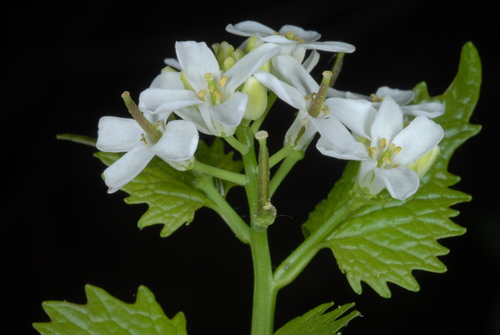
Cardamine flexuosa
With.
Lady’s smock, Wavy Bitter-cress, Woodland Bittercress
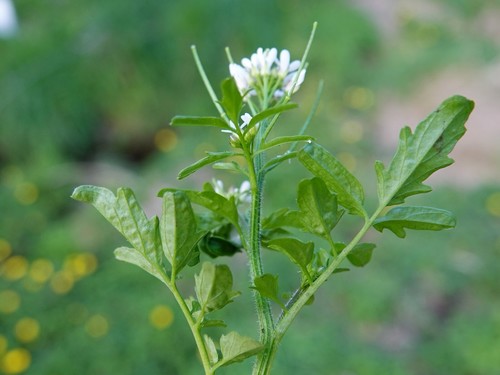
(c) Jacqui Geux, some rights reserved (CC BY), uploaded by Jacqui Geux
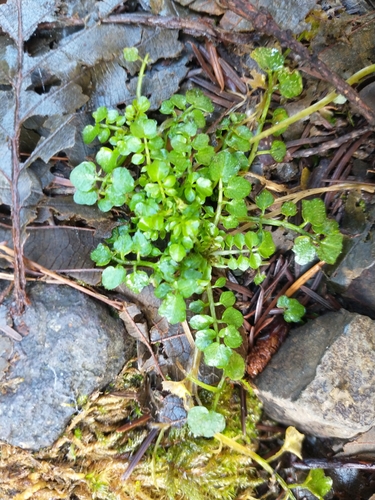
no rights reserved

(c) Karen Andrea Boehme, some rights reserved (CC BY-NC), uploaded by Karen Andrea Boehme
What to Eat
Edible parts: Leaves, Root, Shoots, Flowers
Both the leaves and root can be eaten raw or cooked. The leaves have a hot, cress-like flavour and make a nice addition to salads as a flavouring; they are typically available throughout the year.
Where to Find It
It is a temperate plant. It grows in mountain slopes, roadsides, fields, clearings, wastelands, damp fields, roadsides, grasslands, disturbed sites, stream sides, clearings, running water, wet forests, dry sites, greenhouses; near sea level to 3600 m altitude in China. In Argentina it grows to 2,000 m above sea level. Tasmania Herbarium. In Yunnan.
Africa, Argentina, Asia, Australia, Bangladesh, Bhutan, Britain, China, East Africa, Europe, Finland, Hawaii, Himalayas, India, Indochina, Indonesia, Italy, Japan, Kashmir, Korea, Laos, Luxembourg, Malaysia, Mediterranean, Myanmar, Nepal, New Zealand, Northeastern India, Norway, Pacific, Pakistan, Philippines, Scandinavia, SE Asia, Sikkim, South America, Tasmania, Thailand, Venezuela, Vietnam, North and South America, Zimbabwe,
How to Identify
A cabbage family herb. It grows each year from seeds. It grows up to 50 cm tall. It usually has several low branches. There are a ring of leaves at the base. The flowers are 3-4 mm across. The ripe pod is 1.2-2.5 cm long by 1-1.5 mm wide.
How to Grow
Prefers a moist humus rich soil in shade or semi-shade but it succeeds in most soils and positions. A common garden weed, it is found especially in pot-grown plants.
Propagation: Sow seed in spring or autumn directly in situ. This species needs very little encouragement and will readily self-sow, sometimes too freely.
Medicinal Uses
None known.
Other Uses
None known.
Wikipedia
Source ↗Cardamine flexuosa, commonly known as wavy bittercress or wood bitter-cress, is an herbaceous annual, biennial, or short-lived perennial plant in the cabbage family (Brassicaceae).
Production
Leaves are available all year round.
Notes
Used in medicine. There are about 160 Cardamine species. They are mostly in damp places in temperate regions.
Names & Synonyms
Sheshe sho, Skogkarse
References (19)
- Bremness, L., 1994, Herbs. Collins Eyewitness Handbooks. Harper Collins. p 238
- Chen, B. & Qiu, Z., Consumer's Attitudes towards Edible Wild Plants, Ishikawa Prefecture, Japan. p 22 www.hindawi.com/journals/ijfr/aip/872413.pdf
- Flora of China @ efloras.org Volume 8
- Flora of Australia, Volume 8, Lecythidales to Batales, Australian Government Publishing Service, Canberra (1982) p 312
- Girard, N. J., 2020, Sustainable Foraging of Wild Edible Plants in Norway. A Biocultural Approach. M. Sc. thesis Norwegian University. p 129
- Hwang, H., et al, 2013, A Study on the Flora of 15 Islands in the Western Sea of Jeollanamdo Province, Korea. Journal of Asia-Pacific Biodiversity Vol. 6, No. 2 281-310
- Hwang, HS, et al, 2014, Distribution characteristics of plant in the Ungseokbong Mountain, Gyeongsangnam-do, Korea. Journal of Asia-Pacific Biodiversity. 7(2014) e164-e178
- Kang, Y., et al, 2012, Wild food plants and wild edible fungi in two valleys on the Qinling Mountains (Shaanxi, central China) Journal of Ethnobiology and Ethnomedicine; 9:26
- Lazarides, M. & Hince, B., 1993, Handbook of Economic Plants of Australia, CSIRO. p 47
- Lim, T. K., 2015, Edible Medicinal and Non Medicinal Plants. Volume 9, Modified Stems, Roots, Bulbs. Springer p 22
- Lokho, K. & Narasimhan, D., 2013, Ethnobotany of Mao-Naga Tribe of Manipur, India. Pleione 7(2): 314-324
- Low, T., 1991, Wild Herbs of Australia and New Zealand. Angus & Robertson. p 59
- Paoletti, M.G., Dreon, A.L., and Lorenzoni, G.G., 1995, Pistic, Traditional Food from Western Friuli, NE Italy. Economic Botany 49(1) pp 26-30
- Plants for a Future database, The Field, Penpol, Lostwithiel, Cornwall, PL22 0NG, UK. http://www.scs.leeds.ac.uk/pfaf/
- Tasmanian Herbarium Vascular Plants list p 16
- Wild edible plants of Himachal Pradesh (As Cardamine hirsuta var. sylvatica)
- Williams, D., 2017, Ainu Ethnobiology. Contributions in Ethnobiology. Society of Ethnobiology.
- Xu, You-Kai, et al, 2004, Wild Vegetable Resources and Market Survey in Xishuangbanna, Southwest China. Economic Botany. 58(4): 647-667.
- Zhou Taiyan, Lu Lianli, Yang Guang; Ihsan A. Al-Shehbaz, BRASSICACEAE (CRUCIFERAE), Flora of China.