Cardamine impatiens
L.
Narrow-leaf Bittercress
(c) Aliya_Kharieva, some rights reserved (CC BY-NC), uploaded by Aliya_Kharieva

(c) adrienne alms, some rights reserved (CC BY-NC)

(c) adrienne alms, some rights reserved (CC BY-NC)
What to Eat
Edible parts: Leaves, Flowers
The leaves and young shoots can be eaten raw or cooked and are used as a vegetable.
Where to Find It
It is a temperate plant. It grows in shady or moist slopes, stream sides, fields, roadsides near sea level to 4000 m altitude in China. It grows between 1500-4000 m altitude in Nepal. It grows in wetlands.
Afghanistan, Africa, Asia, Bhutan, Britain, Central Asia, China, Europe, Haiti, Hawaii, Himalayas, India, Japan, Kashmir, Kazakhstan, Korea, Kyrgyzstan, Luxembourg, Mongolia, Nepal, Northeastern India, NW India, Pakistan, Russia, Sikkim, Slovenia, Tajikistan, Uzbekistan, SW Asia, naturalised in S Africa and North America, Tajikistan, West Indies,
How to Identify
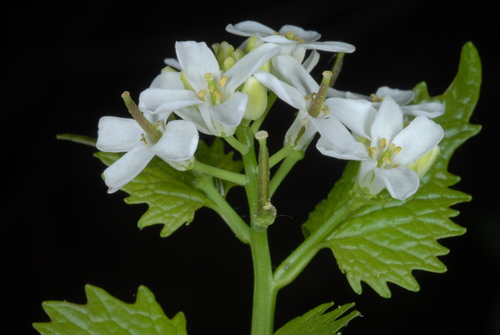
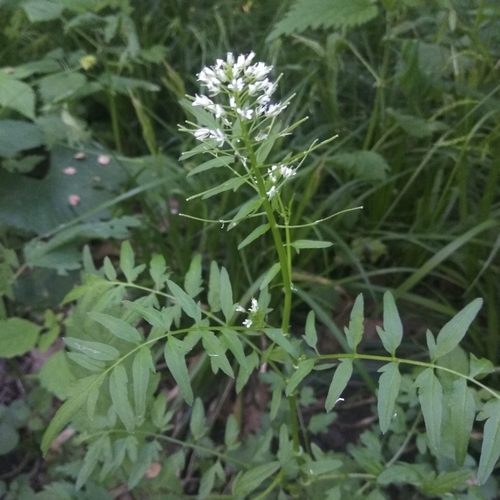
A cabbage family herb. It grows 20-65 cm tall. It can be hairy. The leaves vary in size. The leaves are 3-7 cm long. They have lobes. The lobes are oval. The flowers are white and in groups of 20-30 flowers. The flowers are 3-4 mm across. The fruit is a pod. There are many seeds about 1 mm long.
How to Grow
Plants are grown from seed.
Propagation: Sow seed in spring or autumn directly in situ.
Medicinal Uses
The plant is antirheumatic, diuretic, and stimulant.
Other Uses
None known.
Wikipedia
Source ↗Cardamine impatiens, the narrowleaf bittercress or narrow-leaved bitter-cress, is a plant species in the genus Cardamine of the family Brassicaceae. It is a slender, biennial herb, that produces sterile leaves in the first year, one to several flowering stems during the next. Its leaves are pinnate with several pairs of lanceolate, dentate leaflets and a terminal, slightly longer leaflet. The short petals surpass the calyx by half of its length. The seeds are arranged in one row on each side of the central membrane of the narrow pod and are ejected out in a shower due to the tension formed as the seed pod (silique) dries. It grows on walls, open ground in shady places in forests usually disturbed by human activity. It is native to temperate Eurasia, ranging from Ireland and Spain to the Russian Far East.
Notes
There are about 160 Cardamine species. They are mostly in damp places in temperate regions.
Names & Synonyms
Daraati, Penuša nedotika, Sim sag, Tan lie sui mi qi
References (15)
- Ambasta S.P. (Ed.), 2000, The Useful Plants of India. CSIR India. p 104
- Bhatia, H., et al, 2018, Traditionally used wild edible plants of district Udhampur, J&K, India. Journal of Ethnobiology and Ethnomedicine (2018) 14:73
- Flora of China @ efloras.org Volume 8
- Haj, F., et al, 2012, Species Diversity and Ethno Botanical Classes of the Flora of Allai Valley District Battagram Pakistan. International Journal of Plant Research 2012, 2(4): 111-123
- Hwang, H., et al, 2013, A Study on the Flora of 15 Islands in the Western Sea of Jeollanamdo Province, Korea. Journal of Asia-Pacific Biodiversity Vol. 6, No. 2 281-310
- Khan, M. & Hussain, S., 2014, Diversity of wild edible plants and flowering phenology of district Poonch (J & K) in the northwest Himalaya. Indian Journal of Sci, Res. 9(1): 032-038
- Manandhar, N.P., 2002, Plants and People of Nepal. Timber Press. Portland, Oregon. p 134
- Masoodi, H. U. R. & Sundriyal, R. C., 2020, Richness of non-timber forest products in Himalayan communities—diversity, distribution, use pattern and conservation status. Journal of Ethnobiology and Ethnomedicine 16:56
- Plants for a Future database, The Field, Penpol, Lostwithiel, Cornwall, PL22 0NG, UK. http://www.scs.leeds.ac.uk/pfaf/
- Plants of Haiti Smithsonian Institute http://botany.si.edu
- Sp. pl. 2:655. 1753
- Urgamal, M., Oyuntsetseg, B., Nyambayar, D. & Dulamsuren, Ch. 2014. Conspectus of the vascular plants of Mongolia. (Editors: Sanchir, Ch. & Jamsran, Ts.). Ulaanbaatar, Mongolia. “Admon“ Press. 334pp. (p. 79-90).
- Wild edible plants of Himachal Pradesh
- Zhang, Y., et al, 2014, Diversity of wetland plants used traditionally in China: a literature review. Journal of Ethnobiology and Ethnomedicine. 10:72
- Zhou Taiyan, Lu Lianli, Yang Guang; Ihsan A. Al-Shehbaz, BRASSICACEAE (CRUCIFERAE), Flora of China.