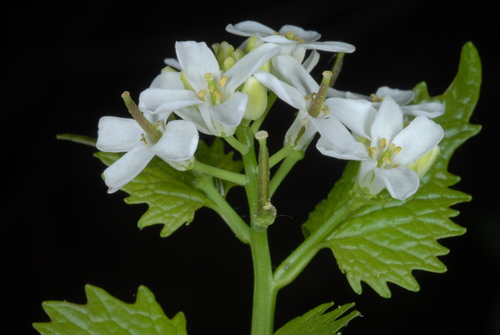
Cardamine leucantha
(Tausch) O.E. Schulz
White-flowered rock mustard

(c) Chuangzao, some rights reserved (CC BY-NC), uploaded by Chuangzao

(c) Moses J. Michelsohn, some rights reserved (CC BY-NC)
What to Eat
Edible parts: Leaves, Leaves - tea, Seedlings
The leaves can be eaten raw or cooked, and the seedlings are also edible. Dried plants are used as a tea substitute.
Where to Find It
It is a temperate plant. It grows on roadsides, shady areas, forests, wet places along streams, roadsides between 100–2000 m. altitude in China. It grows in wetlands.
Asia, China, Japan, Korea, Mongolia, Russia,
How to Identify
A cabbage family herb. It keeps growing from year to year. It grows from 25-70 cm tall. It is hairy. There are 2-3 leaves near the base. These are compound with leaflets along the stalk. There are 5-7 leaflets. The end leaflet is 4-6 cm long and 1-3 cm wide. The leaves on the stem are smaller. The flowers are white and in groups at the top of the plant. The pods are hairy and 1.5-2.5 cm long by 1.5 mm wide. The seeds are brown and 2 mm long.
How to Grow
Propagation: Sow seed in spring in a cold frame; germination typically occurs within 1–3 weeks at 15°C. Once large enough to handle, prick seedlings into individual pots and grow on in light shade in a greenhouse or cold frame for the first two years, planting out when dormant in late summer. Divide in early spring or after the plant dies back in summer. Large clumps can go straight into permanent positions, while smaller clumps are better potted and grown on in a cold frame before planting out in spring.
Medicinal Uses
The rhizomes are used medicinally, though no further details are recorded.
Other Uses
None known.
Wikipedia
A perennial reaching 0.6 m (2 ft) in height. Hardy to UK zone 5. Flowers from April to August with seeds ripening May to September. Hermaphroditic and self-fertile, pollinated by bees, flies, moths, and butterflies. Tolerates light sandy, medium loamy, and heavy clay soils across mildly acidic to mildly alkaline pH ranges. Grows in semi-shade (light woodland) or full sun, preferring moist or wet soil.
Notes
There are about 160 Cardamine species. They are mostly in damp places in temperate regions.
Names & Synonyms
Bai hua sui mi qi, Minarinaeng-i
References (9)
- Chen, B. & Qiu, Z., Consumer's Attitudes towards Edible Wild Plants, Ishikawa Prefecture, Japan. p 22 www.hindawi.com/journals/ijfr/aip/872413.pdf
- Flora of China @ efloras.org Volume 8
- Hu, Shiu-ying, 2005, Food Plants of China. The Chinese University Press. p 414
- Pemberton, R. W. & Lee, N. S., 1996, Wild Food Plants in South Korea: Market Presence, New Crops, and Exports to the United States. Economic Botany, Vol. 50, No. 1, pp. 57-70
- Plants for a Future database, The Field, Penpol, Lostwithiel, Cornwall, PL22 0NG, UK. http://www.scs.leeds.ac.uk/pfaf/
- Urgamal, M., Oyuntsetseg, B., Nyambayar, D. & Dulamsuren, Ch. 2014. Conspectus of the vascular plants of Mongolia. (Editors: Sanchir, Ch. & Jamsran, Ts.). Ulaanbaatar, Mongolia. “Admon“ Press. 334pp. (p. 79-90).
- Wujisguleng, W., & Khasbagen. K., 2010, An integrated assessment of wild vegetable resources in Inner Mongolian Autonomous Region, China. Journal of Ethnobiology and Ethnomedicine 6:34
- Zhang, Y., et al, 2014, Diversity of wetland plants used traditionally in China: a literature review. Journal of Ethnobiology and Ethnomedicine. 10:72
- Zhou Taiyan, Lu Lianli, Yang Guang; Ihsan A. Al-Shehbaz, BRASSICACEAE (CRUCIFERAE), Flora of China. Vol. 8 p 90