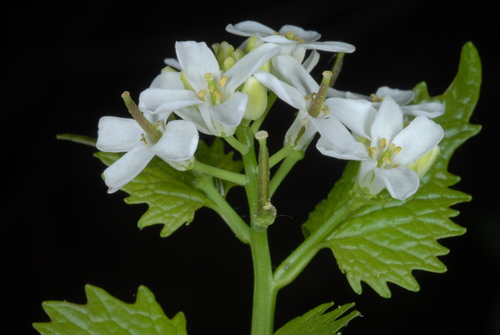
Cardamine parviflora
L.
Smallflowered Bittercress
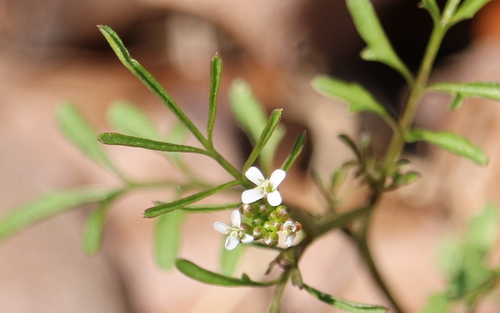
(c) Deb Tyler, some rights reserved (CC BY-NC), uploaded by Deb Tyler
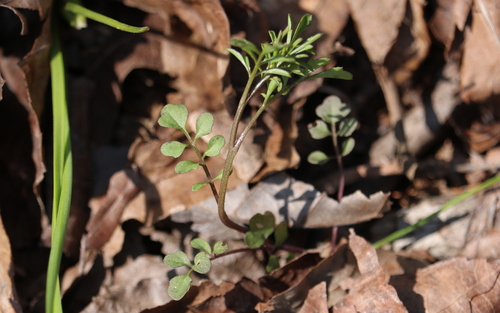
(c) Deb Tyler, some rights reserved (CC BY-NC), uploaded by Deb Tyler
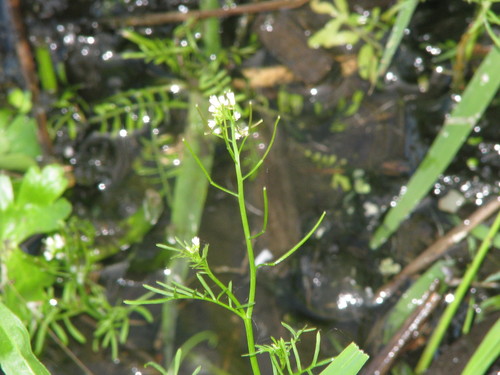
(c) Denys Davydov, some rights reserved (CC BY-NC), uploaded by Denys Davydov
What to Eat
Edible parts: Leaves
The young leaves are used as a potherb.
Where to Find It
It is a temperate plant. It grows on river banks, along ditches, meadows, roadsides; near sea level to 2500 m altitude in China.
Africa, Algeria, Central Asia, China, Europe, Japan, Kazakhstan, Korea, Mongolia, North Africa, North America, Russia, SW Asia, USA,
How to Identify
A cabbage family herb (Brassicaceae) growing about 30 cm tall, found in temperate regions on river banks, ditches, meadows, and roadsides from near sea level to 2500 m altitude.
Wikipedia
Source ↗Cardamine parviflora, commonly known as small-flowered bittercress or sand bittercress, is a species of flowering plant belonging to the family Brassicaceae. Its native range is temperate Eurasia, subarctic America to Northern, Central, and Eastern United States.
Notes
There are about 160 Cardamine species. They are mostly in damp places in temperate regions.
Names & Synonyms
Xiao hua sui mi qi
References (6)
- Duke, J.A., 1992, Handbook of Edible Weeds. CRC Press. p 58
- Flora of China @ efloras.org Volume 8
- Hwang, H., et al, 2013, A Study on the Flora of 15 Islands in the Western Sea of Jeollanamdo Province, Korea. Journal of Asia-Pacific Biodiversity Vol. 6, No. 2 281-310 (As Cardamine fallax)
- Seidemann J., 2005, World Spice Plants. Economic Usage, Botany, Taxonomy. Springer. p 84
- Urgamal, M., Oyuntsetseg, B., Nyambayar, D. & Dulamsuren, Ch. 2014. Conspectus of the vascular plants of Mongolia. (Editors: Sanchir, Ch. & Jamsran, Ts.). Ulaanbaatar, Mongolia. “Admon“ Press. 334pp. (p. 79-90).
- Zhou Taiyan, Lu Lianli, Yang Guang; Ihsan A. Al-Shehbaz, BRASSICACEAE (CRUCIFERAE), Flora of China.