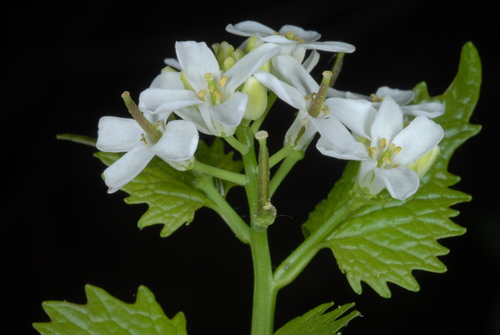
Cardamine trifolia
L.
Trifoliate bitter cress

(c) ahumboldt, some rights reserved (CC BY-NC)
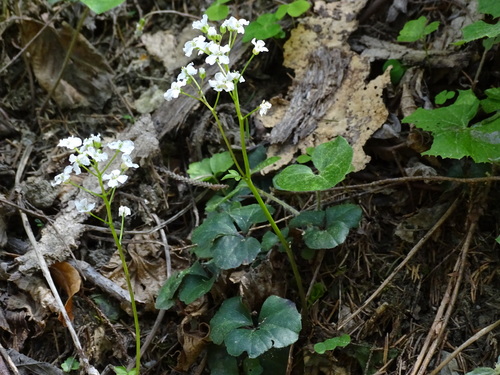
(c) Christian Berg, some rights reserved (CC BY), uploaded by Christian Berg

(c) jacki-dee, some rights reserved (CC BY-NC-ND)
What to Eat
Edible parts: Leaves
No specific information is available for this species, but the leaves are almost certainly edible either raw or cooked, based on close relatives.
Where to Find It
It is a temperate plant.
Balkans, Bosnia, Britain, Croatia, Europe, Slovenia,
How to Identify
A cabbage family herb. It is an evergreen plant. It grows to 15 cm high. It forms a spreading mat. The flowers are small and white.
How to Grow
Succeeds in most soils so long as they are not dry. Prefers a moist humus rich soil in shade or semi-shade. A mat-forming stoloniferous species.
Propagation: Sow seed in spring in a cold frame. Germination typically occurs within 1–3 weeks at 15°C. Once large enough to handle, prick seedlings out into individual pots and grow on in light shade in a greenhouse or cold frame for the first two years, planting out when dormant in late summer. Divide clumps in early spring or after summer die-back. Larger clumps can be replanted directly into permanent positions; pot up smaller clumps and grow on in a cold frame until well rooted before planting out in spring.
Medicinal Uses
None known.
Other Uses
Makes an excellent ground cover for woodland settings or beneath shrubs. Space plants approximately 30cm apart in each direction.
Wikipedia
Source ↗Cardamine trifolia, the trefoil cress, trifoliate bittercress, or three-leaved cuckoo flower, is a species of flowering plant in the family Brassicaceae. It is native to central and southern Europe, and has been introduced to Great Britain. It appears to have survived in several glacial refugia in the Alps, the western Carpathians and Dinaric Alps from where it spread to nearby area. A creeping perennial, in the garden it is recommended as a ground cover in shady areas.
Notes
There are about 160 Cardamine species. They are mostly in damp places in temperate regions.
Names & Synonyms
Trilistna penuša
References (3)
- Plants for a Future database, The Field, Penpol, Lostwithiel, Cornwall, PL22 0NG, UK. http://www.scs.leeds.ac.uk/pfaf/
- Seidemann J., 2005, World Spice Plants. Economic Usage, Botany, Taxonomy. Springer. p 85
- Slocum, P.D. & Robinson, P., 1999, Water Gardening. Water Lilies and Lotuses. Timber Press. p 112