Cardaria draba
(L.) Desv.
Hoary Pepperwort, Whitetop

(c) Sergey Mayorov, some rights reserved (CC BY-NC)

(c) Sergey Mayorov, some rights reserved (CC BY-NC)
(c) euanmck, some rights reserved (CC BY)
What to Eat
Edible parts: Leaves, Stems, Seeds - spice
Young leaves and shoots can be eaten raw in salads or cooked as a potherb. Note that young leaves have been reported to contain hydrogen cyanide; in small quantities this substance is relatively harmless and has even been suggested to have health benefits, but caution is advised. The pungent leaves are also used as a seasoning. Seeds serve as a condiment and pepper substitute. The leaves, flowers, and seeds are all edible when cooked. Raw, the flavour is intensely spicy, mustardy, and sharp — far too aggressive for most salads — and the hoary texture of raw leaves is off-putting. Cooking improves all parts significantly, softening fibres, reducing bitterness, and taming the glucosinolate heat. Flower clusters can be used similarly to broccoli florets when briefly cooked, though their flavour is less refined. Seeds are spicy and benefit from toasting or boiling. The plant rates highly as a survival or bulk-foraging species due to its abundance and reliability, despite moderate culinary quality. Fresh leaves taste spicy, acrid, and cabbage-like with strong wild-mustard intensity. The felt-like surface hairs create a dry mouthfeel when raw but soften with heat. Boiled leaves become mild and palatable. Fresh flowers are the mildest component, with slight sweetness from nectar traces; unopened clusters can be steamed, boiled, or added to mixed greens. Seeds are hot and mustard-like; roasting brings out nuttiness and reduces harshness. Thorough washing is essential before cooking. Rosettes emerge in early spring and flowering runs from May through August depending on climate and elevation. Leaves are most palatable in spring through early summer, becoming tougher as plants mature. Seeds can be collected by tapping mature pods into a container, then dried and winnowed before toasting or grinding.
Known Hazards
Where to Find It
It is a temperate plant. It grows on mountain slopes, roadsides, fields, agricultural lands, river banks, pastures and waste areas near sea level to 4200 m in China. It is drought and frost resistant. It can grow in arid places. Tasmania Herbarium.
Afghanistan, Africa, Argentina, Armenia, Asia, Australia, Austria, Azerbaijan, Balkans, Belgium, Bosnia, Britain, Bulgaria, Canada, Caucasus, Central Asia*, Chile, China, Egypt, Europe, France, Georgia, Germany, Greece, India, Iran, Iraq, Israel, Italy, Jordan, Kashmir, Kazakhstan, Kuwait, Kyrgyzstan, Libya, Luxembourg, Mediterranean, Middle East, Netherlands, New Zealand, North Africa, North America, Oman, Pakistan, Poland, Romania, Russia, Saudi Arabia, Scandinavia, South Africa, South America, Spain, Sweden, Switzerland, Syria, Tajikistan, Tasmania, Turkey, Türkiye, Turkmenistan, Uruguay, USA, Uzbekistan, Yemen, Yugoslavia,
How to Identify
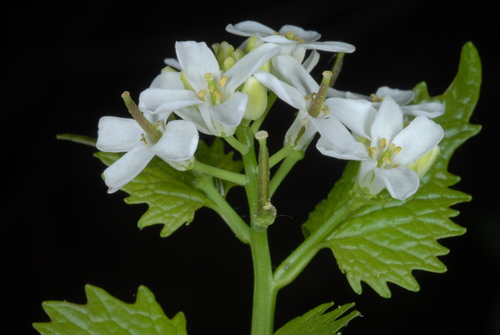
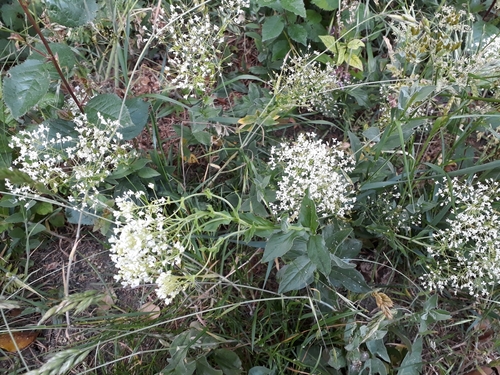
A cabbage family herb. It keeps growing from year to year. It has a stout taproot. It also has a tough, woody, much-branched root system. New shoots can develop from these side roots. The plant grows to 90 cm high. The stem is usually unbranched except just near the top. The leaves are oblong or oval and covered with flattened hairs. The leaves do not have stalks and clasp the stem. The flowers are in a flat topped panicle. The petals are white. The fruit are heart shaped. The fruit separates from the plant as a single seeded nutlet.
Nutrition
| Part | Moisture | kJ | kcal | Protein | Vit A | Vit C | Iron | Zinc |
|---|---|---|---|---|---|---|---|---|
| Leaves | 87 | — | — | — | — | — | 1.9 | 0.8 |
| Seeds | — | — | — | — | — | — | — | — |
How to Grow
Plants are grown by seed.
Propagation: Sow seed in situ in spring. Division can be done in spring. There is little need to actively encourage this plant, as it is a rapidly spreading weed in Britain.
Medicinal Uses
The plant is antiscorbutic. The seeds have been used as a remedy for flatulence and fish poisoning — the latter reference is assumed to mean food poisoning from suspect fish.
Other Uses
Flowers are highly attractive to insect pollinators, particularly small bees, syrphid flies, and other generalist foraging insects. Rhizomatous mats can exclude native forbs and grasses, reducing biodiversity and altering soil dynamics. Seeds may be eaten opportunistically by small birds or rodents. The plant's glucosinolate chemistry provides some resistance to herbivory.
Wikipedia
Cardaria draba is a perennial reaching 50 cm tall, hardy to UK zone 6. It flowers May–June and grows in semi-shade to full sun across sandy, loamy, and clay soils with mildly acid to basic pH, preferring moist conditions. Hermaphroditic flowers are pollinated by bees and other insects; the plant is self-fertile.
Notes
Declared noxious weed in Victoria. It does not contain oxalic acid in samples in Spain.
Names & Synonyms
Blanquilla, Cardaria, Cranson rampant, Hoary cress, Kediotu, Owen ci, Srdasica, Toklubas, Wanci, Wancy, Wency, White weed
References (31)
- Ambasta S.P. (Ed.), 2000, The Useful Plants of India. CSIR India. p 104
- Bircher, A. G. & Bircher, W. H., 2000, Encyclopedia of Fruit Trees and Edible Flowering Plants in Egypt and the Subtropics. AUC Press. p 82
- Blamey, M and Grey-Wilson, C., 2005, Wild flowers of the Mediterranean. A & C Black London. p 67
- Bodkin, F., 1991, Encyclopedia Botanica. Cornstalk publishing, p 213
- Curtis, W.M., 1956, The Students Flora of Tasmania Vol 1 p 46 (As Lepidium draba)
- Dashorst, G.R.M., and Jessop, J.P., 1998, Plants of the Adelaide Plains & Hills. Botanic Gardens of Adelaide and State Herbarium. p 68
- Dogan, Y., et al, 2004, The Use of Wild Edible Plants in Western and Central Anatolia (Turkey). Economic Botany 58(4) pp. 684-690
- Dogan, Y., 2012, Traditionally used wild edible greens in the Aegean Region of Turkey. Acta Societatis Botanicorum Poloniae 81(4): 329-342
- Facciola, S., 1998, Cornucopia 2: a Source Book of Edible Plants. Kampong Publications, p 57
- Flora of China @ efloras.org Volume 8
- Flora of Australia, Volume 8, Lecythidales to Batales, Australian Government Publishing Service, Canberra (1982) p 286
- Guil, J. L., et al, 1996, Oxalic Acid and calcium Determination in Wild Edible Plants. Journal of Agricultural and Food Chemistry. 44: 1821-1823
- Gunes, S. et al, 2018, Survey of wild food plants for human consumption in Karaisali (Adana-Turkey). Indian Journal of Traditional Knowledge. Vol. 17(2), April 2018, pp 290-298
- Hedrick, U.P., 1919, (Ed.), Sturtevant's edible plants of the world. p 377 (As Lepidium draba)
- Hussey, B.M.J., Keighery, G.J., Cousens, R.D., Dodd, J., Lloyd, S.G., 1997, Western Weeds. A guide to the weeds of Western Australia. Plant Protection Society of Western Australia. p 116
- Hyde-Wyatt, B.H. & Morris D.I., 1975, Tasmanian Weed Handbook. Dept of Ag Tasmania. p 49
- J. Bot. Agric. 3:163. 1814
- Lamp, C & Collet F., 1989, Field Guide to Weeds in Australia. Inkata Press. p 51
- Lazarides, M. & Hince, B., 1993, Handbook of Economic Plants of Australia, CSIRO. p 47
- Low, T., 1992, Bush Tucker. Australia’s Wild Food Harvest. Angus & Robertson. p 146
- Mahklouf, M. H., 2019, Ethnobotanical Study of Edible Wild Plants in Libya. European Journal of Ecology. 5(2): 30-40
- Malezas Comestibles del Cono Sur, INTA, 2009, Buernos Aires
- Martin, F.W. & Ruberte, R.M., 1979, Edible Leaves of the Tropics. Antillian College Press, Mayaguez, Puerto Rico. p 188 (As Lepidium draba)
- Oran, S. A. S., 2015, Selected Wild Aromatic Plants in Jordan. International Journal of Medicinal Plants. Photon 108 (2015) 686-699
- Plants for a Future database, The Field, Penpol, Lostwithiel, Cornwall, PL22 0NG, UK. http://www.scs.leeds.ac.uk/pfaf/
- Redzic, S. J., 2006, Wild Edible Plants and their Traditional Use in the Human Nutrition in Bosnia-Herzegovina. Ecology of Food and Nutrition, 45:189-232 (Also as Lepidium draba)
- Redzic, S., 2010, Use of Wild and Semi-Wild Edible Plants in Nutrition and Survival of People in 1430 Days of Siege of Sarajevo during the War in Bosnia and Herzegovina (1992–1995). Coll. Antropol 34 (2010) 2:551-570
- Royal Botanic Gardens, Kew (1999). Survey of Economic Plants for Arid and Semi-Arid Lands (SEPASAL) database. Published on the Internet; http://www.rbgkew.org.uk/ceb/sepasal/internet [Accessed 15th April 2011]
- Seidemann J., 2005, World Spice Plants. Economic Usage, Botany, Taxonomy. Springer. p 85
- Terra, G.J.A., 1973, Tropical Vegetables. Communication 54e Royal Tropical Institute, Amsterdam, p 56 (As Lepidium draba)
- Zhou Taiyan, Lu Lianli, Yang Guang; Ihsan A. Al-Shehbaz, BRASSICACEAE (CRUCIFERAE), Flora of China.