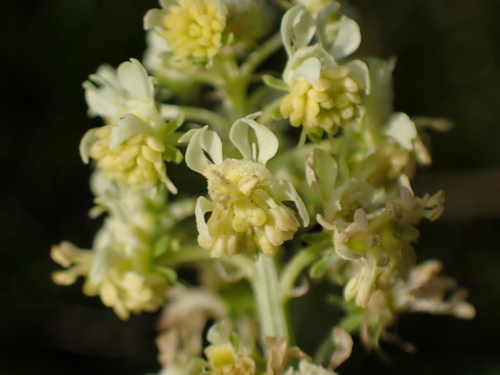
Reseda alba
L.
White mignonette

(c) Rafi Amar, some rights reserved (CC BY-NC), uploaded by Rafi Amar
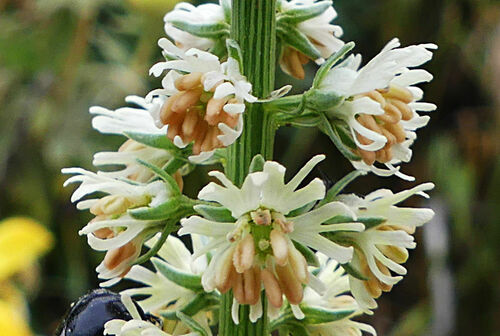
(c) lougarou, some rights reserved (CC BY-NC), uploaded by lougarou
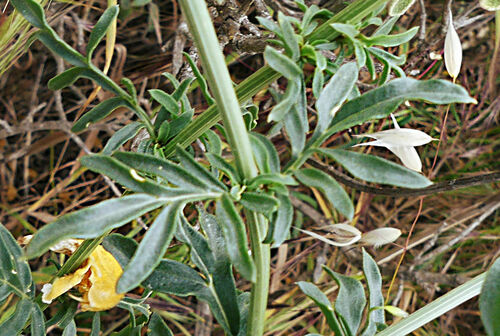
(c) lougarou, some rights reserved (CC BY-NC), uploaded by lougarou
What to Eat
Edible parts: Leaves, Roots - spice
Young leaves are eaten as a bitter green vegetable. Dried roots are eaten as a spice.
Where to Find It
It is a Mediterranean climate plant. It can grow in arid places.
Africa, Asia, Australia, Britain, China, Czech Republic, East Africa, Egypt, Europe, France, Germany, Greece, Israel, Italy, Mediterranean, Middle East, Morocco, Netherlands, North Africa, North America, Portugal, Romania, Sicily, Slovakia, Spain, Taiwan, Tasmania, USA, Yugoslavia, Zimbabwe,
How to Identify
A herb. It is an erect annual plant. It can keep growing for a few years. It grows 30-90 cm tall. The flowers are white and in a spike. They have a scent.
Wikipedia
Source ↗Reseda alba is a species of flowering plant in the reseda family known by the common names white mignonette or white upright mignonette. It is native to Europe, Asia, and North Africa, and it can be found in parts of the Americas and Australia as an introduced species. It is also cultivated as an ornamental plant for its spikelike racemes of fragrant white flowers. This is an annual or perennial herb growing up to a meter tall. The leaves are divided deeply into many narrow lobes. The inflorescence, which may take up most of the upper stem, is densely packed with many white flowers. Each flower has five or six petals, each of which is divided into three long, narrow lobes, making the raceme appear frilly. The fruit is a nearly rectangular four-angled capsule up to 1.4 centimeters in length.
Names & Synonyms
Chouwal lekhrouf, Chrab ikhrouf, Erbe craprina, Gattinaria
References (6)
- Biscotti, N. et al, 2018, The traditional food use of wild vegetables in Apulia (Italy) in the light of Italian ethnobotanical literature. Italian Botanist 5:1-24
- Flora of China @ efloras.org Volume 8
- Nebel, S., Pieroni, A. & Heinrich, M., 2006, Ta cho`rta: Wild edible greens used in the Graecanic area in Calabria, Southern Italy. Appetite 47 (2006) 333–342
- Pasta, S., et al, 2020, An Updated Checklist of the Sicilian Native Edible Plants: Preserving the Traditional Ecological Knowledge of Century-Old Agro-Pastoral Landscapes. Frontiers in Plant Science. Volume 11|Article 388
- Royal Botanic Gardens, Kew (1999). Survey of Economic Plants for Arid and Semi-Arid Lands (SEPASAL) database. Published on the Internet; http://www.rbgkew.org.uk/ceb/sepasal/internet [Accessed 6th June 2011]
- Tbatou, M, et al, 2016, Wild Edible Plants traditionally used in the countryside of El Jadida, Coastal Area in the Center of Morocco. Life Sciences Leaflets 75:28-48