Diascia integerrima
A. Mey ex Benth.
Twinspurs

(c) Tony Rebelo, some rights reserved (CC BY-SA), uploaded by Tony Rebelo
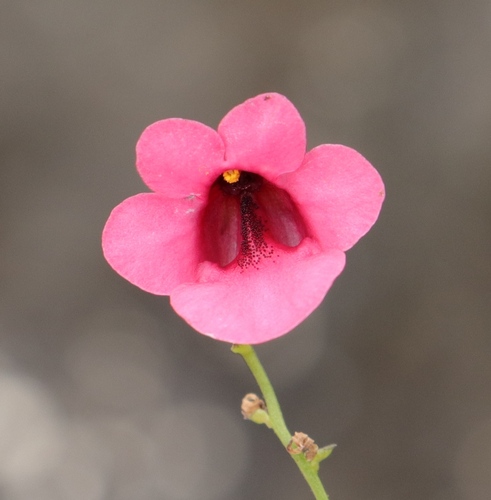
(c) Sandra Falanga, some rights reserved (CC BY-NC), uploaded by Sandra Falanga
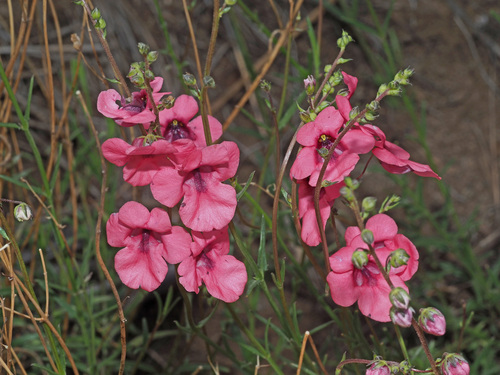
(c) Felix Riegel, some rights reserved (CC BY-NC), uploaded by Felix Riegel
What to Eat
Edible parts: Leaves
The young leaves are used as a potherb.
Where to Find It
It is a subtropical plant.
Africa, Lesotho, South Africa, Southern Africa, Zambia,
How to Identify
An erect herb. It keeps growing from year to year. It grows 30-90 cm tall. The stem is reddish brown, woody and branched. The leaves are simple and opposite. They are narrow and small. The flowers are in groups at the ends of the branches. The flowers are small and 10 mm long. They have long stalks are pink. The fruit is an oval smooth capsule.
Wikipedia
Source ↗Diascia integerrima, the entire-leaved twinspur, is a species of flowering plant in the family Scrophulariaceae, native to South Africa and Lesotho. It is the hardiest of the twinspurs, to USDA zone 6a. It gained the Royal Horticultural Society's Award of Garden Merit in 1995, but the award appears to have been recently revoked.
Names & Synonyms
Balao-ba-litoeba, Malane-a-konyana
References (5)
- Fox, F. W. & Young, M. E. N., 1982, Food from the Veld. Delta Books. p 340
- https://growwild.co.za Edible Indigenous plants
- Plowes, N. J. & Taylor, F. W., 1997, The Processing of Indigenous Fruits and other Wildfoods of Southern Africa. in Smartt, L. & Haq. (Eds) Domestication, Production and Utilization of New Crops. ICUC p 189
- Ruiters-Welcome, A. K., 2019, Food plants of southern Africa. Ph.D. thesis. Univ. of Johannesburg p 102
- Welcome, A. K. & Van Wyk, B.-E., 2019, An inventory and analysis of the food plants of southern Africa. South African Journal of Botany 122 (2019) 136–179