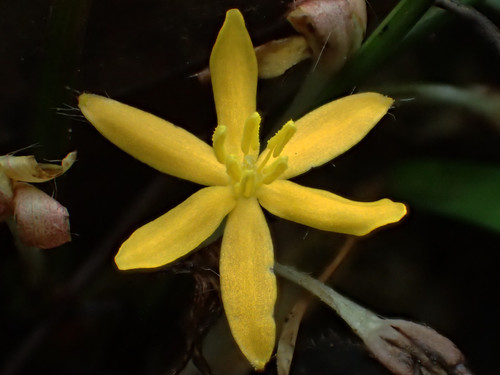
Hypoxis hirsuta
(L.) Colville
Yellow star grass

(c) Bart Jones, some rights reserved (CC BY-NC), uploaded by Bart Jones
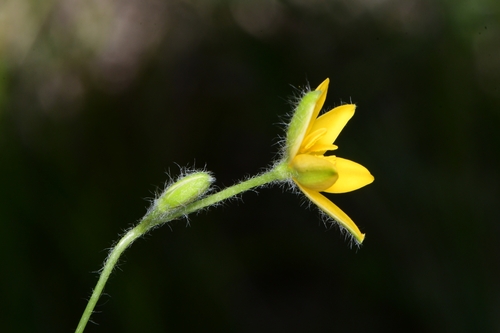
(c) Joey Santore, some rights reserved (CC BY-NC), uploaded by Joey Santore

(c) Douglas Goldman, some rights reserved (CC BY-SA), uploaded by Douglas Goldman
What to Eat
Edible parts: Roots
The roots are cooked and eaten as a vegetable.
Where to Find It
It grows on mountain slopes and rocky places. It is best in acid soils.
Canada, North America, USA,
How to Identify
A herb. It keeps growing from year to year. It has a large corm. The stems are 15-30 cm tall. The leaves are sword shaped and 60-70 cm long by 1 cm wide. They are covered with white hairs. The flowers have 6 star shaped petals. They are about 1 cm across. They are in groups of 5-7 flowers. They are pale yellow. The flower buds are covered with small hairs.
How to Grow
Plants can be grown from seeds.
Wikipedia
Source ↗Hypoxis hirsuta, commonly known as common goldstar, common star-grass, eastern yellow stargrass, yellow star grass, or yellow star flower, is a perennial ornamental plant in the family Hypoxidaceae. Sometimes this plant is placed in the family Amaryllidaceae or the family Liliaceae. The species is native to the United States, Canada, and northeastern Mexico.
Notes
It has also been put in the family Amaryllidaceae.
Names & Synonyms
References (1)
- Esperanca, M. J., 1988. Surviving in the wild. A glance at the wild plants and their uses. Vol. 2. p 366