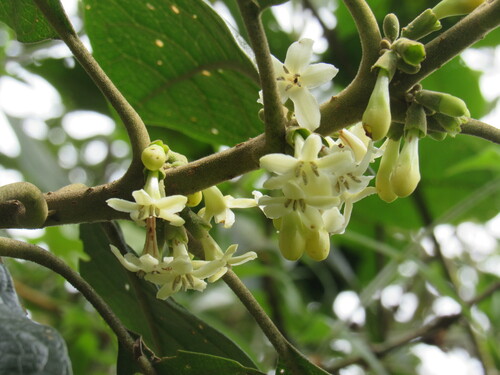
Plectranthus ternifolius
D. Don
LamiaceaeLeaves

gbif · cc0
Conveyor Belt
Conveyor Belt

gbif · cc-by
Meise Botanic Garden
Meise Botanic Garden

gbif · cc-by-sa
GBIF
GBIF
What to Eat
Edible parts: Leaves
The young shoots are cooked and eaten as a vegetable with fish or meat. Fresh harvested shoots can be stored 4-5 days.
Where to Find It
It is a tropical and subtropical plant. It suits damp and shady places.
Asia, India, Indochina, Myanmar, Northeastern India, SE Asia, Thailand,
Countries: United Arab Emirates, Afghanistan, Armenia, Azerbaijan, Bangladesh, Bahrain, Brunei, Bhutan, China, Georgia, Indonesia, Israel, India, Iraq, Iran, Jordan, Japan, Kyrgyzstan, Cambodia, North Korea, South Korea, Kuwait, Kazakhstan, Laos, Lebanon, Sri Lanka, Myanmar, Mongolia, Maldives, Malaysia, Nepal, Oman, Philippines, Pakistan, Qatar, Saudi Arabia, Singapore, Syria, Thailand, Tajikistan, Timor-Leste, Turkmenistan, Turkey, Taiwan, Uzbekistan, Vietnam, Yemen
How to Identify
A small shrub. It has a dense grey covering. The leaves are 15 cm long. They are in rings and have short stalks. The leaves are sword shaped and taper to the tip. They have teeth along the edge. The flowers are white and in dense groups. The fruit are small nutlets.
Other Information
It is popular.
Names & Synonyms
Mirne kotung, Jiglaori, Jwglaori
References (7)
- Anderson, E. F., 1993, Plants and people of the Golden Triangle. Dioscorides Press. p 218
- Baro, D., Baruah, S. and Borthukar, S. K. 2015, Documentation on wild vegetables of Baksa district, BTAD (Assam). Scholars Research Library. Archives of Applied Science Research, 2015, 7 (9):19-2
- Dutta, U., 2012, Wild Vegetables collected by the local communities from the Churang reserve of BTD, Assam. International Journal of Science and Advanced Technology. Vol. 2(4) p 122
- Narzary, H., et al, 2013, Wild Edible Vegetables Consumed by Bodo tribe of Kokrajhar District (Assam), North-East India. Archives of Applied Science Research, 5(5): 182-190
- Patiri, B. & Borah, A., 2007, Wild Edible Plants of Assam. Geethaki Publishers. p 105
- Pegu, R., et al, 2013, Ethnobotanical study of Wild Edible Plants in Poba Reserved Forest, Assam, India. Research Journal of Agriculture and Forestry Sciences 1(3):1-10
- Sarma, H., et al, 2010, Updated Estimates of Wild Edible and Threatened Plants of Assam: A Meta-analysis. International Journal of Botany 6(4): 414-423