Combretum padoides
Engl. & Diels
Thicket combretum
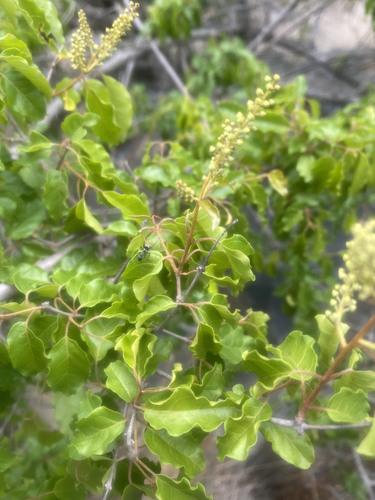
(c) Linda Loffler, some rights reserved (CC BY-NC), uploaded by Linda Loffler

(c) Graeme White, some rights reserved (CC BY-NC), uploaded by Graeme White
What to Eat
Edible parts: Vegetable, Leaves
Leaves - cooked. The tender young leaves are collected, chopped up and cooked alone or with other vegetables such as peas or amaranth, pounded simsim or groundnut paste are added and then the whole is eaten with a staple.
Where to Find It
It is a tropical plant. It grows along rivers and in swamp forests. It can be on rocky hills. It grows between sea level and 1,500 m above sea level.
Africa, Central Africa, Congo, East Africa, Malawi, Mozambique, South Africa, Southern Africa, Tanzania, Zambia, Zimbabwe,
How to Identify
A shrub. It has many branches and loses its leaves during the year. It can be 1-12 m tall. It has long trailing branches. These can scramble into trees nearby. The bark is rough and dark brown. The leaves are opposite and narrowly oval. They are 5-10 cm long. They are thin and papery. They are dull green and have hairs on the veins underneath. The tip is long and pointed. The flowers are white to yellow and very small. They have a sweet scent. They can occur singly, in loose spikes or in dense masses. The fruit has 4 wings and is round and 2 cm across. They have small golden scales. The wings are 7-9 mm wide.
How to Grow
Propagation: Seed - The seed of most, if not all, species can be stored inside the fruit for several years without losing viability.
Medicinal Uses
The leaves are used as a remedy for snakebites and wounds. The roots are used to treat hookworm infections..
Other Uses
The wood is used for poles, tool handles and pegs. The wood is used for fuel. The tree is locally important as a source of bee forage..
Wikipedia
Source ↗Combretum padoides, the thicket bushwillow, occurs in the lowlands of tropical and south-eastern Africa. They grow in a range of habitats from muddy riverbanks to dry rocky hillsides. The mostly opposite oval leaves are carried on long slender branches. The trees or shrubs flower in profusion in mid-summer and the 4-winged fruits reach maturity from late summer to mid winter. Mature plants, though large, don't assume a true tree shape as their drooping branches are adapted to merge or intertwine with surrounding grass and shrubs for support. Combretums with a comparable growth habit are C. celastroides (Jesse), C. edwardsii, C. mossambicense, and C. paniculatum.
Production
In Tanzania the leaves are collected from October to December.
Names & Synonyms
Mgona-nkolongo, Mkowatama, Msangate, Mulukahlahle, Nangunfue
References (4)
- Grubben, G. J. H. and Denton, O. A. (eds), 2004, Plant Resources of Tropical Africa 2. Vegetables. PROTA, Wageningen, Netherlands. p 560
- Msuya, T. S., et al, 2010, Availability, Preference and Consumption of Indigenous Foods in the Eastern Arc Mountains, Tanzania, Ecology of Food and Nutrition, 49:3, 208-227
- Ruffo, C. K., Birnie, A. & Tengnas, B., 2002, Edible Wild Plants of Tanzania. RELMA p 216
- World Checklist of Useful Plant Species 2020. Royal Botanic Gardens, Kew


