Cymbidium goeringii
(Rchb. f.) Rchb. f.
Spring flower

(c) vico, some rights reserved (CC BY-NC), uploaded by vico
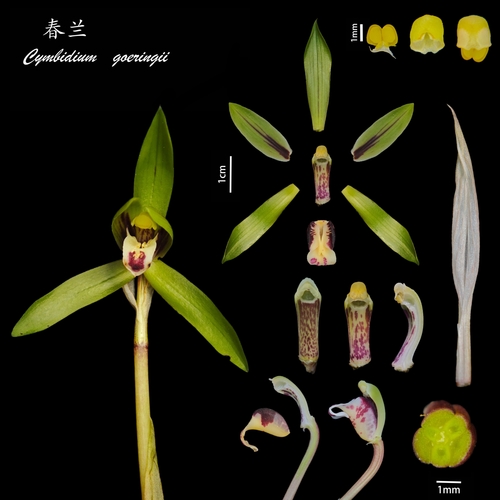
(c) 李博恒, some rights reserved (CC BY-NC), uploaded by 李博恒
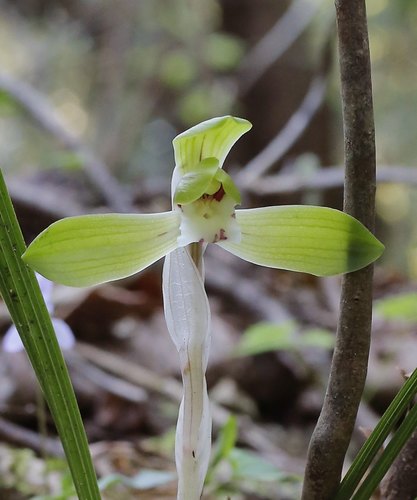
(c) 空猫 T. N, some rights reserved (CC BY-NC), uploaded by 空猫 T. N
What to Eat
Edible parts: Flowers, Stem, Flavouring
The flowers and stems are edible and used as a flavoring.
Where to Find It
It is a tropical and subtropical plant. It grows in rocky places and on the edges of forests between 300-2,200 m above sea level in China. In Sichuan and Yunnan.
Asia, Bhutan, China, Himalayas, India, Japan, Korea, Taiwan,
How to Identify
An orchid. It grows in the soil. The false bulbs are oval and small. They are 1-3 cm long by 1-2 cm wide. They are enclosed in leaf bases. There are 4-7 leaves. They are 20-40 cm long and 1 cm wide. There are usually teeth along the edge. The flowering stalk arises from near the base of the false bulb. It usually has one flower. It is yellowish-green with purple brown veins.
Wikipedia
Source ↗Cymbidium goeringii, commonly known as chun lan (Chinese: 春兰), is a species of terrestrial orchid native to Asia including Bhutan, China, north-western India, Japan, and Korea.
Names & Synonyms
References (4)
- Chen, B. & Qiu, Z., Consumer's Attitudes towards Edible Wild Plants, Ishikawa Prefecture, Japan. p 23 www.hindawi.com/journals/ijfr/aip/872413.pdf
- Liu, Yi-tao, & Long, Chun-Lin, 2002, Studies on Edible Flowers Consumed by Ethnic Groups in Yunnan. Acta Botanica Yunnanica. 24(1):41-56
- Wiersema, J. H. & Leon, B., 2013, World Economic Plants. A Standard Reference CRC Press. 2nd Ed. p 224
- World Checklist of Useful Plant Species 2020. Royal Botanic Gardens, Kew