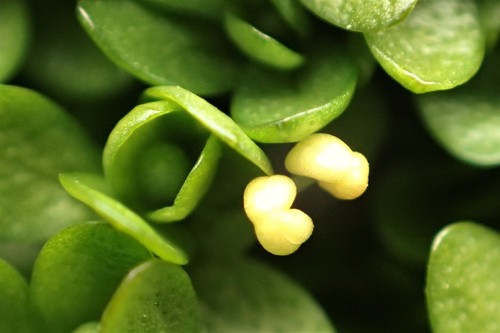
Hippuris tetraphylla
L.f.
Fourleaf marestail
PlantaginaceaeLeaves

iNaturalist · cc-by-nc
(c) Raphael Forns, some rights reserved (CC BY-NC), uploaded by Raphael Forns
(c) Raphael Forns, some rights reserved (CC BY-NC), uploaded by Raphael Forns

iNaturalist · cc-by-nc
(c) Svetlana Nesterova, some rights reserved (CC BY-NC), uploaded by Svetlana Nesterova
(c) Svetlana Nesterova, some rights reserved (CC BY-NC), uploaded by Svetlana Nesterova
iNaturalist · cc-by-nc
(c) J. Burke Korol, some rights reserved (CC BY-NC), uploaded by J. Burke Korol
(c) J. Burke Korol, some rights reserved (CC BY-NC), uploaded by J. Burke Korol
What to Eat
Edible parts: Leaves
The young leaves are eaten as greens, with the best flavor when gathered frozen in winter when they are less bitter.
Where to Find It
It is a temperate plant. It grows in bogs and salt marshes.
Alaska, Asia, China, Europe, Japan, North America, USA,
Countries: Andorra, United Arab Emirates, Afghanistan, Antigua & Barbuda, Albania, Armenia, Austria, Azerbaijan, Bosnia & Herzegovina, Barbados, Bangladesh, Belgium, Bulgaria, Bahrain, Brunei, Bahamas, Bhutan, Belarus, Belize, Canada, Switzerland, China, Costa Rica, Cuba, Cyprus, Czechia, Germany, Denmark, Dominica, Dominican Republic, Estonia, Spain, Finland, France, United Kingdom, Grenada, Georgia, Greece, Guatemala, Honduras, Croatia, Haiti, Hungary, Indonesia, Ireland, Israel, India, Iraq, Iran, Iceland, Italy, Jamaica, Jordan, Japan, Kyrgyzstan, Cambodia, St Kitts & Nevis, North Korea, South Korea, Kuwait, Kazakhstan, Laos, Lebanon, St Lucia, Liechtenstein, Sri Lanka, Lithuania, Luxembourg, Latvia, Monaco, Moldova, Montenegro, North Macedonia, Myanmar, Mongolia, Malta, Maldives, Mexico, Malaysia, Nicaragua, Netherlands, Norway, Nepal, Oman, Panama, Philippines, Pakistan, Poland, Puerto Rico, Portugal, Qatar, Romania, Serbia, Russia, Saudi Arabia, Sweden, Singapore, Slovenia, Slovakia, San Marino, El Salvador, Syria, Thailand, Tajikistan, Timor-Leste, Turkmenistan, Turkey, Trinidad & Tobago, Taiwan, Ukraine, United States, Uzbekistan, St Vincent, Vietnam, Yemen
How to Identify
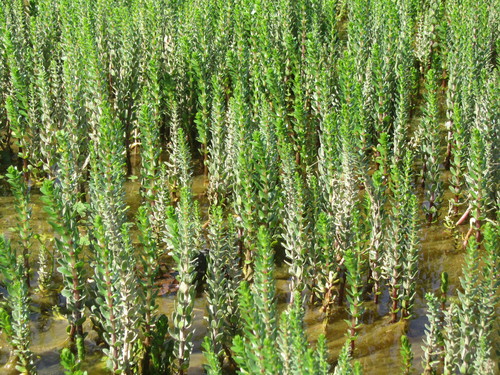
A herb that grows in water. It keeps growing from year to year. It has creeping rhizomes. The stems are 10-50 cm long. The leaves are in 4 rings. They are oval and 4-12 mm long by 5-7 mm wide. They are fleshy. The leaves under the water are shorter than the leaves above water. The flowers are purplish.
Notes
Also put in the family Hippuridaceae.
Names & Synonyms
Tayaruq
References (2)
- Jernigan, K. (Ed.), 2012, A Guide to the Ethnobotany of the Yukon-Kuskokwim Region. Draft.
- Moerman, D. F., 2010, Native American Ethnobotany. Timber Press. p 267