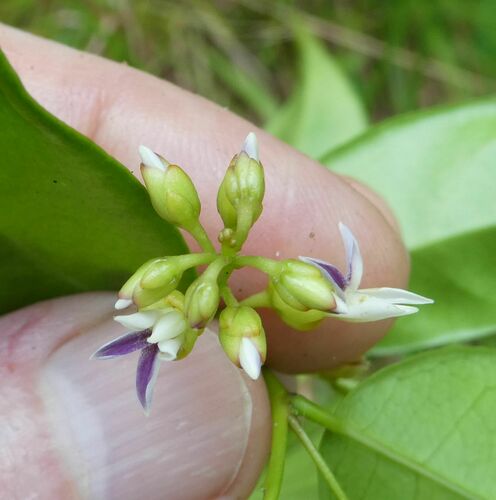
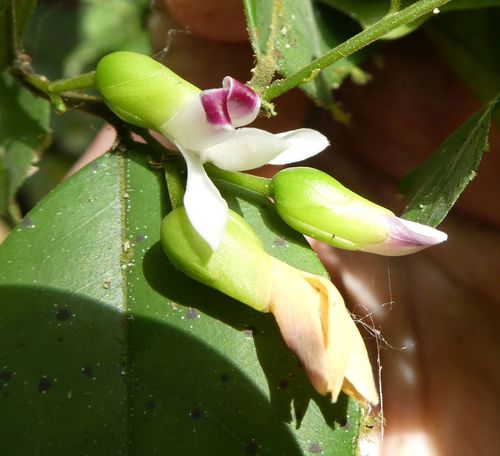
Carpolobia lutea
G. Don
Afeakoo
What to Eat
The leaves and fruit are used as a vegetable.
Where to Find It
Western tropical Africa - Sierra Leone to Cameroon.
Rain-forest and stream banks from sea level to elevations of 400 metres.
How to Identify
A member of the Polygalaceae family cultivated in tropical regions.
How to Grow
Polygalaceae
Medicinal Uses
It is used by the local people as a stomach medicine, to cure bone fractures, and to boost male sexual performance. Some of its extracts were found to be effective against some bacterial and fungal strains. Its leaves are cultivated to be eaten as vegetables and the fruits are also eaten.
Other Uses
The wood is very hard and resists termites. It is used for house posts, walking sticks, tool-handles, household utensils and torches. The wood is characterized by a good inflammability and can be used as fuel.
Wikipedia
Source ↗Carpolobia lutea is a plant species in the milkwort family (Polygalaceae). It is native to rainforests and the banks of streams with altitudes below 400 m (1,300 ft) in coastal areas of West Africa. C. lutea was first formally named by George Don in 1831. According to the IUCN Red List, its population is stable and its conservation status is categorized as "least concern".
Production
A shrub or small tree. It grows 5 m high. The leaves are variable. The flowers are white. The fruit are orange. The fruit are edible.
Names & Synonyms
Dodochika, Ememou, Sekenouwa
References (16)
- Assogbadjo, A. E. et al, 2013, Specific Richness and Cultural Importance of Wild Edible Trees in Benin. Acta Hort. 979, ISHS 2013
- Bircher, A. G. & Bircher, W. H., 2000, Encyclopedia of Fruit Trees and Edible Flowering Plants in Egypt and the Subtropics. AUC Press. p 85
- Boateng, S. K., et al, 2007, Wet Season of Edible Wild Fruits in Three Regions of Ghana. Journal of Plant Sciences 2(3): 353-357
- Codjia, J. T. C., et al, 2003, Diversity and local valorisation of vegetal edible products in Benin. Cahiers Agricultures 12:1-12
- Dalziel, J. M., 1937, The Useful plants of west tropical Africa. Crown Agents for the Colonies London.
- Diop, A. l., et al, 2021, Cultural importance of wild edible plants in three sympatric communities: Agni, Akyé and Gwa in the Department of Alépé (Southeast of Côte d’Ivoire). Ethnobotany Research and Applications 22:35. p 7
- Food Composition Tables for use in Africa FAO http://www.fao.org/infoods/directory No. 887
- Grubben, G. J. H. and Denton, O. A. (eds), 2004, Plant Resources of Tropical Africa 2. Vegetables. PROTA, Wageningen, Netherlands. p 560
- Heywood, V.H., Brummitt, R.K., Culham, A., and Seberg, O., 2007, Flowering Plant Families of the World. Royal Botanical Gardens, Kew. p 262
- Jardin, C., 1970, List of Foods Used In Africa, FAO Nutrition Information Document Series No 2.p 125
- Manvell, A., 2011, Use of Non-Timber Forest Products around Sapo National Park, Liberia (Report B) p 52
- Martin, F.W. & Ruberte, R.M., 1979, Edible Leaves of the Tropics. Antillian College Press, Mayaguez, Puerto Rico. p 213
- Nkeoua, G. & Boundzanga, G. C., 1999, Donnees sur les produits forestieres non ligneux en Republique du Congo. FAO. p 22
- Peters, C. R., O'Brien, E. M., and Drummond, R.B., 1992, Edible Wild plants of Sub-saharan Africa. Kew. p 161
- Udo, E. S., et al, 2009, Life-form and Density of Valuable Non-timber Plants in Ukpom Community Forest, Akwa Ibom State, Nigeria. African Research Review 3(3) p 8
- World Checklist of Useful Plant Species 2020. Royal Botanic Gardens, Kew