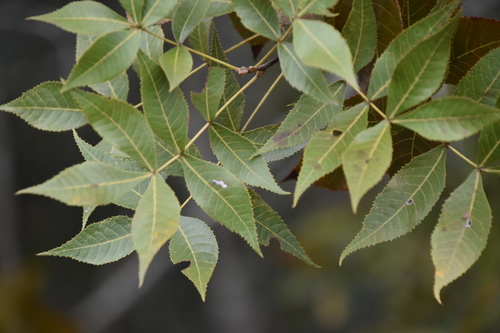
Carya aquatica
(F. Michx.) Nutt.
Water hickory, Swamp hickory, Bitter pecan
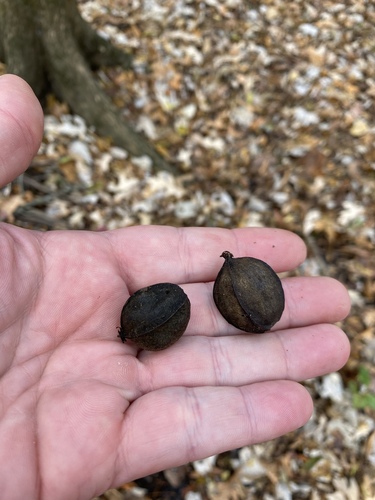
(c) abelkinser, some rights reserved (CC BY-NC)
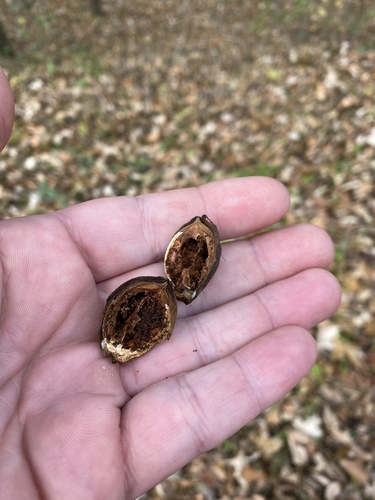
(c) abelkinser, some rights reserved (CC BY-NC)
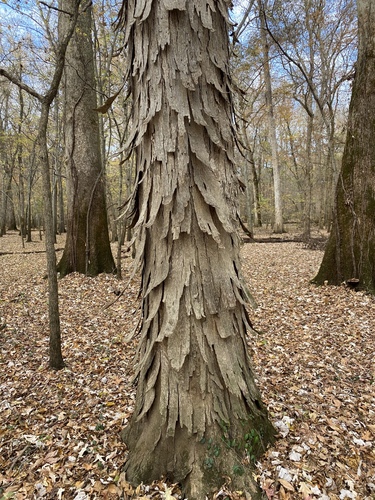
(c) abelkinser, some rights reserved (CC BY-NC)
What to Eat
Edible parts: Seeds, Nuts
The seed can be eaten raw or cooked, though it is astringent. Seeds are up to 35mm long, produced in clusters of 3–4, and have a thin shell, but the kernel is very bitter. They ripen in late autumn and, when stored in the shell in a cool place, will keep for at least 6 months.
Where to Find It
A temperate plant. It grows in low, wet flatlands. It is often on clay soils and can be partly in water. It needs an open, sunny position. It is resistant to frost but damaged by drought. It suits hardiness zones 6-9.
Australia, North America*, USA,
How to Identify
A deciduous tree. It grows 21 m high. It spreads to 12 m wide. The trunk is tall and straight. The bark is light brown and peels off. The leaves are sword shaped and 12 cm long. They have about 13 individual leaflets. There are fine teeth along the edge. The flowers are small and greenish. The male flowers are in slender drooping catkins and the female flowers are in groups or 2-10 at the tips of the same twigs. The fruit is egg shaped. It is 2.5-4 cm long and flattened with 4 wings.
How to Grow
Plants can be grown from seeds.
Propagation: Seed requires a period of cold stratification and is best sown in a cold frame as soon as it is ripe. Stored seed should be kept moist but not wet before sowing and sown in a cold frame as soon as possible. Where feasible, sow only 1 or 2 seeds per deep pot and thin to the strongest seedling. Transplant seedlings as soon as they are large enough to handle, again using deep pots to accommodate the taproot. Move plants to their permanent positions as soon as possible — ideally in their first summer — and provide some frost protection for at least the first winter. Seed can also be sown in situ provided it is protected from mice and cold; a plastic bottle with top and bottom removed and a wire mesh top makes a suitable guard.
Medicinal Uses
None known.
Other Uses
The wood is heavy and close-grained but soft and brittle, which limits its usefulness. Weighing 46lb per cubic foot, it is used mainly for fencing and as fuel, where it produces considerably more heat than most other woods.
Wikipedia
Source ↗Carya aquatica, the bitter pecan or water hickory, is a large tree, that can grow over 30 metres (98 ft) tall of the Juglandaceae or walnut family. In the American South it is a dominant plant species found on clay flats and backwater areas near streams and rivers. The species reproduces aggressively both by seed and sprouts from roots and from stumps of cut trees. Water hickory is a major component of wetland forests now in the south eastern US, because of the selective cutting of more desirable tree species for the lumber industry. It is considered important in cleansing drainage waters since the plants slow water flow during flooding, allowing sediments to fall out of the water column. This tree species is tolerant of wet soils but grows best on well draining soils near rivers and other water ways.
Notes
There are about 14-25 Carya species.
Names & Synonyms
References (9)
- Bircher, A. G. & Bircher, W. H., 2000, Encyclopedia of Fruit Trees and Edible Flowering Plants in Egypt and the Subtropics. AUC Press. p 86
- Bodkin, F., 1991, Encyclopedia Botanica. Cornstalk publishing, p 218
- Cundall, P., (ed.), 2004, Gardening Australia: flora: the gardener's bible. ABC Books. p 334
- Etherington, K., & Imwold, D., (Eds), 2001, Botanica's Trees & Shrubs. The illustrated A-Z of over 8500 trees and shrubs. Random House, Australia. p 184
- Gen. N. Amer. pl. 2:222. 1818 (ex Elliott, Sketch bot. S. Carolina 2:627. 1824)
- Krochmal, A. & Krochmal, C., 1982, Uncultivated Nuts of The United States. United States Department of Agriculture Forest Service. p 37
- Little, E.L., 1980, National Audubon Society Field Guide to North American Trees. Alfred A. Knopf. p 345
- Plants for a Future database, The Field, Penpol, Lostwithiel, Cornwall, PL22 0NG, UK. http://www.scs.leeds.ac.uk/pfaf/
- Wickens, G.E., 1995, Edible Nuts. FAO Non-wood forest products. FAO, Rome. p 133
More from Juglandaceae