Platanthera sparsiflora
(S. Watson) Schltr.
Canyon bog orchid, Fringe orchid

no rights reserved, uploaded by Alex Heyman
(c) Shane Hanofee, some rights reserved (CC BY-NC), uploaded by Shane Hanofee
(c) yerbasanta, some rights reserved (CC BY-NC), uploaded by yerbasanta
What to Eat
Edible parts: Root, Bulb
The bulbs and roots are eaten, particularly in times of food shortage.
Where to Find It
It is a warm temperate plant.
Mexico, North America, USA,
How to Identify
A warm temperate orchid used as a famine food, valued for its edible bulbs and roots during periods of food shortage.
Wikipedia
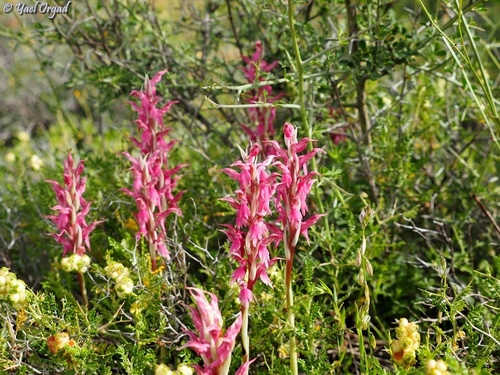
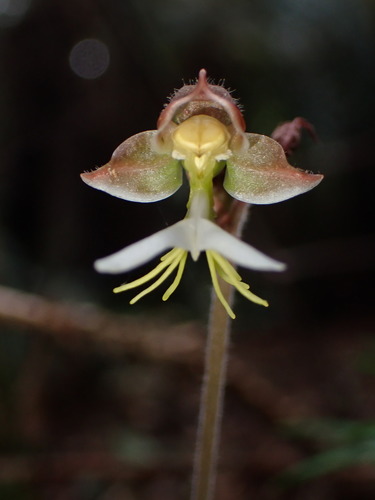
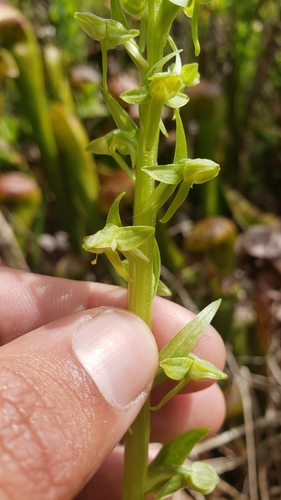
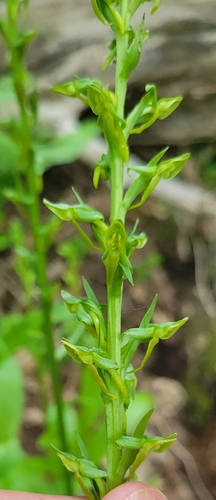
Source ↗Platanthera sparsiflora is a species of orchid known by the common name sparse-flowered bog orchid. It is native to the forests and meadows of the western United States (Colorado and New Mexico west to California, plus Washington and Oregon), and also south to Baja California. Platanthera sparsiflora can be found in wet habitats. It produces a slender, erect flowering stem up to about 1⁄2 meter (1 ft 8 in) tall. The longest leaves near the base of the stem are up to 15 centimeters (6 in) long by 3 centimeters (1+1⁄4 in) wide. The inflorescence has widely spaced twisted green flowers with petals up to 1 centimeter (1⁄3 in) in length.
Other Information
It is used as a famine food.
Names & Synonyms
References (7)
- Beckstrom-Sternberg, Stephen M., and James A. Duke. "The Foodplant Database." http://probe.nalusda.gov:8300/cgi-bin/browse/foodplantdb.(ACEDB version 4.0 - data version July 1994) (As Habenaria sparsiflora)
- CASTETTER, (As Habenaria sparsiflora)
- Kermath, B. M., et al, 2014, Food Plants in the Americas: A survey of the domesticated, cultivated and wild plants used for Human food in North, Central and South America and the Caribbean. On line draft. p 670
- Lim, T. K., 2015, Edible Medicinal and Non Medicinal Plants. Volume 9, Modified Stems, Roots, Bulbs. Springer p 45
- MINNIS, (As Habenaria sparsiflora)
- Moerman, D. F., 2010, Native American Ethnobotany. Timber Press. p 418
- Yanovsky, E., 1936, Food Plants of the North American Indians. United States Department of Agriculture Miscellaneous Publication No 237. Washington, D.C. (As Habenaria sparsiflora)