Poa secunda
J. Presl.
Sandberg bluegrass

no rights reserved, uploaded by Laura Holloway
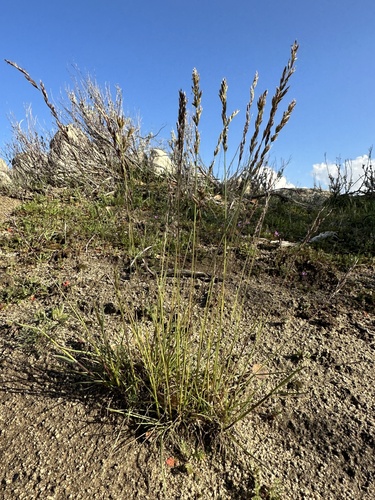
(c) Matt Berger, some rights reserved (CC BY), uploaded by Matt Berger

(c) Matt Lavin, some rights reserved (CC BY-SA)
What to Eat
Edible parts: Seeds
The seeds are edible.
Where to Find It
It is a temperate plant. In Argentina it grows between 300-2,700 m above sea level.
Argentina, Chile, North America, South America, USA,
How to Identify
Sandberg bluegrass is a perennial grass in the Poaceae family with stalks ranging from 15–120 cm tall. It is a temperate plant found in Argentina at elevations between 300–2,700 m above sea level.
Wikipedia
Source ↗Poa secunda (variously known by the common names of Sandberg bluegrass, alkali bluegrass, big bluegrass, Canby's bluegrass, Nevada bluegrass, one-sided bluegrass, Pacific bluegrass, pine bluegrass, slender bluegrass, wild bluegrass, and curly bluegrass) is a widespread species of perennial bunchgrass native to North and South America. It is highly resistant to drought conditions, and provides excellent fodder; and has also been used in controlling soil erosion, and as revegetator, often after forest fires. Cultivars include 'Canbar', 'Service', 'Sherman', and 'Supernova'. Historically, indigenous Americans, such as the Gosiute of Utah, have used P. secunda for food. It was originally described botanically in 1830 by Jan Svatopluk Presl, from a holotype collected from Chile by Thaddäus Haenke in 1790.
Names & Synonyms
References (1)
- Moerman, D. F., 2010, Native American Ethnobotany. Timber Press. p 420


