Sporobolus wrightii
Munro ex Scrinbn.
Giant sacaton
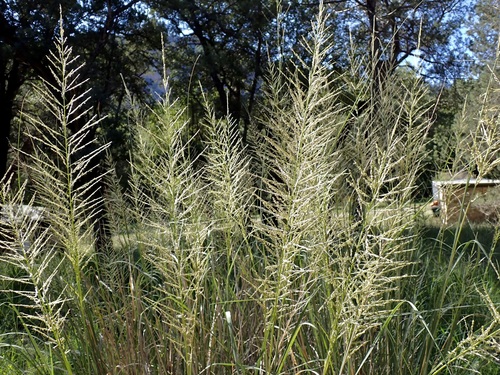
(c) Sue Carnahan, some rights reserved (CC BY), uploaded by Sue Carnahan
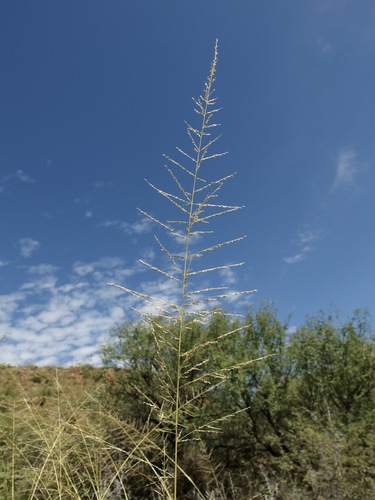
(c) Sue Carnahan, some rights reserved (CC BY), uploaded by Sue Carnahan
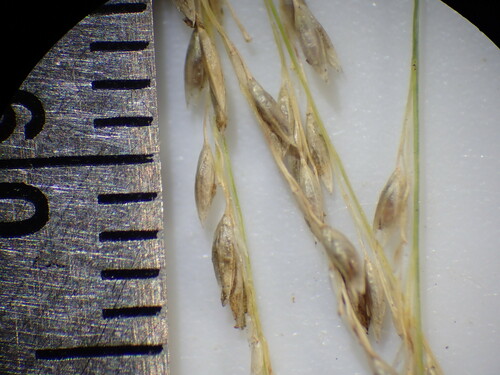
(c) Ethan, some rights reserved (CC BY-NC), uploaded by Ethan
What to Eat
Edible parts: Seeds
The grains of big sacaton were a valued food for Native Americans, much as those of the closely related alkali sacaton (S. airoides), a plant to which this species is nearly identical. The tiny, sand-like seeds are nutritious, pleasantly flavoured, and relatively easy to harvest and process. They were traditionally cooked into mushes or porridges, or ground into flour. Boiling quickly softens the grains and produces a rich, golden-brown broth or hearty porridge; toasting adds flavour but is less effective at softening the seeds. Grains ripen in late summer to autumn and often linger into early winter, though most fall earlier. As with all grasses, only healthy, mould-free grains should be gathered, as infected seeds may carry toxic moulds such as ergot (Claviceps species). Ergot toxins are not removed by cooking, so careful selection is essential. A few grasses in the region also contain cyanogenic glycosides, which boiling can reduce. Big sacaton is a large perennial bunchgrass growing 1–2 m tall and thriving in dry washes and floodplains across arid and semi-arid parts of the southwestern United States. Its size and high seed yields made it one of the most important wild grasses for traditional food use.
Where to Find It
It is a temperate plant.
North America, USA,
How to Identify
Big sacaton is a large evergreen perennial bunchgrass reaching 1–2 m tall and 1.5 m wide. Hardy to UK zone 7, it grows in light sandy, medium loamy, and heavy clay soils, thriving in neutral to very alkaline and saline soils. Requiring full sun and preferring moist to wet conditions, it inhabits arid and semi-arid habitats including dry washes and floodplains of the southwestern United States.
How to Grow
The plant is found in the wild primarily on heavier soils in lowland or wetland sites. It is tolerant of highly alkaline and saline soil and can tolerate poorly drained soils and seasonally flooded areas. It is also found in open areas such as rocky slopes, plateaus, and mesas. It generally grows on sand, sandy loam, silty clay loam, and saline soils. Plants are top-killed by fire, they usually regrow freely from the roots unless the fire has been hot enough to damage them. USDA Hardiness Zone: 6–9. Weed Potential: Big sacaton is not generally considered an invasive weed; instead, it is valued for erosion control, rangeland restoration, and forage production. Its dense root systems help stabilize soil in dry landscapes.
Propagation: Sow seed in spring in a greenhouse, barely covering it; germination should occur within two weeks. Prick seedlings into individual pots once large enough to handle and plant out during summer if sufficiently developed, otherwise overwinter them in the greenhouse and plant out in late spring the following year. For division in spring, larger clumps can go directly into permanent positions, while smaller divisions do best potted up and grown on in a lightly shaded cold frame until well established, then planted out in summer.
Medicinal Uses
None known
Other Uses
Big sacaton can be grown in pure stands or included in rangeland seeding mixes suited to highly alkaline soils, and is useful for revegetating saline soils throughout the Southwest of North America. It performs well as a grass hedge, terrace planting, or windstrip for erosion control, and helps stabilize watershed structures, stream banks, and floodplain areas. The plant also provides wildlife cover and is particularly valuable for slowing erosion in areas prone to flash flooding.
Wikipedia
Source ↗Sporobolus wrightii is a species of grass known by the common names big sacaton and giant sacaton. It is native to the western United States and northern and central Mexico.
Names & Synonyms
Big Sacaton (Sporobolus wrightii Munro ex Scribn. = Sporobolus airoides (Torr.) Torr. var. wrightii (Munro ex Scribn.) Gould)
References (1)
- Moerman, D. F., 2010, Native American Ethnobotany. Timber Press. p 542


