Oxyceros horridus
Lour.
RubiaceaeLeaves
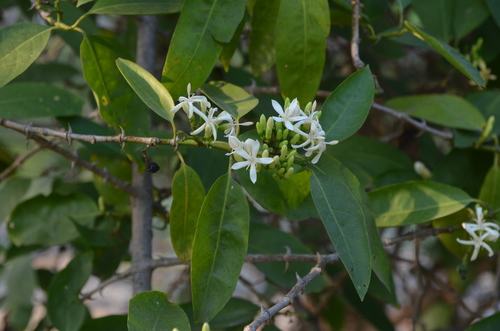
iNaturalist · cc-by-nc
(c) berkovec, some rights reserved (CC BY-NC)
(c) berkovec, some rights reserved (CC BY-NC)

iNaturalist · cc-by-nc
(c) dechaphaetkrathok, some rights reserved (CC BY-NC)
(c) dechaphaetkrathok, some rights reserved (CC BY-NC)

iNaturalist · cc-by-nc
(c) dechaphaetkrathok, some rights reserved (CC BY-NC)
(c) dechaphaetkrathok, some rights reserved (CC BY-NC)
What to Eat
Edible parts: Leaves
The leaves are eaten.
Where to Find It
It is a tropical plant.
Asia, Cambodia, India, Indochina, Laos, SE Asia, Thailand,
Countries: United Arab Emirates, Afghanistan, Armenia, Azerbaijan, Bangladesh, Bahrain, Brunei, Bhutan, China, Georgia, Indonesia, Israel, India, Iraq, Iran, Jordan, Japan, Kyrgyzstan, Cambodia, North Korea, South Korea, Kuwait, Kazakhstan, Laos, Lebanon, Sri Lanka, Myanmar, Mongolia, Maldives, Malaysia, Nepal, Oman, Philippines, Pakistan, Qatar, Saudi Arabia, Singapore, Syria, Thailand, Tajikistan, Timor-Leste, Turkmenistan, Turkey, Taiwan, Uzbekistan, Vietnam, Yemen
How to Identify
A climbing shrub. The branches are curved. It grows 3-6 m tall. The leaves are simple and opposite. They are oblong and 6-10 cm long by 3-4 cm wide. The flowers are in a cluster in the axils of leaves. They are white but turn yellow. The fruit is a round berry.
Notes
The fruit is used as medicine.
Names & Synonyms
Bai kat kaaw
Gardenia horrida (Lour.) Spreng.Griffithia siamensis Miq.Oxyceros pauciflorus (Ridl.) Turveng.Randia horrida (Lour.) Schult.Randia pauciflora var. horrida (Lour.) Pierre ex Pit.Randia pauciflora var. minor CraibRandia siamensis (Miq.) CraibRandia uncata Ridl.Solena horrida (Lour.) D. Dietr.Webera siamensis (Miq.) Kurz
References (1)
- Cruz-Garcia, G. S., & Price, L. L., 2011, Ethnobotanical investigation of 'wild' food plants used by rice farmers in Kalasin, Northeast Thailand. Journal of Ethnobiology and Ethnomedicine 7:33


