Caryocar glabrum
(Aublet) Persoon
Pique, Piquia-rana

(c) Stéphane Bello, some rights reserved (CC BY-NC), uploaded by Stéphane Bello
(c) copaela, some rights reserved (CC BY-NC)

(c) Fernanda França, some rights reserved (CC BY-NC)
What to Eat
Edible parts: Kernel, Nuts
The kernel of the nut is eaten and is highly esteemed.
Known Hazards
Where to Find It
A tropical plant. It grows in forests on non flooded ground.
Amazon, Bolivia, Brazil, Colombia, Ecuador, Guiana, Guianas, Guyana, Peru, South America, Suriname, Venezuela,
How to Identify
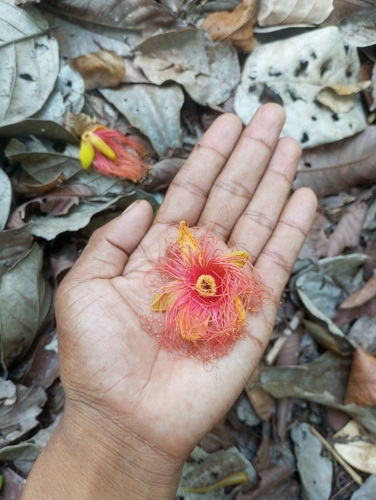
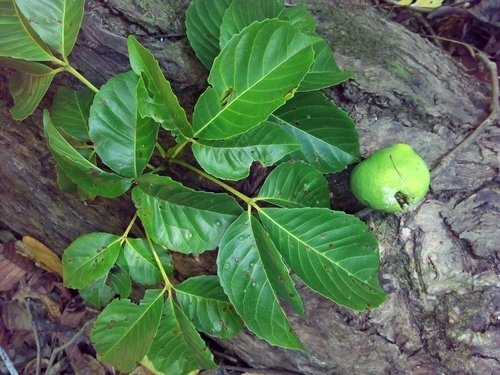
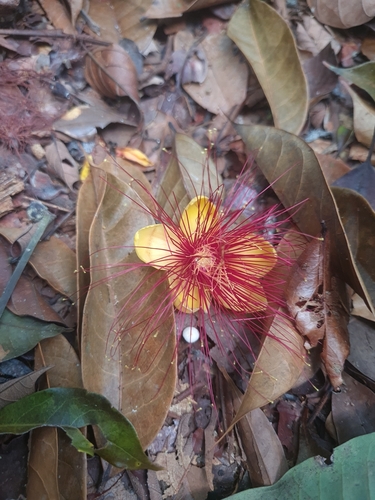
A tree. It grows 50 m high. The leaves have 3 leaflets. The end leaflet is 8-15 cm long and 4-7 cm wide. There are usually 15-25 flowers in a group. Plants flower at night. The flowers are yellow or orange. There are many stamens. They are in 2 rings. The fruit is broadly oval and flattened. It is 5-6 cm long by 5-8 cm wide. They are yellowish. There are some subspecies.
How to Grow
Propagation: Seed - takes 6 - 12 months to germinate. Grow young plants on in a sheltered position with some shelter from the sun.
Medicinal Uses
The shell of the fruit is burned along with maize (Zea mays) and banana peels, then mixed with cinnamon and anise in water, and ingested to cure diarrhoea. The ash of the burnt bark is used in the treatment of dysentery. The seed is used to regulate menstruation. The seed contains a buttery substance that is used to soothe burns.
Other Uses
The inner bark is used for washing hair, clothes etc. The stem bark is rich in saponins and is used as a hair wash. The heartwood is greyish brown to yellow brown; it is not always sharply demarcated from the 3 - 5cm wide band of sapwood that is white or pale yellow, occasionally with dark or almost black streaks. The texture is medium to coarse; the grain roey or straight; there is no discernible odour or taste once seasoned. The wood is decidedly heavy; moderately hard; strong; tough; and fairly durable, being resistant to termites and fungi, but susceptible to dry wood borers. It is rather slow to season, with a high risk of checking or distortion; once dry it is poorly stable in service. The wood is not difficult to work with ordinary tools, but sawing and machining require sharp tools in order to avoid a fuzzy surface due to the interlocked grain; it finishes smoothly, making it suitable for purposes requiring strength and resistance to moisture; it nails and screws well, but requires pre-boring; gluing is poor. The wood has a wide range of applications, including for heavy carpentry, heavy flooring, cooperage, exterior panelling, construction, tool handles and ship building. It is used locally for making canoes and piling.
Wikipedia
Source ↗Caryocar glabrum is a species of tree in the family Caryocaraceae. It is native to South America.
Other Information
The nuts are highly esteemed.
Notes
The Caryocaraceae occur in tropical America. There are 16 Caryocar species.
Names & Synonyms
Agoegagi, Almendro, Almendro blanco, Cagui, Gladbast sopo-oedoe, Kasanjan, Kula
References (16)
- Bendezu, Y. F., 2018, Arboles nativos de lad Region Ucayali. Instituto Nacional de Innovacion Agraria. p 85
- Bircher, A. G. & Bircher, W. H., 2000, Encyclopedia of Fruit Trees and Edible Flowering Plants in Egypt and the Subtropics. AUC Press. p 87
- Flores, Y., 2018, Arboles nativos de la Region Ucayili. Estacion Experimental Agragia Pucallpa. Pucallpa Peru, 375 p. p 85
- Grandtner, M. M. & Chevrette, J., 2013, Dictionary of Trees, Volume 2: South America: Nomenclature, Taxonomy and Ecology. Academic Press p 103
- Hedrick, U.P., 1919, (Ed.), Sturtevant's edible plants of the world. p 172
- Martin, F. W., et al, 1987, Perennial Edible Fruits of the Tropics. USDA Handbook 642 p 91
- Menninger, E.A., 1977, Edible Nuts of the World. Horticultural Books. Florida p 66
- Reis, S. V. and Lipp, F. L., 1982, New Plant Sources for Drugs and Foods from the New York Botanical Garden herbarium. Harvard. p 182
- Roa, J. A. G. & Boada, D. S. G., 2018, Fundación para el Fortalecimiento de la Fruticultura y Plantas Alimenticias no Convencionales en Colombia.
- Smith, N., Mori, S.A., et al, 2004, Flowering Plants of the Neotropics. Princeton. p 87 (Drawing)
- Smith, N., Mori, S.A., et al, 2004, Flowering Plants of the Neotropics. Princeton. Plate 11 (Photo)
- Syn. pl. 2(1):84. 1806
- Torre, de la, L., et al, 2008, Enciclopedia de las Plantas Útiles del Ecuador. Herbario QCA. Pontificia Universidad Católica del Ecuador. p 277
- van Roosmalen, M.G.M., 1985, Fruits of the Guianan Flora. Utrecht Univ. & Wageningen Univ. p 72
- Vasquez, R. and Gentry, A. H., 1989, Use and Misuse of Forest-harvested Fruits in the Iquitos Area. Conservation Biology 3(4): 350f
- Wickens, G.E., 1995, Edible Nuts. FAO Non-wood forest products. FAO, Rome. p 114