Mitracarpus hirtus
(L.) DC.
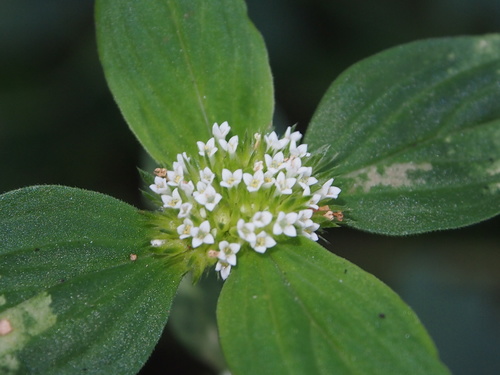
(c) Sunnetchan, some rights reserved (CC BY-NC-ND), uploaded by Sunnetchan

(c) scallions, some rights reserved (CC BY)

(c) scallions, some rights reserved (CC BY)
What to Eat
Edible parts: Roots, Leaves
The young leaves are boiled and eaten as a vegetable. The roots are cooked and eaten.
Where to Find It
It is a tropical plant. It grows from sea level to 1,500 m above sea level.
Africa, Angola, Asia, Australia, Cape Verde, Central African Republic, CAR, Congo DR, East Africa, Guinea, Guinée, Himalayas, India, Indonesia, Kenya, Malawi, Marianas Is. Mauritania, Myanmar, New Guinea, Nigeria, SE Asia, Seychelles, South America, Sudan, Tanzania, Uganda, West Africa, West Indies, Zambia,
How to Identify
An erect herb. It grows 10-40 cm tall. The stems has few branches. The leaves are narrowly oval and 1-6 cm long by 0.5-2 cm wide. There are flowering groups in the axils of the leaves.
How to Grow
The plant has become naturalized as a weed in many areas of the tropics.
Medicinal Uses
The dried leaves are said to heal old ulcers rapidly. The plant is an antidote for arrow poison.
Wikipedia
Source ↗Mitracarpus hirtus, the tropical girdlepod, is a species of annual herb in the family Rubiaceae. It is native to Mexico and much of tropical America but has been widely introduced to Africa, Asia, and other tropical regions. The species typically grows in seasonally dry tropical biomes and is recognized by its small, white, funnel-shaped flowers arranged in leaf axils.
Names & Synonyms
Banda nzazi, Talu
References (4)
- Harris, F. M. A. and Salisu Mohammed, 2003, Relying on nature: Wild Foods in Northern Nigeria. AMBIO Vol. 32 No. 1, p 27 (As Mitracarpum verticillatum)
- Latham, P., 2004, Useful Plants of Bas-Congo province. Salvation Army & DFID p 191
- Murtem, G. & Chaudhrey, P., 2016, An ethnobotanical note on wild edible plants of Upper Eastern Himalaya, India. Brazilian Journal of Biological Sciences, 2016, v. 3, no. 5, p. 63-81 (As Mitracarpus verticillatus)
- Reis, S. V. and Lipp, F. L., 1982, New Plant Sources for Drugs and Foods from the New York Botanical Garden herbarium. Harvard. p 289


