Combretum mucronatum
Schumach. & Thonn.
CombretaceaeLeaves
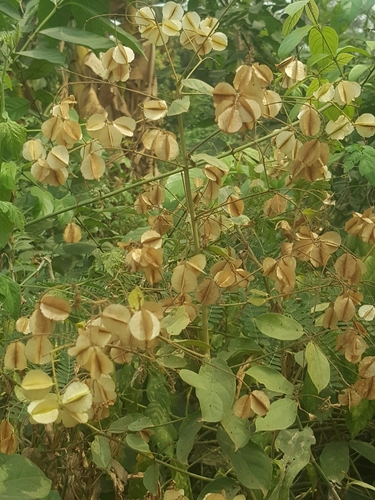
iNaturalist · cc-by-nc
(c) Maxwell C. Obiakara, some rights reserved (CC BY-NC)
(c) Maxwell C. Obiakara, some rights reserved (CC BY-NC)
What to Eat
Edible parts: Leaves ?, Medicine ?
Where to Find It
It is a tropical plant. It grows in forests and along rivers. It grows in seasonally flooded forest. It grows up to 800 m above sea level.
Africa, Benin, Central Africa, Central African Republic, CAR, Congo DR, Ethiopia, Gambia, Ghana, Guinea, Guinée, Guinea-Bissau, Senegal, South Africa, Uganda, West Africa,
Countries: Angola, Burkina Faso, Burundi, Benin, Botswana, Congo (DRC), Central African Republic, Congo (Republic), Cote d'Ivoire, Cameroon, Cape Verde, Djibouti, Algeria, Egypt, Eritrea, Ethiopia, Gabon, Ghana, Gambia, Guinea, Equatorial Guinea, Guinea-Bissau, Kenya, Comoros, Liberia, Lesotho, Libya, Morocco, Madagascar, Mali, Mauritania, Mauritius, Malawi, Mozambique, Namibia, Niger, Nigeria, Rwanda, Seychelles, Sudan, Sierra Leone, Senegal, Somalia, South Sudan, Sao Tome & Principe, Eswatini, Chad, Togo, Tunisia, Tanzania, Uganda, South Africa, Zambia, Zimbabwe
How to Identify
A shrub or woody climber. Young branches have rusty hairs. The leaves are opposite. They are 16 cm long by 8 cm wide. They taper to an abrupt tip. The flowers ate crowded in groups in the axils of leaves on shoots up to 9 cm long. The fruit is broadly oval and 1-2 cm long.
Production
In Central African Republic it flowers in February and August and fruits in March.
Names & Synonyms
Iari-safi-bate
Combretum pellucidum ExellCombretum smeathmannii G. Don
References (1)
- Achigan-Dako, E, et al (Eds), 2009, Catalogue of Traditional Vegetables in Benin. International Foundation for Science.


