Miconia ceramicarpa
(DC.) Cogn.
MelastomataceaeFruit
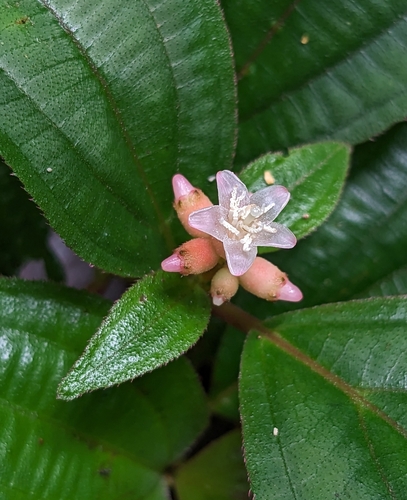
iNaturalist · cc-by-nc
(c) accidentalshrike, some rights reserved (CC BY-NC), uploaded by accidentalshrike
(c) accidentalshrike, some rights reserved (CC BY-NC), uploaded by accidentalshrike

iNaturalist · cc-by-nc
(c) Marcel Bingley, some rights reserved (CC BY-NC)
(c) Marcel Bingley, some rights reserved (CC BY-NC)

iNaturalist · cc-by-nc
(c) fmunoz, some rights reserved (CC BY-NC)
(c) fmunoz, some rights reserved (CC BY-NC)
What to Eat
Edible parts: Fruit
The ripe blue berries are eaten, particularly by children, in secondary forests and abandoned fields where the plant grows.
Where to Find It
It is a tropical plant. It grows in secondary forests and abandoned fields.
America, Guiana, Guianas, Guyana, South America, Suriname, Venezuela,
How to Identify
A shrub. The stems are red. The leaves are covered with soft red hairs. There are teeth along the edges. Young leaves are red. The flowers are white. The fruit is a red berry that turns blue and spongy when ripe.
Other Information
The fruit are eaten especially by children.
Names & Synonyms
Karimanbari, Tonoro wokuru, Waraia
Clidemia ceramicarpa DC.Clidemia coccinea DC.Clidemia violacea DC.Miconia ceramicarpa var. ceramicarpaMiconia ceramicarpa var. violacea Cogn.Miconia erythropila Steud.Miconia iodopila Steud.Miconia leschenaultiana Sagot ex Naudin
References (1)
- van Andel, T., 2000, Useful plants of Guyana. Non-timber forest products of the North-West District of Guyana. Part 2. A Field Guide. Tropenbos-Guyana Programme. p 289


