Dendrocnide sinuata
(Bl.) Chew.
Devil nettle, Fever nettle
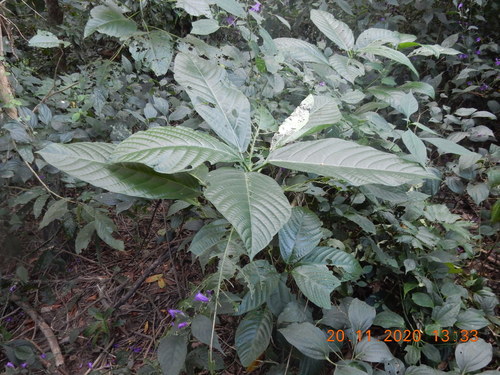
(c) Rinzin Dorji, some rights reserved (CC BY-NC), uploaded by Rinzin Dorji
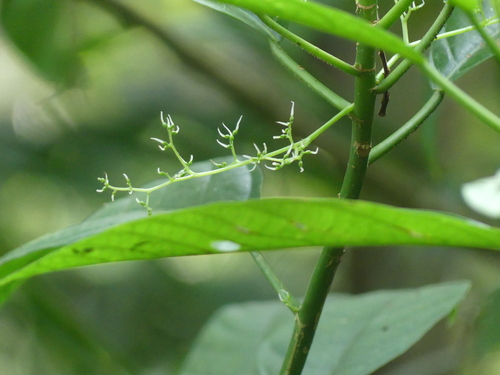
(c) Radha Veach, some rights reserved (CC BY-NC)
What to Eat
Edible parts: Leaves, Flowers, Seeds - spice
The flowers are carefully picked and cooked as a vegetable, used in curries, or fried. Young shoots are boiled and eaten. The seeds are used as a spice similar to coriander.
Known Hazards
Where to Find It
It is a subtropical plant. It grows in wet evergreen forests in Asia. It usually grows between 300-850 m above sea level but can grow to 1,200 m.
Asia, Bhutan, Himalayas, India, Indochina, Indonesia, Malaysia, Myanmar, Northeastern India, SE Asia, Sikkim, Sri Lanka, Thailand,
How to Identify
A shrub. It can grow 5 m tall. It has soft stems. The young parts have stinging hairs. The leaves are large and oval. They can have notches near the tip. The flowers are white.
How to Grow
Plants in this genus are essentially lowland primary forest species preferring slightly moist and somewhat shady habitats. A dioecious species, both male and female forms need to be grown if fruit and seed are required.
Propagation: Seed - easy. Cuttings root easily - simply thrusting a branch into moist ground will usually result in it rooting.
Medicinal Uses
The root juice is used in the treatment of chronic fevers. A decoction of the roots, combined with the leaves of a Schizostachyum species, is drunk as a remedy for swollen limbs. The roots and leaves are applied topically to treat swellings and abscesses.. The leaves are applied externally as a treatment against scabies. The plant is claimed to be used as an oral contraceptive.
Other Uses
The sap is occasionally used as a hair wash. The wood is very soft.
Wikipedia
Source ↗Dendrocnide sinuata (meaning "tree nettle" with "wavy leaf margin" in Greek) is a poisonous plant called pulutus, pulus, stinging tree, fever nettle, or elephant nettle, growing in subtropical wet evergreen forests throughout Asia. Some of its uses in herbal medicine have been scientifically validated.
Names & Synonyms
Anachoriyan, Chorpata, Gilmat-jakma, Jelatang nyiru, Kerma, Moringe, Morungey, Ongyalop, Ottapilavu, Paji, Phronglo, Pur raat, Sorot gosh, Sorot-gach, Tarmepi, Thak-pui, Thlak-pui, Torash, Utigun
References (14)
- Ambasta, S.P. (Ed.), 2000, The Useful Plants of India. CSIR India. p 316 (As Laportea crenulata)
- Burkill, I.H., 1966, A Dictionary of the Economic Products of the Malay Peninsula. Ministry of Agriculture and Cooperatives, Kuala Lumpur, Malaysia. Vol 2 (I-Z) p 1339 (As Laportea stimulans ? = stimulus)
- Dobriyal, M. J. R. & Dobriyal, R., 2014, Non Wood Forest Produce an Option for Ethnic Food and Nutritional Security in India. Int. J. of Usuf. Mngt. 15(1):17-37
- Flora of China @ efloras.org Volume 5
- Hariyadi, B., 2008, The Entwined Tree: Traditional Natural Resource Management of Serampas, Jambi, Indonesia. Ph. D thesis. Univ. or Hawaii. p 402 ( As Laportea sinuata)
- Patiri, B. & Borah, A., 2007, Wild Edible Plants of Assam. Geethaki Publishers. p 131
- Pegu, R., et al, 2013, Ethnobotanical study of Wild Edible Plants in Poba Reserved Forest, Assam, India. Research Journal of Agriculture and Forestry Sciences 1(3):1-10
- Kar, A., et al, 2013, Wild Edible Plant Resources used by the Mizos of Mizoram, India. Kathmandu University Journal of Science, Engineering and Technology. Vol. 9, No. 1, July, 2013, 106-126 (As Laportea crenulata)
- Khodram,S. D., et al, 2019, Local knowledge of edible flowers used in Mizoram. Indian Journal of Traditional Knowledge Vol 18(40 pp 715-723
- Mukhia, P.K., et al, 2013, Wild plants as Non Wood Forest Products used by the rural community of Dagana, a southern foothill district of Bhutan, SAARC Journal, 27 pages
- Murtem, G. & Chaudhrey, P., 2016, An ethnobotanical note on wild edible plants of Upper Eastern Himalaya, India. Brazilian Journal of Biological Sciences, 2016, v. 3, no. 5, p. 63-81 (As Laportea crenulata)
- Seidemann J., 2005, World Spice Plants. Economic Usage, Botany, Taxonomy. Springer. p 197 (As Laportea crenulata)
- Singh, V. B., et al, (Ed.) Horticulture for Sustainable Income and Environmental Protection. Vol. 1 p 220 (As Laportea crenulata)
- Wikipedia,


