Rourea commutata
Planch.
ConnaraceaeFruit

gbif · cc0
President and Fellows of Harvard College
President and Fellows of Harvard College

gbif · cc0
President and Fellows of Harvard College
President and Fellows of Harvard College
What to Eat
Edible parts: Fruit aril
The fruit aril is eaten.
Where to Find It
It is a subtropical plant.
Asia, Bangladesh, India, Myanmar, Northeastern India, SE Asia,
Countries: United Arab Emirates, Afghanistan, Armenia, Azerbaijan, Bangladesh, Bahrain, Brunei, Bhutan, China, Georgia, Indonesia, Israel, India, Iraq, Iran, Jordan, Japan, Kyrgyzstan, Cambodia, North Korea, South Korea, Kuwait, Kazakhstan, Laos, Lebanon, Sri Lanka, Myanmar, Mongolia, Maldives, Malaysia, Nepal, Oman, Philippines, Pakistan, Qatar, Saudi Arabia, Singapore, Syria, Thailand, Tajikistan, Timor-Leste, Turkmenistan, Turkey, Taiwan, Uzbekistan, Vietnam, Yemen
How to Identify
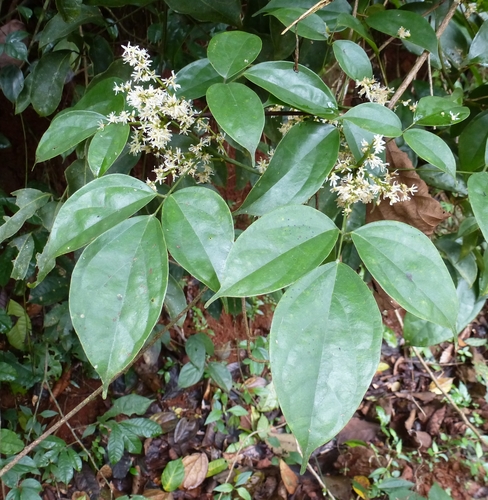
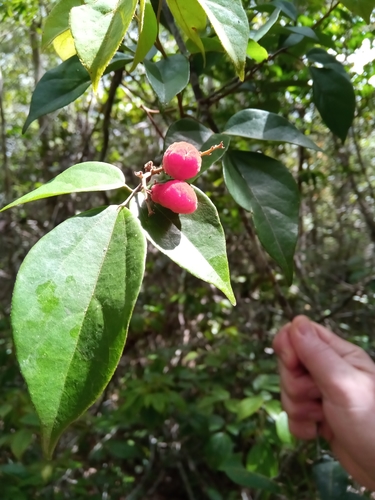
A large shrub. The leaves are compound with leaflets along the stalk and one at the end. The leaves are 20-30 cm long. There are 5-9 leaflets. They are oval and 8-17 cm long. The flowers are small and white. They are in branched groups 5-10 cm long. The fruit is a follicle 2.5 cm long. It is curved and tapering.
Names & Synonyms
Anone-lou-chari, Hurng-mung, Mayan-kaung, Talidi
References (1)
- Sawian, J. T., et al, 2007, Wild edible plants of Meghalaya, North-east India. Natural Product Radiance Vol. 6(5): p 421