Tetrastigma leucostaphylum
(Dennst.) Alston
Indian chestnut vine

(c) Sam Thomas, some rights reserved (CC BY-NC-SA)
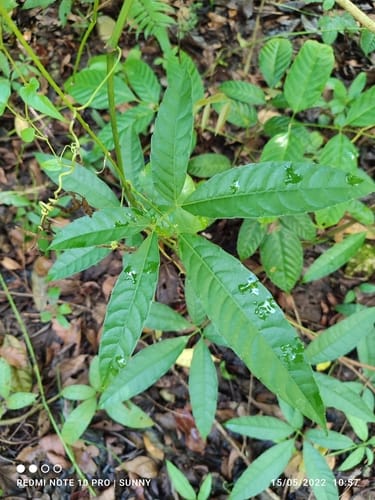
(c) SunGW, some rights reserved (CC BY-NC)
What to Eat
Edible parts: Fruit, Leaves
The fruit are eaten raw. The leaves are also edible.
Where to Find It
It is a subtropical plant. It occurs in the Western Ghats in India.
Asia, Bangladesh, India, Indonesia, Malaysia, Myanmar, Nepal, Northeastern India, SE Asia, Singapore, Sri Lanka, Vietnam,
How to Identify
A woody climber. The stems can be lumpy. The leaves usually have 3 leaflets. The leaflets are oblong and taper to each end. They are softly leathery. There are shallow teeth along the edge. The flowers are in groups in the axils of leaves. The fruit is round or oval and white when ripe. They are 1-2 cm across. There are 1 or 2 seeds.
How to Grow
Plants can be grown from seed.
Wikipedia
Source ↗Tetrastigma leucostaphylum, the Indian chestnut vine, is a flowering plant in the family Vitaceae. It is native to Sri Lanka, India, Nepal and South East Asia.
Names & Synonyms
Akar chabang limah, Akar papan, Horina lata, Kankong gajah, Khajorlicha vel, Kond draaksha, Pirantaikkoti
References (6)
- Bandyopadhyay, S. et al, 2009, Wild edible plants of Koch Bihar district, West Bengal. Natural Products Radiance 8(1) 64-72
- Burkill, I.H., 1966, A Dictionary of the Economic Products of the Malay Peninsula. Ministry of Agriculture and Cooperatives, Kuala Lumpur, Malaysia. Vol 2 (I-Z) p 2286 (As Vitis lanceolaria)
- Flowers of India. flowersofindia.net
- Jadhav, R., et al, 2015, Forest Foods of Northern Western Ghats: Mode of Consumption, Nutrition and Availability. Asian Agri-History Vol. 19, No. 4: 293-317
- Sawian, J. T., et al, 2007, Wild edible plants of Meghalaya, North-east India. Natural Product Radiance Vol. 6(5): p 422
- Terra, G.J.A., 1973, Tropical Vegetables. Communication 54e Royal Tropical Institute, Amsterdam, p 80 (As Vitis lanceolaria)


